Sign in. It’s quick, free and it’s up to you.
An account is an optional way to support the work we do. Find out more.
Sign in. It’s quick, free and it’s up to you.
An account is an optional way to support the work we do. Find out more.
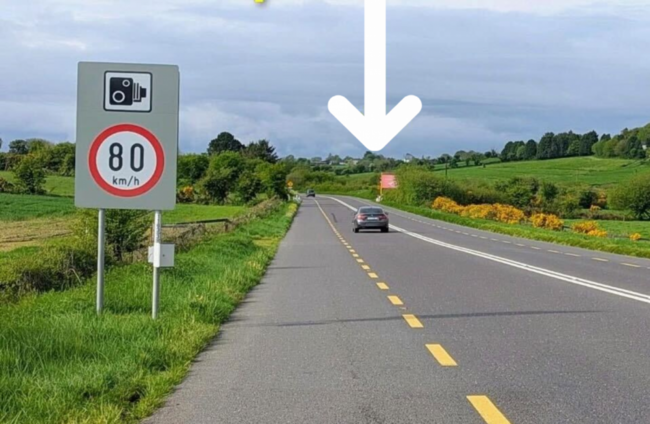
MINISTER FOR JUSTICE Jim O’Callaghan has asked his department officials to look into the case of a controversial speed camera in Kilkenny responsible for issuing over 30,000 fines in a single year.
Installed in May last year, the static camera is at the N25 near Glenmore, Co Kilkenny. The national road is a busy route, linking the counties of Waterford, Kilkenny and Wexford.
There are claims that there is confusion arising from the structure of the road, due to a sudden speed limit transition from 100 kilometres per hour to 80 kilometres per hour when travelling from Wexford.
The number of fines issued by this camera dwarf those issued by the eight other static speed cameras in Ireland.
Issues raised regarding the signage resulted in Transport Infrastructure Ireland approving a request from Kilkenny County Council to erect new signage about 400 metres further away from the old sign.
The matter was raised with O’Callaghan in the Dáil this week. The minister said that such cameras are “not about catching people out” but ensuring safety on Irish roads.
When pressed about the disparity between fines issued by the eight other cameras and the Kilkenny camera by Labour TD George Lawlor, O’Callaghan said it would be hard to contest the figures “indicate there are aberrations in different parts of the country”.
When he saw the figures, he said, he asked the department why a greater number of fixed charge notices are being issued by two particular cameras (the speed camera on the N80 in Carlow has issued 15,880 fines in the same period).
O’Callaghan told Lawlor he does not have an answer at the moment but that the matter is being examined.
“Maybe there is a road people speed on consistently,” he suggested.
“I do not know the answer but I will look at it and I will ask officials to inquire into it because there is a significant deviation between the notices being issued by cameras in one area and those in other areas.”
Lawlor said while he was not campaigning for people to have speeding fines rescinded, there is an issue with the signage and people coming from a 100km/h zone into the 80km/h zone where the camera is are “not given a chance to obey the law”.
The Labour TD said people who were driving below 100km/h – many of whom were decelerating – “should be fairly treated”.
“This one camera generated €4.9 million in revenue in 11 months. It is off the charts. It needs to be seriously investigated. Court cases are being taken because people have lost their licences as a result of this camera in Glenmore in particular,” he argued.
“It is beyond the pale to think we are penalising people unfairly. They must be treated justly and if it comes to it, their fines and points must be rescinded.”
The minister said he presumes those who received speeding fines, were, in fact, speeding – but added that it may be the case that they were not given sufficient time or notice to slow down before they were captured by the camera.
O’Callaghan concluded: “Being frank, looking at the data, it seems unusual that two cameras seem to have so many more fixed charge notices emanating from them than others.
“I suspect the reason is the positioning of the camera, perhaps coming out of an area that permits a faster speed limit into an area that is perhaps very close, with a slower speed limit. That could be the reason for it. I have asked because the figures jumped out at me when I saw them.”

To embed this post, copy the code below on your site










have your say