Sign in. It’s quick, free and it’s up to you.
An account is an optional way to support the work we do. Find out more.
Sign in. It’s quick, free and it’s up to you.
An account is an optional way to support the work we do. Find out more.
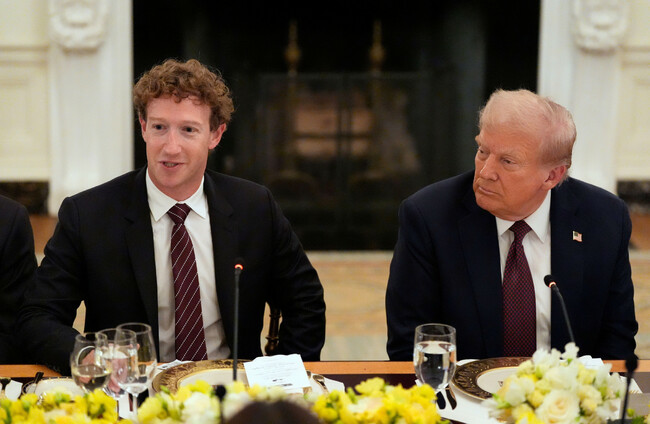
VIDEOS THAT PURPORTEDLY show Mark Zuckerberg saying that water will run out in the following year are AI-generated fakes.
The AI footage is an almost exact match for news footage of a widely publicised meeting US president Donald Trump held with tech leaders, including Zuckerberg, the head of Meta, which owns Facebook, Instagram and WhatsApp.
However, the audio in the AI clip is completely different, and the footage appears to have been slightly altered using deepfake technology to make Zuckerberg’s mouth appear like it is uttering the words in the AI-generated footage.
Deepfakes refer to AI-generated images created to mimic real people by using older photos and videos of them as a template.
“There is no water left for humans to survive more than one year,” Zuckerberg appears to say in the video. “So we will absolutely be supporting the World Water Reserve with a $200 billion capital allocation.”
Some of the videos then go on to include commentary, pushing people to buy tokens for the World Water Reserve — a cryptocurrency also known as WWR. While the website for these crypto tokens has a theme involving water infrastructure, owning tokens does not appear to have any real-world effects or give any rights over actual water or projects.
Multiple variations of these videos have been posted to Facebook and Instagram since August, accumulating thousands of views.
However, the footage is fake, and Zuckerberg never uttered the words during his meeting with Trump and other tech leaders.
A transcript of the meeting shows that the term “water” was never used.
Moreover, the real meeting was held in September 2025, meaning if Zuckerberg’s comments were accurate, humanity will die due to a lack of water in less than a week.
The deceptive depiction of Zuckerberg appears to be part of a wider trend of deepfake videos being used to promote cryptocurrencies. This is likely part of an effort to hype it up, increasing the value of already-owned World Water Reserve tokens so they can be sold at a profit.
There has been a spate of deepfaked celebrity videos being used to promote water-themed cryptocurrencies, including recent posts featuring billionaire Bill Gates, Canadian leader Mark Carney, and US president Donald Trump.
The Journal has previously debunked hoax ads featuring AI-generated videos of celebrities, often with the aim of tricking people into buying cryptocurrencies.
These have included depictions of Simon Harris, Sharon Ní Bheoláin, Fintan O’Toole, Brendan Gleeson, RTÉ newsreader Sharon Tobin, and scientist Luke O’Neill.
Other AI-generated videos have featured Michael O’Leary, as well as an interview between Elon Musk and Irish BBC newsreader Tadhg Enright.
Less sophisticated scam ads debunked by The Journal have featured images of politicians Leo Varadkar, Micheál Martin and Enda Kenny, as well as television presenters such as Pat Kenny, Anne Doyle, Bláthnaid Ní Chofaigh, Maura Derrane, Ryan Tubridy, Colette Fitzpatrick, Ciara Doherty, Brian Dowling, and Alan Hughes.
Images of comedian Dara Ó Briain, political strategist Alastair Campbell on the Late Late Show with Patrick Kielty, a fake interview of Eamon Ryan on the Tommy Tiernan Show, and fake photos of presenter Tommy Bowe being escorted by PSNI officers have also been featured on fake ads debunked by The Journal.
Readers have told The Journal that they had reported scam deepfake ads to the social media companies hosting them, to be told that they did not breach their rules.
In 2025, The Journal Investigates uncovered more than 100 pages that have attempted to scam shoppers with more than 50,000 Meta ads.
In response, Meta said that those ads were “driven by ruthless cross-border criminal networks that use sophisticated schemes” and Meta was continuing to invest in technology to tackle them.
The Journal’s FactCheck is a signatory to the International Fact-Checking Network’s Code of Principles. You can read it here. For information on how FactCheck works, what the verdicts mean, and how you can take part, check out our Reader’s Guide here. You can read about the team of editors and reporters who work on the factchecks here.

To embed this post, copy the code below on your site















have your say