Sign in. It’s quick, free and it’s up to you.
An account is an optional way to support the work we do. Find out more.
Sign in. It’s quick, free and it’s up to you.
An account is an optional way to support the work we do. Find out more.
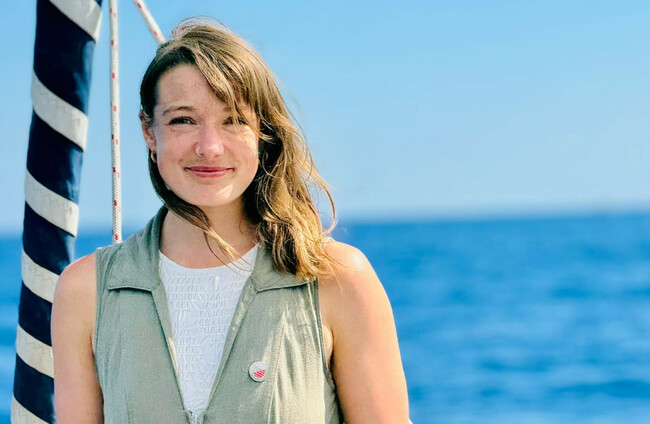
THE FLEET OF boats bringing aid across the Mediterranean to Gaza left Barcelona at the beginning of September and one of its 50 vessels is carrying legal experts who have committed to monitoring the flotilla’s progress, and its setbacks, as the activists attempt to break Israel’s blockade.
One of the lawyers on the independent legal support boat is Irish barrister Leigh Brosnan, who said she left Dublin behind so she could do something practical in response to Israel’s genocidal war on the Palestinian territory.
Brosnan spoke to The Journal about feeling compelled to set out on the risky voyage, experiencing attacks en route, and why she’s sounding the alarm about the threat Israeli impunity poses to the international legal order.
Brosnan spoke to The Journal by phone from the Shireen Abu Akleh, the boat named after the famed Palestinian-American journalist who was killed by an Israeli sniper in 2022.
The Dublin-based human rights lawyer described Tuesday’s nighttime drone attack on some of the flotilla’s boats.
Drones dropped non-lethal explosives and corrosive chemicals on the boats under the cover of darkness. The incident was met with outrage in Ireland, where politicians called on the government to send an observer ship to shadow the flotilla.
Italy responded by dispatching a navy frigate to assists Italian citizens and some elected representatives on board the boats.
Brosnan said there was “no logical or legal basis” for the attack, which took place roughly 600 nautical miles from Palestine off the coast of Greece.
Israel has not taken responsibility for the act of intimidation, nor the other attacks on the fleet while they waited to leave Tunisia, but the Israeli government has promised to prevent the boats from reaching their destination and threatened to treat the activists on board as “terrorists” who are “serving Hamas”.
“Israel will not allow vessels to enter an active combat zone and will not allow any breach of the lawful naval blockade,” foreign ministry spokesman Oren Marmorstein said on Wednesday.
The Foreign Ministry said that the flotilla could deposit the aid its carrying so it can be distributed in Gaza.
A report by Doctors Without Borders (MSF) published this week outlined the many ways in which Israel has hindered and blocked the entry of food, medicine and other supplies into the Strip.
The Hamas flotilla refuses Israel’s proposal to unload aid peacefully at the nearby Ashkelon Marina. Instead, it chooses the illegal path — sailing into a combat zone and breaching the lawful naval blockade.
— Israel ישראל (@Israel) September 23, 2025
This proves their true aim: serving Hamas rather than delivering aid to… pic.twitter.com/m19i9CiI8d
Israel already scuppered two previous attempts to break its Gaza blockade in June and July of this year.
“There’s simply no other body or jurisdiction that would have any incentive to act in an aggressive and harmful manner to the flotilla,” Brosnan said of Israel.
The UN’s human rights office called for an independent inquiry into the attack.
Brosnan said that the Israeli government’s attempts to smear and misrepresent those sailing in the flotilla were “part of their semantic warfare”.
These smears have been levelled at UN agencies and NGOs like MSF, she said, and used “as a pretext for the unlawful restriction of access to the Occupied Palestinian Territories, and in extreme cases extrajudicial killing”.
Attacks like the one on Tuesday night show why bringing along a group of human rights lawyers to monitor the flotilla’s voyage was a sound decision.
Brosnan explained that while she was moved to join the fleet by the plight of people in Gaza, she is not technically sailing towards Palestine in an activist capacity.
“It’s a together-apart ethos and function that we’re serving. So we’re accompanying the flotilla, as opposed to being activists.
“The independent legal support boat will not be attempting to break the blockade,” she said.
“However, we will accompany and bear witness to the flotilla as it carries out its activities.”
Where governments and international organisations have failed, citizens are stepping in to do something in response to Israel’s crimes in Gaza.
“There’s been a moral collapse internationally,” she said.
She pointed to the fact that 26,000 people applied to join the flotilla and put themselves in harm’s way.
Brosnan is keen to stress that the danger faced by those on the fleet bears no comparison to what Palestinians are facing in Gaza, where more than 65,000 people have been killed and the vast majority of the population has been displaced.
Still, “the risk of the risk of harm is quite real” for those 500 plus people out of the 26,000 who have ended up on the boats.
For Brosnan, the prospect of joining the flotilla appealed to her at a time when the prevailing mood among those who support Palestine is one of frustration and despair.
“I felt called to participate when I found out that there was an independent legal support boat being formed,” she said.
“The whole international legal order is under threat due to the impunity with which Israel gets to decimate the rule of law, gets to trample upon human rights and international humanitarian law, and that distinct lack of accountability spurred me to go and be there on the water.”
She finds the apparent acceptance among many states that Israel can commit war crimes and crimes against humanity day after day “very concerning”.
“The overwhelming sense of lack of humanity and lack of efficacy of a legal system which can uphold law and which all humans are protected within it is of great concern to me as a legal practitioner.”
In spite of the relative inaction among Western states, Brosnan does see signs that opinions about Israel are changing.
“I think that the sands are shifting. I think that people’s willingness to turn a blind eye to the ongoing impunity of Israel is weakening.
This mounting feeling is approaching a tipping point, she believes.
“I have faith that the international and multilateral systems we have will have more weight, or will have more of a concrete response and a sanctions-based response.”
She said the only things that could hinder Israel’s actions are either economic sanctions or military intervention and peacekeeping.
Treating Israel as a “pariah state” is essential, she said.
Brosnan said that while the people manning the boats in the flotilla deserve admiration, “it’s what the human response is” but that many people are simply overwhelmed by a kind of paralysis or hopelessness.
What is most important to recognise, though, is that “states are abdicating their responsibility to take the lead and to have that moral leadership and to actually take the mantle and respect the democratic mandates of their respective citizenry”.
Despite the danger in which Brosnan has placed herself, she said her family and friends are fully behind her.
“They know I have more fear of living in a world where a people are casually destroyed, through death and destruction, while we all stand idly by.”

To embed this post, copy the code below on your site















have your say