Sign in. It’s quick, free and it’s up to you.
An account is an optional way to support the work we do. Find out more.
Sign in. It’s quick, free and it’s up to you.
An account is an optional way to support the work we do. Find out more.
LAST UPDATE | 2 Apr 2025
A NUMBER OF women arrested and cautioned by gardaí after being removed from a protest at the gates of Leinster House are seeking legal advice as they consider making a complaint to Garda watchdog body GSOC.
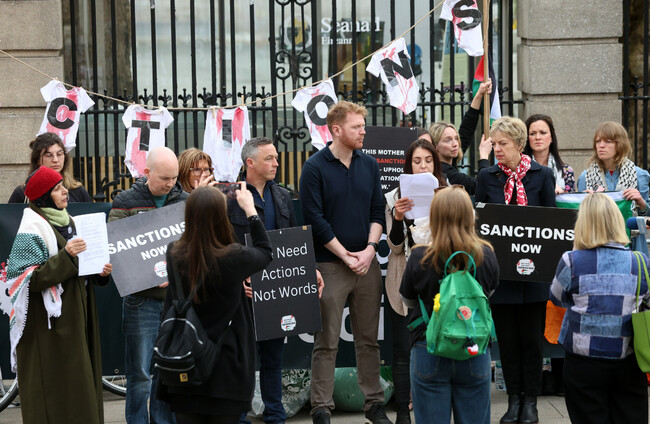
Fourteen people in total – including four men – were arrested on Kildare Street on Monday after holding an overnight vigil outside the Oireachtas to coincide with Mother’s Day.
Protesters supporting the Mothers against Genocide group returned to street today, and said they were “devastated” over Garda treatment of those detained.
Of the fourteen people arrested this week three individuals were charged and eleven others received adult cautions.
In the Dáil yesterday, People Before Profit TD Richard Boyd Barrett said some of the women were “strip searched” after their arrest.
His party colleague Ruth Coppinger told the chamber that a “cavity search” was conducted on one of the women arrested.
In a statement, a Garda spokesperson stood over the arrests, claiming they took place after members engaged with the protestors who were blocking the entrance to Dáil Éireann and were detained after they did not comply with directions, contrary to public order laws.
It is understood that those who were cautioned are now seeking legal advice on whether to make a GSOC complaint.
A Garda spokesperson said any searches were carried out in respect of legislation pertaining to treatment of persons in custody in Garda Síochána stations.
The statement added: “An Garda Síochána refutes any allegation that a cavity search took place.”
Speaking in the Dáil, Boyd Barrett quoted an account he said he received from one of the women involved: “I was stripped completely naked and was asked to remove my underwear. When I questioned the necessity of this, I was told I would be forced violently, if I didn’t comply.”
The TD said the alleged behaviour was “absolutely disgusting” and said the women “were a threat to nobody”.
A senior Garda source who spoke to The Journal said all of those who were taken into custody were searched, but rejected that any strip searches took place.
The source said one of the women was directed to remove a belt as regulations state that any potential ligature should be removed. When this was done her trousers were unable to stay up and her underwear was exposed at that stage, they said. She was given a replacement trousers by gardaí, it is understood.
Another woman was directed to remove her hijab so that the gardaí could remove a pin which was used to secure it. Once the pin was removed she was given back the headdress to wear again, the source added.
While common law allows gardaí to search people in custody or prison, regulations afford a number of rights to people being searched in custody, including the right to be told the reason for the search, that it be conducted by a Garda of the same sex and that all details of the event be recorded and kept on file.
Two gardaí of the same sex as the person in custody conduct the search in a discreet room. The regulations state gardaí do not touch the person during any part of the strip search, but give directions to remove clothing until they are satisfied there is nothing concealed.
One woman claims that gardaí conducted a visual cavity search, rather than an invasive one requiring a doctor, the Dáil was told.
Boyd Barrett, when quoting the account in the Dáil of the woman, said: “After removing my underwear, they looked inside my private areas and touched all my sensitive parts.”
A spokesperson for Mothers Against Genocide said the movement stands over the claim that a cavity search took place and said that the woman is “traumatised” as a result.
- With reporting from Niall O’Connor

To embed this post, copy the code below on your site












have your say