Sign in. It’s quick, free and it’s up to you.
An account is an optional way to support the work we do. Find out more.
Sign in. It’s quick, free and it’s up to you.
An account is an optional way to support the work we do. Find out more.
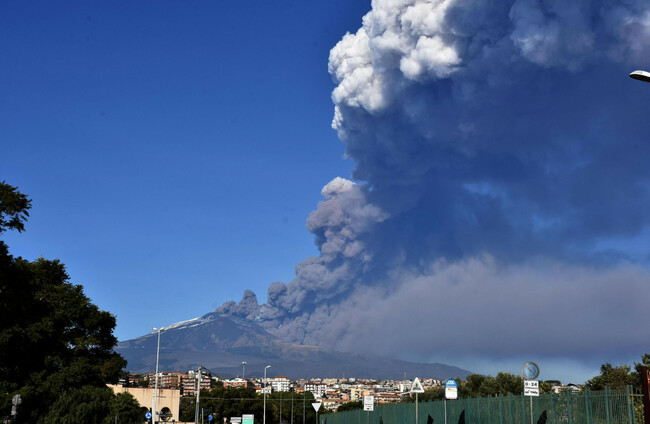
MOUNT ETNA IN Italy has erupted this afternoon, sending a huge ash cloud into the sky above Sicily.
The airspace around the mountain has been partially closed to planes as a result of the volcanic action.
Italy’s national institute for geophysics and vulcanology (INGV) counted more than 130 seismic shocks in the zone afterwards, with the strongest reaching a magnitude of 4.0.
“The eruption occurred on the side of Etna,” Boris Behncke, a vulcanologist at INGV, said. “It’s the first lateral eruption in more than 10 years, but it doesn’t seem to be dangerous.”
Due to bad visibility because of the ash authorities restricted local airspace, allowing only four landings per hour at the eastern Sicilian airport of Catania.
Visibility was still too poor to determine whether the eruption was accompanied by lava, Behncke said.
At any rate, both the seismic activity and ash production appeared to be diminishing in the afternoon, he said.
Mount Etna, 3,300 metres high, is the biggest active volcano in Europe, with frequent eruptions recorded in the past 2,700 years.
Its most recent eruptions occurred in the spring of 2017 and its last major eruption in the 2008/2009 winter.
At the end of March a study published in the Bulletin of Volcanology said that Etna is slowly sliding towards the Mediterranean — at a constant pace of 14 millimetres per year.

To embed this post, copy the code below on your site











have your say