Sign in. It’s quick, free and it’s up to you.
An account is an optional way to support the work we do. Find out more.
Sign in. It’s quick, free and it’s up to you.
An account is an optional way to support the work we do. Find out more.
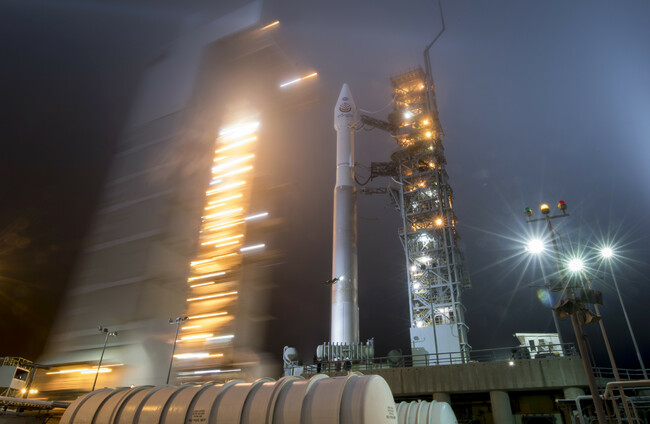
A ROBOTIC GEOLOGIST armed with a hammer and quake monitor rocketed toward Mars aiming to land on the red planet and explore its mysterious insides.
In a twist, NASA launched the Mars InSight lander from California rather than Florida’s Cape Canaveral. It was the first interplanetary mission ever to depart from the West Coast, drawing pre-dawn crowds to Vandenberg Air Force Base and rocket watchers down the California coast into Baja.
The spacecraft will take more than six months to get to Mars and start its unprecedented geologic excavations, traveling 300 million miles to get there.
InSight will dig deeper into Mars than ever before — nearly 16 feet — to take the planet’s temperature. It will also attempt to make the first measurements of marsquakes, using a high-tech seismometer placed directly on the Martian surface.
Also aboard the Atlas V rocket: a pair of mini satellites, or CubeSats, meant to trail InSight all the way to Mars in a first-of-its-kind technology demonstration.
The $1 billion mission involves scientists from the US, France, Germany and elsewhere in Europe.
“I can’t describe to you in words how very excited I am … to go off to Mars,” said project manager Tom Hoffman from NASA’s Jet Propulsion Laboratory in Pasadena, California. “It’s going to be awesome.”
NASA hasn’t put a spacecraft down on Mars since the Curiosity rover in 2012. The U.S. is the only country to successfully land and operate a spacecraft at Mars. It’s tough, complicated stuff. Only about 40% of all missions to Mars from all countries — orbiters and landers alike — have proven successful over the decades.
If all goes well, the three-legged InSight will descend by parachute and engine firings onto a flat equatorial region of Mars — believed to be free of big, potentially dangerous rocks — on Nov. 26. Once down, it will stay put, using a mechanical arm to place the science instruments on the surface.
“This mission will probe the interior of another terrestrial planet, giving us an idea of the size of the core, the mantle, the crust and our ability then to compare that with the Earth,” said NASA’s chief scientist Jim Green. “This is of fundamental importance to understand the origin of our solar system and how it became the way it is today.”
InSight’s principal scientist, Bruce Banerdt of JPL, said Mars is ideal for learning how the rocky planets of our solar system formed 4.5 billion years ago. Unlike our active Earth, Mars hasn’t been transformed by plate tectonics and other processes, he noted.

To embed this post, copy the code below on your site













have your say