Sign in. It’s quick, free and it’s up to you.
An account is an optional way to support the work we do. Find out more.
Sign in. It’s quick, free and it’s up to you.
An account is an optional way to support the work we do. Find out more.
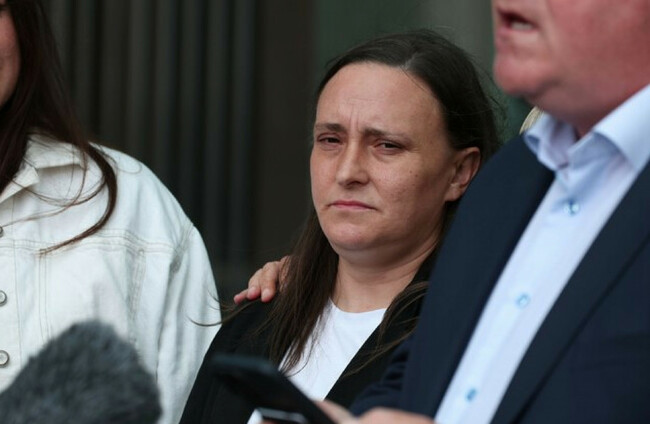
A WOMAN WHO survived torture and false imprisonment is still waiting for a public health psychiatric appointment, ten months after she endured a three-hour “sadistic” assault by five men.
Last September, Natalie Ennis was beaten to the head and body with a metal pole, burned with a makeshift blow torch and a heated hammer head, cut with a knife, kicked and punched, had her hair cut off and was threatened with rape, Dublin Circuit Criminal Court heard.
Yesterday, five men were jailed for their roles in the “cruel” torture and false imprisonment in a flat in Dublin over a false accusation about missing drugs.
In her victim impact statement, Natalie said she suffers from flashbacks, constant headaches and pain all over her body, but is still waiting for an appointment to receive counselling.
Speaking to The Journal, David Hall, CEO of Sonas Domestic Abuse, highlighted the “abject failure” of the state to join up all the services required by victims.
He said there is a general belief that victims of crime receive automatic follow up and services that they need, such as counselling, dental work and housing, but this is not the case.
“It will be eleven months before Natalie has a psychiatric appointment,” he said.
“There’s a raft of basic services that are needed. There is an abject failure to join the dots to ensure all services required by victims are offered.”
He said: “It’s expensive to be a victim of crime”, noting that there is a large cost associated with being a victim, citing health appointments as an example.
To receive support and compensation, victims can apply to the Victims of Crime Programme.
Hall believes there should be centres for victims of crime and violence to attend in person and receive support, rather than forcing victims to suffer the “indignity of applying”.
He said: “Natalie and many like her don’t need more sympathy, they need services.”
“It’s very important for Natalie to be able to give herself every opportunity to get back into society after the ordeal she has gone through.”
“We say we want to help, well we’re not acting that way,” he added.
Following last September’s attack, Natalie was left with a broken eye socket, broken cheekbone, broken nasal bone, broken elbow, burns, dislocated teeth, bruising and lacerations across her head and scalp among other injuries. She required skin grafts, staples to her scalp and later had surgery to remove a disc in her back, the court heard. She spent three weeks in hospital in the immediate aftermath of the assault.
In her victim impact statement, which was read out in court by the investigating officer, Natalie said the torture she endured was the longest three hours of her life and she continues to suffer.
“What happened to me is something I will never forget,” she said.
She said she was “petrified” in the flat. “If police didn’t come in through that door that day, I was sure I was dead,” she said, describing the men as “animals”.
“I was beaten, stabbed and burnt – tortured to confess to something I knew nothing about,” she said.
“The smell of my skin burning, I will never get that smell out of my mind again,” she said, adding that she was “completely helpless” and outnumbered by the eight men.
“I never knew humanity could be so cruel,” she said.
During the attack the men took running jumps at her during the assault, threatened to make her drink ammonia and also threatened to rape her teenage daughter.
The assault only ended when gardaí unexpectedly entered the flat with a search warrant, the court heard. All of the men, who have between one and 124 previous convictions respectively, were on bail at the time of the offence.
Five of the eight men present that day entered guilty pleas, while another man and a juvenile are still before the courts. The eighth person is not before the courts.
Mark Keogh (33), Mark McMahon (55) and Braxton Rice (21), all of Henrietta House, Henrietta Place, Dublin 7, along with Sean Conroy (21) of Sillogue Road, Ballymun and Kian Walshe (22) of Constitution Hill, Dublin 7, all pleaded guilty to false imprisonment and assault causing harm to the woman at Henrietta House on 26 September 2024.
The men collectively received a jail sentence of over 56 years. Rice was handed a sentence of 15 years, with the final 12 months suspended on strict conditions. Conroy was jailed 13 years, with the final 12 months suspended on strict conditions. McMahon recieved a sentence of 12 years, while his son, Keogh was jailed for nine years. Walshe was handed a sentence of 11 years with the final two-and-a-half years suspended on strict conditions.
Imposing the sentences yesterday, Judge Pauline Codd said the context of this offending “highlights the degree to which normal humanity and decency are absent” in the drugs trade.
The judge said the violence included “disturbing, cruel and sadistic methods of torturing a woman by a group of men”, adding later that a group of men against one woman is, in itself, “terrifying”.

To embed this post, copy the code below on your site








have your say