Sign in. It’s quick, free and it’s up to you.
An account is an optional way to support the work we do. Find out more.
Sign in. It’s quick, free and it’s up to you.
An account is an optional way to support the work we do. Find out more.
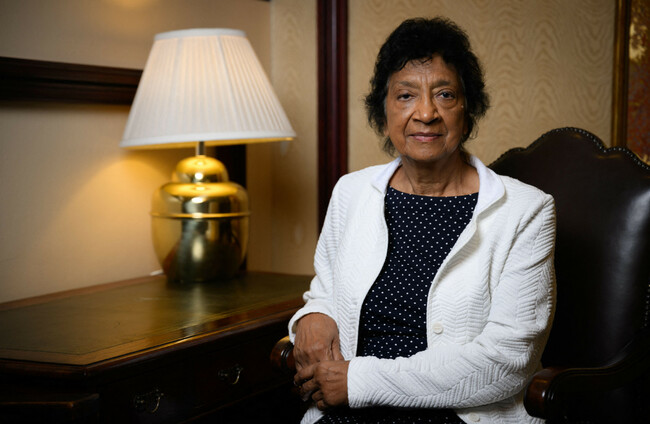
SOUTH AFRICAN HUMAN rights lawyer and judge Navi Pillay has been awarded the 2026 Nobel Peace Prize for her efforts to promote peace and international law.
The Norwegian Nobel Committee announced the award in Oslo this morning, praising Pillay’s decades of work holding states and political leaders accountable for war crimes, crimes against humanity and genocide.
The committee said Pillay had shown “exceptional courage and integrity” throughout a career dedicated to strengthening international law.
“This year’s laureate has been instrumental in ensuring that war crimes, crimes against humanity and genocide are prosecuted,” it said.
Born into a family of Indian Tamil origin in Durban, South Africa, Pillay grew up under apartheid and went on to become a lawyer, challenging the country’s system of racial segregation and discrimination.
Her early legal work included defending Nelson Mandela and other opponents of apartheid.
She later served as a judge in South Africa, at the International Criminal Tribunal for Rwanda and at the International Criminal Court (ICC).
Pillay also served as the United Nations High Commissioner for Human Rights and, until recently, chaired the UN Independent International Commission of Inquiry on the Occupied Palestinian Territory.
In 2025, during her time as chair, the UN commission concluded that Israel had committed genocide against Palestinians in Gaza.
She is currently serving as a judge in proceedings before the International Court of Justice concerning allegations of genocide against Myanmar, according to the Nobel Committee.
Reacting to the news, Pillay appeared stunned by the announcement, initially questioning whether it was genuine.
“I said it must be a joke,” she told a small gathering of people at the Nuremberg Court when she learned of the award.
She also joked about Donald Trump’s desire to win the prize, telling the applauding audience: “If you clap a little bit more, I may share this prize with Trump.”
Amazing moment. Navi Pillay has received the Nobel Peace Prize ! https://t.co/HL3r1PJzLO We are at the Nuremberg Court; I cannot think of a stronger symbol for her Nobel prize. We are all so thrilled! This is her first reactions upon hearing the news: https://t.co/Crbj6XdiyQ
— Agnes Callamard (@AgnesCallamard) October 9, 2026
Pillay also referenced her recent work with the UN commission.
“The last thing I did is the [report] in Gaza, naming what’s happening there as genocide,” Pillay said.
She added that people had praised her courage for reaching that conclusion, but questioned why courage should be necessary.
“Why would you need courage to speak the truth? You interpret the law, you look at all the facts.”
The Nobel Committee also warned that the international legal system was under “tremendous pressure”, with its institutions facing attacks and a growing shift towards power politics.
The system of international law is under tremendous pressure, and its institutions are under attack.
“Today, as these same judges are sanctioned, and their institutions are attacked, we need people of courage, vision and determination,” it said, pointing to Pillay as an example.
“Whenever might overtakes right, it undermines stability, trust and peaceful co-existence,” the committee added.
It said the rule of law was essential to resolving conflicts without violence, declaring: “Peace requires justice.”
The committee’s warning comes amid an ongoing campaign of US sanctions against judges and prosecutors at the ICC.
The Trump administration has targeted court officials over investigations involving American personnel and Israeli leaders, including arrest warrants issued for Israeli Prime Minister Benjamin Netanyahu and former defence minister Yoav Gallant following an investigation of war crimes and crimes against humanity.
In August, the US imposed further sanctions on ICC president Tomoko Akane and senior trial lawyer Abdoulaye Seye.
The court said the latest measures meant nine of its 18 judges had been sanctioned by Washington, describing the sanctions as a “flagrant attack” on its independence.
Last year’s Nobel Peace Prize was awarded to Venezuelan opposition leader María Corina Machado for her efforts to promote democratic rights and achieve a peaceful transition from dictatorship to democracy in Venezuela.
However, Machado made headlines again in January when she presented her Nobel Peace Prize medal to Trump during a meeting at the White House.
Trump, who has repeatedly expressed his desire to win the award, accepted the medal and thanked Machado for the gesture.
The unusual exchange prompted the Norwegian Nobel Institute to clarify that while a winner is free to give away their medal, the Nobel Peace Prize itself cannot be transferred to another person.
Trump has long argued that his diplomatic efforts to resolve international conflicts make him deserving of the award.
He has also criticised the Nobel Committee for overlooking him in previous years.
“I don’t know what their decision is going to be,” Trump told reporters on Thursday regarding this year’s award.
“They have a reputation for maybe not giving it to people like me.”
Other recent recipients include the Japanese organisation Nihon Hidankyo, a grassroots movement of atomic bomb survivors, which won in 2024 for its efforts towards a world free of nuclear weapons.
Iranian human rights activist Narges Mohammadi received the prize in 2023 for her fight against the oppression of women in Iran and her work promoting human rights.
In 2022, the award was shared by Belarusian human rights activist Ales Bialiatski and two human rights organisations, Memorial in Russia and the Center for Civil Liberties in Ukraine.
Among the more famous previous recipients are former US president Barack Obama, who won in 2009, Pakistani education activist Malala Yousafzai, who shared the prize in 2014, and Northern Ireland peace campaigners Betty Williams and Mairead Corrigan, who were jointly awarded the prize in 1976.
The Nobel Peace Prize was first awarded in 1901 and is decided by a five-member committee appointed by the Norwegian parliament.

To embed this post, copy the code below on your site












have your say