Sign in. It’s quick, free and it’s up to you.
An account is an optional way to support the work we do. Find out more.
Sign in. It’s quick, free and it’s up to you.
An account is an optional way to support the work we do. Find out more.
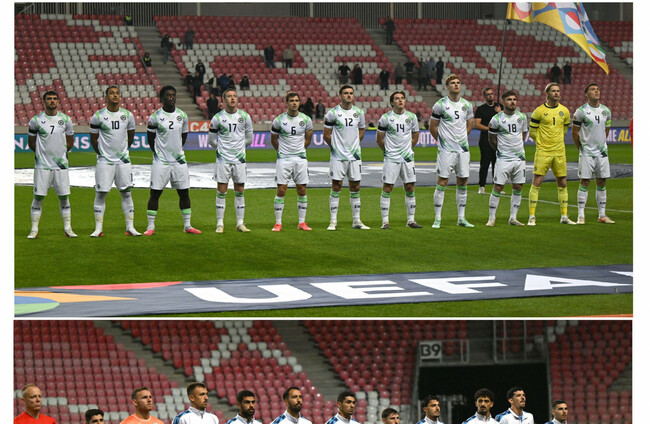

Fintan Drury has worked in professional football as a licensed agent and an adviser for over 30 years. He is also known as an advocate and writer on migration and Palestine. Here he reflects on events around Ireland’s matches against Israel…
LAST FRIDAY AFTERNOON I spoke at the Clifden Arts Festival. The talk was entitled ‘Indifference – A Genocide and Our Part in It’.
We consider ourselves fiercely pro-Palestine. The truth is more nuanced. When it comes to the culpability of the West for the horror in Gaza, most attention has focused on the United States, Germany, the UK and the EU. In this context, sovereign support actors can escape scrutiny; Ireland is among them.
In Clifden, I used the fact that we were scheduled to play Israel in two Nations League matches as symbolic of how weak our institutional support of Palestine has been. In a previous life, I managed the commercial interests of the Irish squad that contested both the 1990 and 1994 World Cup Finals.
Their exploits generated unprecedented levels of excitement. The whole nation was intoxicated by it; metaphorically at least. The next time an Irish football squad generated anything like the same attention was when Roy Keane and Mick McCarthy fell out in Saipan in 2002.
It was a footballing calamity for a talented squad, one that should have been avoided. Football administrators in many countries have shown a capacity for mismanagement, but the FAI has a particular gift for it.
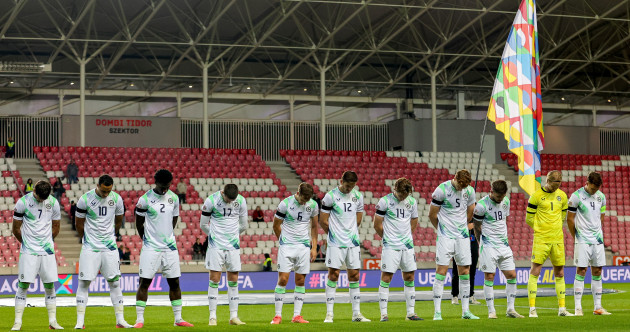
What emerged over the course of last weekend in relation to the FAI’s handling of the Ireland vs Israel games, did more than expose that flaw as never before; it betrayed the wider institutional indifference that has characterised much of Ireland’s approach to Palestine’s suffering.
The FAI board put this Irish squad in a hopeless position, but did so with clear government support. This matters. Last November, the board formally asked UEFA to ban Israel from all national and club competitions. It believed then that no nation, no group of players, should be asked to fulfil a fixture against Israel as long as its barbarism continued. It appeared to have informed itself and decided Israel’s participation in all competitions was unacceptable. So too the government.
Except, they were bluffing. When UEFA rejected the appeal, the FAI let matters rest. They didn’t attempt to force the issue. The Nations League draw in Brussels last February was attended by an FAI delegation: its president, Paul Cooke; CEO David Courell; and manager Heimir Hallgrimsson.

If its appeal of November for Israel to be banned had real conviction, no delegation would have been sent, and the FAI would have told UEFA that, if drawn against Israel, the matches would not be played.
The FAI’s bluff was called, but when it quickly announced that it would fulfil the fixtures, the flaw running through much of institutional Ireland’s response to Israel’s genocide was exposed. Within hours, on RTÉ, Taoiseach Micheál Martin said the games should proceed, and wished the team success.
Given Palestine’s fate, focusing on the welfare of Irish football by saying the team’s improved form was the ‘rejuvenation of a nation’ was unforgivable. Micheál Martin had, by then, taken to describing Israel’s conduct as a genocide, yet he saw no reason why Ireland should not play competitive sport against it.
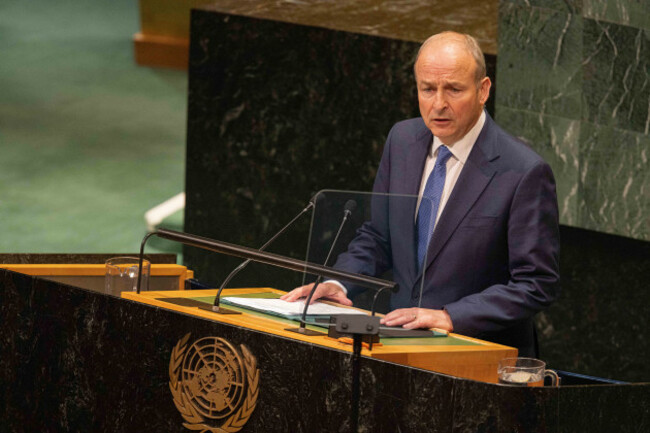
The FAI board’s decision to play the matches must be seen in this wider institutional context. Ireland is the world’s second-largest importer of Israeli goods, and yet this government engaged in deliberate delays on the Occupied Territories Bill and ultimately excluded services.
The United States uses Shannon Airport on the western coast in support of its backing of Israel, and the government fawned over US President Donald Trump a fortnight ago when he came to see the Irish Open golf championship on his course in Co. Clare.
The Taoiseach knows full well that Trump’s peace plan for Gaza is a scam – 24 hours after his return to Washington from Doonbeg, Trump sanctioned a further $2.2 billion (€1.93 billion) in arms funding for Israel.
Ireland needs to be honest with itself about its support of Palestine; any institutional weight is on things that carry little or no threat or cost. Israel’s relationship with the US has compromised us hopelessly. It has steadfastly refused to do or say anything that could upset the United States, sponsor-in-chief of Israel’s genocide.
We should just declare that to be the case. We’ve done some symbolic things well, but we are not where we like to think we are, and playing football against Israel proves the point.
The institutional ‘drag’ is revelatory. While hundreds of thousands have engaged in public protest or regularly attend meetings and vigils across the country, many more hundreds of thousands do not. Most of these people are not unconcerned, but they are, relatively speaking, indifferent.
This is the uncomfortable truth, and it is why institutional indifference prevails. Promoting Palestine’s cause and my two unashamedly partisan books have taken me to most parts of our island over the past three years. There is an increasing sense of speaking into an echo chamber – the passion and determination of Palestine’s friends and advocates is unquestioned; the indifference of the majority is curious, to say the least.
Those who live with that indifference were also emboldened by commentator Brenda Power in recent days, who spoke to Matt Cooper on the Path to Power podcast. Power argued that many people in Ireland were ‘hypocritical’ over other Irish sporting fixtures played against countries like Afghanistan, where women are treated appallingly. “Where was your indignation” when the Irish cricket team played Afghanistan last month, was her question.
She is correct, of course. I remember in 2016 talking with Amjed, a shopkeeper from Kabul who was a refugee in Greece, as he explained how he and his wife had to leave when their two daughters were born. “My son would have a life – not my young girls,” he explained.
One thing I often hear is about other genocides and why we are so focused on this one. This is where Brenda Power is not right. We can compare most things in life, but not genocides or extreme abuses of human rights.
The reason Palestine’s fate concerns us so much is that we must own it, take some responsibility for it. This is why we have to find our voice. The State of Israel claims to be a bulwark of Western civilisation. It is not. It is an abominably cruel genocidal state determined to erase Palestine from the map. For approaching three years now, they have been pursuing that very outcome using Western arms, facilities, money and diplomatic support to realise that objective.
I hope that, amidst the betrayal of community, of humanity, by Irish football, the voice of one young Irishman, Gavin Bazunu, will resonate most clearly with his fellow citizens.
When he said his decision not to play these two matches was based on his belief that the killing of ‘innocent people is wrong ’, he surely spoke for the majority. However, unlike most of us, he was prepared to risk damaging his professional career by taking a stand.
Most football fans know Bazunu has had a very challenging last few seasons; his career was in reverse until, in recent weeks, he found brilliant form with his new club, Bolton Wanderers.
With his injury problems, Gavin Bazunu could have, as many players have done over the years, withdrawn from the squad on fitness grounds. No one would have questioned the decision. It is not his way.
Gavin Bazunu has strong beliefs. One would have been that, not being injured, he must join the squad; the other would have been that playing football against a nation conducting a genocide would not be a moral thing to do.
Fintan Drury is a former RTÉ journalist, broadcaster and businessman. His new book, ‘Genocide: Sponsoring the Destruction of Palestine’ (Merrion Press) is published and available from all bookshops. €18.99
To embed this post, copy the code below on your site













have your say