Sign in. It’s quick, free and it’s up to you.
An account is an optional way to support the work we do. Find out more.
Sign in. It’s quick, free and it’s up to you.
An account is an optional way to support the work we do. Find out more.
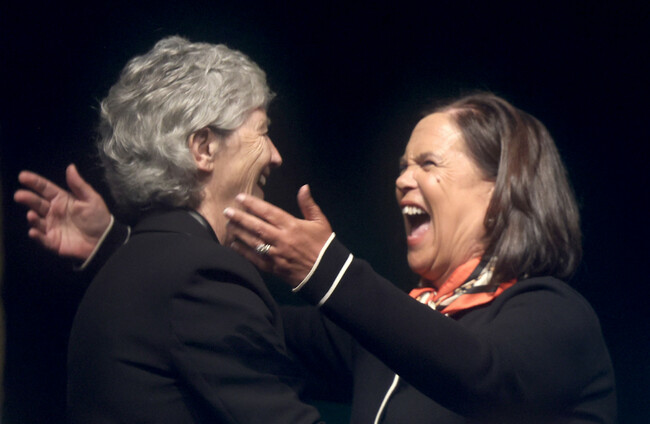

CATHERINE CONNOLLY HAS won in a landslide, achieving the highest vote share for a presidential election in the entire history of this State.
As the dust settles, many will now begin to analyse what worked well about her campaign.
I volunteered for her campaign as a local organiser in Waterford, and as an eco-socialist, we align on values of equality, public services, community, and neutrality. From my weeks of canvassing daily and from helping out with the national campaign’s social media, these are my three main takeaways.
Several times during the campaign, Connolly repeated the idea of focusing on there being a ‘right vs wrong’ rather than a ‘left vs right’ division.
Rather than just being a candidate of the left-wing parties that backed her, she sought to position herself as an independent candidate with broad support from all those who opposed the Fianna Fáil and Fine Gael status quo – not anti-establishment, but also distinctly not of the establishment.
This was, in my view, pivotal in Catherine Connolly’s overwhelming victory.
Instead of focusing on culture-war wedge issues or divisive social rights, Connolly repeatedly highlighted her unifying stances on broad geopolitical, cultural, and economic issues.
She emphasised her consistent support for peace and neutrality as well as her staunch opposition to the genocide in Palestine – views on geopolitical issues that are largely shared in everyday Ireland.
While clearly standing proudly for the equality of LGBTQIA+ people and immigrants, Catherine was most vocal on language, disability, and women’s rights – her stances aligning with the broad consensus in each case.
At every opportunity, she brought up the economic issues which find widespread support across our nation – the housing crisis, inequality and poverty, and the deficit in infrastructure, especially in rural areas.
This framing will be harder to repeat in a general or local election with reactionary right-wing candidates using every opportunity to move the debate cynically towards more controversial and divisive topics, but the left focusing on unifying values will help to attract the votes of many who are unhappy with the Fianna Fáil and Fine Gael status quo.
To me, this election has shown how our population support left-wing values much more than they support left-wing parties.
While it is easy for politicians, the media, or influencers to tar an entire party based on the actions of an individual member, it is much more difficult to do that when you have an independent candidate.
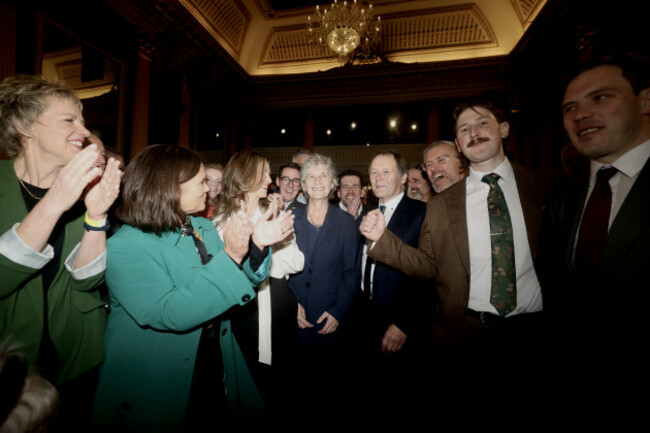
While attempts were made to highlight individual opposition to Connolly, pointing to a few vocal members of Labour and the Greens, these attempts failed to stick, as the independent nature of Connolly’s campaign gave it something of a teflon quality.
This was maybe the most negative and smear-ridden election we’ve possibly ever seen here, but Connolly largely sought to frame her talking points through a lens of optimism.
Take, for example, her response to the debate surrounding her hiring a woman who had served time in prison.
While many in the media and in Fine Gael attempted to use this to try to ‘smear the bejaysus’ out of her, Catherine reframed it as a chance to talk about rehabilitation and to empathise with a woman whose personal story had become a national talking point.
Connolly turned what could have been a negative into a positive by highlighting her belief in rehabilitation and personal privacy.
This election must be seen as a foundational first step towards collaboration between independents and parties on the left, with an aim to build a more fleshed out alliance ahead of the local and general elections planned for 2029.
On the ground, we should continue building links locally – including protesting the government-caused housing crisis, marching in solidarity with Palestine, and building a broad front against the tiny but growing fascism in our society.
At a leadership level, parties must identify local versions of Catherine Connolly – independents who are consistently left and progressive with a reputation for honesty and integrity – to support as a united alliance of independent candidates in the next local and general elections.
Next, the left should focus on building a coalition not against Fianna Fáil and Fine Gael, but for a positive alternative vision to the Fianna Fáil and Fine Gael status quo.
What this means will differ in each area, but can range from anything as specific as parties agreeing to jointly support candidates from one or two left-wing parties to anything as broad as pre-agreed ‘vote left, transfer left’ pact.
Finally, and this is most essential, all in the opposition must continue to work together broadly on issues of shared concern in order to make an alternative vision for a new republic a coherent reality.
We have seen already how parties like Independent Ireland and Aontú have aligned with the left-wing parties against the government on shared issues like disability rights and better rural infrastructure, and this must continue to be expanded in order to fight against the simplistic left vs right binary, and instead reinforce the message of a Fianna Fáil/Fine Gael elite vs the rest of us who hold a hopeful vision for a new republic.
Killian Mangan is a Computer Game Designer from Waterford who is interested in urban design, accessibility, housing and climate. He is an independent who ran in the recent local and general elections on a platform to Democratise-Decentralise-Decarbonise.
To embed this post, copy the code below on your site












have your say