Sign in. It’s quick, free and it’s up to you.
An account is an optional way to support the work we do. Find out more.
Sign in. It’s quick, free and it’s up to you.
An account is an optional way to support the work we do. Find out more.
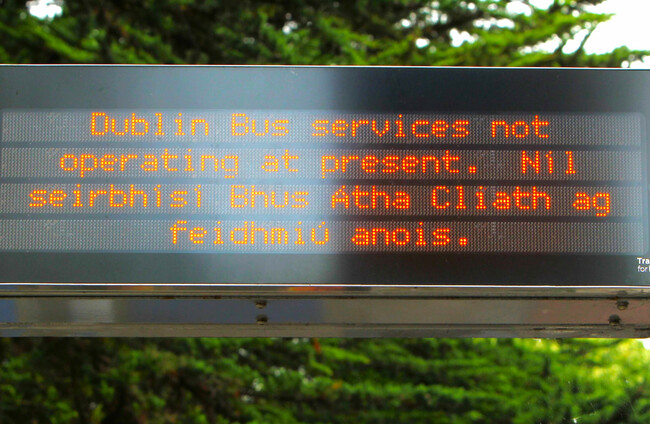

IF YOU’VE TRAVELLED to other European cities in recent years, you’ve probably noticed that many of them have fully integrated transport apps.
These apps allow users to plan entire journeys, often from door to door, using whatever modes of transport are available in that city, be it buses, trams, metro, trains, ferries, or city bikes.
You can pay for tickets for yourself and others, display them, and check live updates, all in one place.
The contrast with Dublin couldn’t be starker. Here, we’re stuck with a handful of semi-(dys)functional Transport for Ireland (TFI) apps that each do one or two things, often not as well as we would like.
At the time of writing, the TFI Live app, which is meant to help users check updates and plan journeys, has a 1.4 out of 5 rating on the App Store from over 1,500 reviews. To me, that says it all.
If you want to pay for the bus, your options are either cash – and only the exact amount in coins – or the trusted Leap card. People in Dublin know this of course, but try explaining this archaic system to a lost tourist just trying to get around the city.
In 2025, fully integrated transport apps aren’t exactly groundbreaking. Other cities have had them for years. Oslo’s app, Ruter, is a brilliant example of a slick, all-in-one platform. It’s simple: plan, buy, display, and repeat. No hassle.
You can even watch your bus move on a live map. No guesswork. You know where it is. There is accountability. In addition, city bikes have recently been added to the app, making bike share feel like a natural extension to public transport.
I recently spent a few weeks in Copenhagen, where they can instantly roll out special passes or temporary discounts on their ticket app, DOT, to encourage public transport use during festivals and events.
Again, the contrast is stark compared to the likes of Michael Healy-Rae arguing for free tolls during GAA matches in Dublin. Yes, it’s not directly comparable, but while the Danes encourage public transport through gentle nudges, we continue to encourage car use.
This brings us to the urgent need to change our transport habits. The National Household Travel Survey for 2024 shows that 56% of all trips in Dublin City and suburbs is by car. That is an increase from 54% in the 2023 survey.
Only 5% of trips are by bus or coach, while a meagre 2% are by LUAS, DART, or train. In view of such statistics, it is unsurprising that our transport emissions only decreased by an inadequate 1.2% in 2024.
This also has significant negative implications human health through local air and noise pollution, sedentary lifestyles, increased road danger, and the loss of valuable public space to roads and parking, to name but a few negative effects.
We need to use every tool available to us to reverse this trend and create a greener, healthier, and more equitable transport system for Dublin.
This should be the easy part.
A fully implemented BusConnects or the long-awaited metro are still years away, not to mention the urgent need for longer and more Luas lines. But a fully integrated transport app could be implemented quickly, if the political will existed. The fact that we are still years away from contactless payment on Dublin public transport shows the complete lack of ambition.
And no, a fully integrated app or contactless payment won’t solve everything, but it would be a crucial step in the right direction. Because let’s face it: we don’t have a world-class public transport system, but we could have a world-class transport app.
People in Ireland have shown they are both willing and able to use apps. Just look at Revolut. That’s not to say we should get rid of the Leap card or cash. It’s crucial we don’t exclude people without smartphones. No one should be left out.
But it’s almost 2026, not 1996. It’s time we acted like it.
Let’s finally introduce a world-class, fully integrated transport app to Dublin. We could call it “Tapa” – the Irish words for fast.
And let’s embrace the fact that Dublin is one of Europe’s tech capitals. There’s no need to reinvent the wheel. Let’s reach out to our counterparts across Europe. Let’s learn from their mistakes.
Yes, there are obstacles. The Dublin region bus scene is fragmented, with multiple private companies operating services instead of one public body managing transport for the region, but these are obstacles that can be overcome.
Dr Ola Løkken Nordrum is a member of Irish Doctors for the Environment.
To embed this post, copy the code below on your site















have your say