Sign in. It’s quick, free and it’s up to you.
An account is an optional way to support the work we do. Find out more.
Sign in. It’s quick, free and it’s up to you.
An account is an optional way to support the work we do. Find out more.

DOES ANYONE ELSE worry that these hosepipe bans may have a counterproductive effect? Have you ever met any man? Not to be too gender essentialist about things, but there’s pretty much only one foolproof way to get a man to do something around the house, and that’s to threaten to take away the means by which he might do it.
Threatening to sell the tools he never uses, for example, or suggesting that it might be best to simply get a professional in to do the job he’s been putting off for god knows how long. Don’t worry, I’m a man, some of my best friends are men, I’m allowed to point this out.
The hosepipe ban seems much the same. There must be thousands of people out there who’ve been putting off watering their garden who hear the news they’re not allowed to and immediately suffer from an acute bout of oppositional defiance disorder. I don’t even have a hosepipe, or a garden with any grass, and the second I was told I wasn’t allowed to use one I started to fantasise about other ways I could waste water. I settled on filling up a bucket of cold water and throwing it over talk of a border poll, but it turns out that Prime Minister Andy Burnham already beat me to it.
Ever since the days of David Cameron, each UK Prime Minister since has been engaged in a high-stakes game of pass-the-parcel. Sooner or later, one of them is going to be caught in possession when either Scotland or Northern Ireland finally decide that they’ve had enough. Maybe even Wales, now that those Plaid Cymru types are finally in the ascendancy. Nowhere is safe!
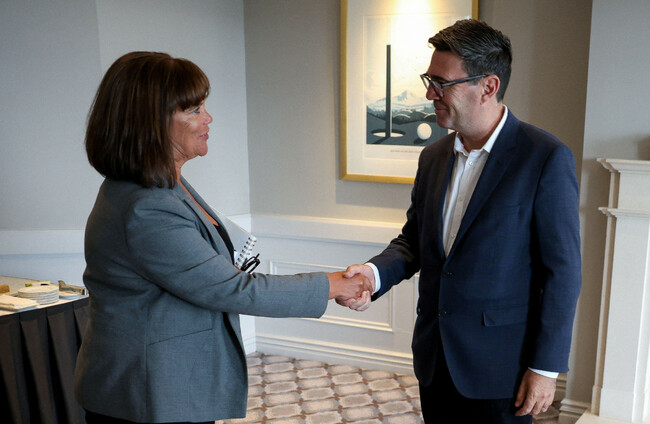
That was the prospect raised during Andy Burnham’s first visit to Northern Ireland as Prime Minister this week, during which he said that a border poll to determine the future status of the north of Ireland was “off the table”. And if you know anything about nationalists from the north, you know how they love for the English government to tell them what is and isn’t on the table.
Procedurally speaking, sure, the decision to call a border poll is the sole province of the UK’s Secretary of State for Northern Ireland (Burnham appointed Chris Bryant to the role in his first cabinet reshuffle). There is, however, a wide-enough gulf between procedure and perception. A rift, if you will. And Andy Burnham doesn’t want any more rifts.
“What we find is the rifts that come from those situations take a long time to heal, and it sets you right back,” is how Burnham justified his position, referring to Brexit and the decade of polarised politics that has followed in its wake. In this instance, polarised politics is a neighbourly euphemism for the total collapse of normality. We’re talking ten straight years of pretty much utter buffoonery, if we’re being honest.
Burnham’s argument seems predicated on the idea that a referendum on Irish unity would cause a rift where there had been none before. ‘Rift’ would actually be quite a quaint description of what the people of the north have experienced thus far in the centuries since our island was first… rifted, shall we say. By the entity of which Burnham now finds himself in charge, in case that happened to escape your notice, in the way that so often seems to be the case for powerful British politicians who could really do with finding a more deft way of speaking about such matters.
After all, saying that a border poll could cause a rift in Northern Ireland is sort of like saying that an ordnance survey of the Grand Canyon might cause a rift in the landscape of northwestern Arizona. Burnham’s comments make it sound like he doesn’t understand that the rift is already there. It’s been there for a while. That’s what the border poll is for, actually.
Of course, even funnier still is his observation that “those situations take a long time to heal”. He’s talking about a ten-year period, by the way. That, to him, is a long time. Those who believe that the island of Ireland should be unified probably have a slightly different idea of what constitutes a long time.
The social, cultural and political rift carved across Ireland all those years ago is a legacy from which the island has not healed, and for Burnham to reach for Brexit — which was an embarrassment, rather than a cataclysmic civil war — as an example, bespeaks a bewildering naivety at best. But what can you expect of a country that has failed to master the humble referendum as we have?
Of course, the people of Scotland and Northern Ireland deserve a vote on whether or not to remain part of the union. Brexit was a bad and stupid idea, but it wasn’t undemocratic, and once that referendum was called, the people of Britain had every right to vote for whichever outcome best pleased them. The problem is that the Brits don’t do any practice referendums.
Sadly, whether it’s referendums, the way to pronounce two-syllable, phonetically simple names like McGrath or Moran, or accepting the reality that we will never be successful at men’s international football tournaments, they simply refuse to learn from our example.
We’ve had high-consequence referendums in the recent past around abortion rights and marriage equality. But we don’t only do the big ones. For every public vote on giving people the right to marry, there’s at least one about how much we should pay the judges. Maybe if the British had come together once or twice to have national conversations about poorly understood treaties named after some of the less-vaunted European cities, then maybe they’d have been better prepared to have a real conversation about EU membership when the time came. There was one time we had to do a whole referendum over again even though you know as well as I do that nobody understood the Lisbon Treaty any better the second time around. These things are all about practice.
Keir Starmer spent much of the final year of his two-year premiership in a nosedive, not at all aided by his staggering lack of personality. Burnham has not reinvented the wheel since ousting his predecessor, but he has turned around Labour’s fortunes in polling, which last week reached its highest point since March 2025.
It is a shame, in that case, that he seems happy enough to speak so casually about a matter that deserves careful consideration — not only as a matter of simple rhetorical appeasement, but because Northern Ireland has been neglected by its custodians in Westminster for so long that it’s well past time for a Prime Minister who takes it seriously.
By speaking so unilaterally on the matter, Burnham risks deepening the rifts that he doesn’t even seem to realise are there.
To embed this post, copy the code below on your site















have your say