Sign in. It’s quick, free and it’s up to you.
An account is an optional way to support the work we do. Find out more.
Sign in. It’s quick, free and it’s up to you.
An account is an optional way to support the work we do. Find out more.
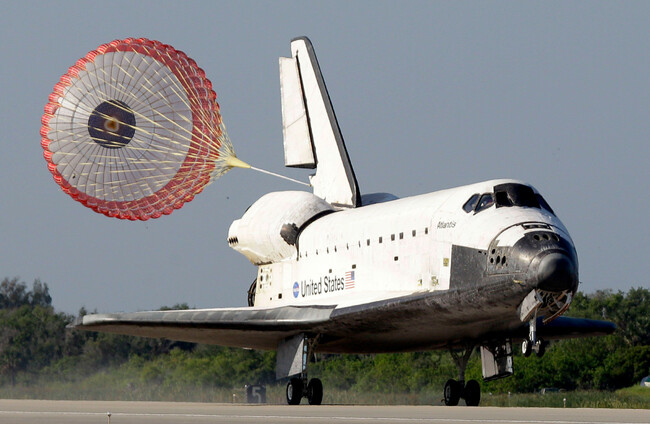
SHANNON AIRPORT WAS proposed as a potential “emergency landing” site for the NASA Space Shuttle after a change in the launch plans for the now-defunct spacecraft some thirty years ago.
According to files released to the National Archives under the 30-year-rule, the Space Shuttle crew may have decided in a chaotic “eight to 20 seconds” that the Co. Clare airport was the safest spot to land.
NASA’s shuttle fleet was retired from service in 2011 after a 30-year programme.
Documents show that the government was approached by the United States in early 1995 about designating the west of Ireland airport as an emergency landing site for shuttle missions.
On 14 March of that year, the US embassy in Dublin wrote to the Department of Foreign Affairs explaining that, as part of “an ongoing review of emergency planning for shuttle launches,” NASA required an “additional emergency landing site.”
The shift arose, the letter said, because the US and Russia were now collaborating on construction of the International Space Station, forcing the shuttle onto a slightly altered launch path — one that brought Ireland into view.
The note set out an “unlikely” scenario in stark terms:
“If there were multiple main engine failures after take off, the shuttle would have to attempt an abort landing at the primary [location] in Zaragoza, Spain.
“If, while taking the action to abort to Zaragoza, the shuttle were to then experience additional engine failure, there would be an eight to 20 second period where insufficient power would exist to get the shuttle all the way to Zaragoza.
In that event, the shuttle could attempt an emergency landing at Shannon Airport.
To reassure Irish authorities, the embassy added that “United States personnel (both US government and contractor) would be dispatched” to recover the shuttle and any “foreign pay-loads” on board in the event of a crash landing.
The document also noted that the US would take any steps required to “safeguard the lives of the astronauts” and was “prepared to assume liability for damage caused.”
Nonetheless, the letter also made clear that Ireland had little room to dispute the request as the country was already part of two celestial agreements, namely:
and
Over subsequent months, officials in the Departments of Foreign Affairs and Transport weighed how to respond. Having ratified both treaties in the 1960s, Ireland was bound to comply, they concluded.
A handwritten note dated just over a month after the US request a Department of Foreign Affairs legal official wrote to a colleague that Ireland was “obliged” to support the request.
On foot of this, the official said that they may need to prepare for the possibility of the shuttle missing its intended landing spot at Shannon.
“We will need to establish a base which will be able to spring into action if an emergency arises, which will contact Shannon ground services to get prepared, which will notify hospital and fire services in case the landing is in a built up area, which will notify and sea rescue and naval services in case it lands in the sea, etc,” the note said.
Despite the concerns, another DFA official subsequently noted after NASA had contacted them about an upcoming launch that the chances of all this happening was unlikely.
“It is our understanding that the possibility of Shannon Airport actually being used as a landing site is a very remote one,” the memo said.
[National Archives document reference number: 2025/124/266}

To embed this post, copy the code below on your site














have your say