Sign in. It’s quick, free and it’s up to you.
An account is an optional way to support the work we do. Find out more.
Sign in. It’s quick, free and it’s up to you.
An account is an optional way to support the work we do. Find out more.
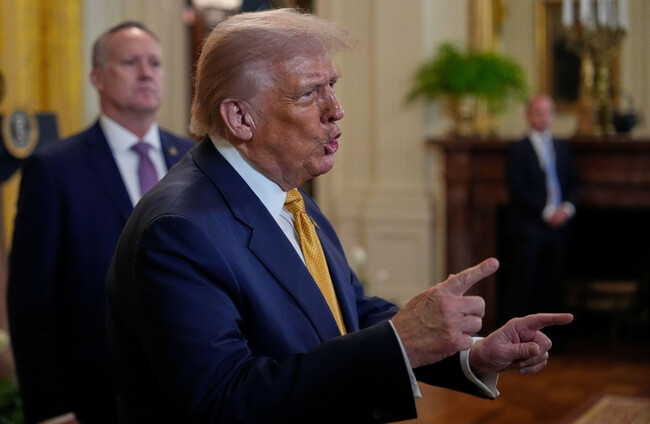
US PRESIDENT DONALD Trump has announced a “massive” trade deal with Japan, marking a key breakthrough for major US trade partners as they scramble to strike agreements before the end of the month.
In an attempt to slash his country’s colossal trade deficit, Trump has vowed to hit dozens of countries with punitive “reciprocal” tariffs if they do not hammer out a pact with Washington by 1 August.
The breakthrough makes Japan one of five countries to have signed an agreement – along with Britain, Vietnam, Indonesia and the Philippines – after Trump promised in April he would get “90 deals in 90 days”.
“We just completed a massive Deal with Japan, perhaps the largest Deal ever made,” he wrote on his Truth Social platform.
He said that under the deal, “Japan will invest, at my direction, $550 Billion Dollars into the United States, which will receive 90% of the Profits”.
He did not provide further details on the unusual investment plan, but said it “will create Hundreds of Thousands of Jobs”.
Later, he wrote: “I just signed the largest TRADE DEAL in history with Japan. We worked on it long and hard — It’s a great deal for everybody…”
Japanese exports to the United States were already subject to a 10% tariff, which would have risen to 25% on August 1 without a deal.
Duties of 25% on Japanese autos – an industry accounting for 8% of Japanese jobs – were also already in place, plus 50% on steel and aluminium.
Japanese Prime Minister Shigeru Ishiba said that the autos levy had now been cut to 15%, sending Japanese car stocks soaring, with Toyota and Mitsubishi up around 14% each.
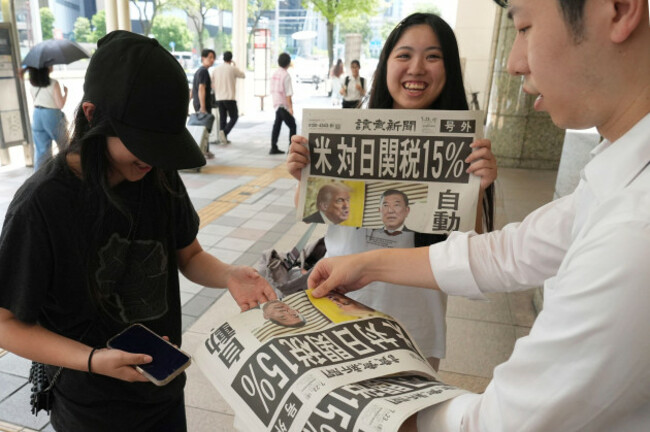
“We are the first (country) in the world to reduce tariffs on automobiles and auto parts, with no limits on volume,” he told reporters.
“By protecting what needs to be protected, we continued the negotiations with an aim to reach an agreement that meets the national interest of both Japan and the United States,” Ishiba added.
“In this agreement with President Trump, I think we were able to realise such an agreement.”
However, Japan’s trade envoy Ryosei Akazawa, who secured the deal on his eighth visit to Washington, said the 50% tariffs on steel and aluminium would remain.
Akazawa also said that increased defence spending by Japan – something Trump has pressed for – was not part of the agreement.
Trump said today that Japan has also agreed to “open their Country to Trade including Cars and Trucks, Rice and certain other Agricultural Products, and other things”.
Rice imports are a sensitive issue in Japan, and Ishiba’s government– which lost its upper house majority in elections on Sunday – had previously ruled out any concessions.
Japan currently imports 770,000 tonnes of rice tariff-free under its World Trade Organization commitments, and Ishiba said it would import more US grain within this.
Ishiba said today that the deal does not “sacrifice” Japan’s agricultural sector.
Tatsuo Yasunaga, the chair of Japan Foreign Trade Council welcomed the trade deal announcement but said the business community needed to see details to assess its impact.
“I highly commend the fact that this major milestone has been achieved and dispelled the uncertainty that private companies had been concerned about,” Yasunaga said.
Naomi Omura, an 80-year-old voter, said it was “disappointing that Japan cannot act more strongly” towards the United States.
Tetsuo Momiyama, 81, said that Ishiba “is finished… It’s good timing for him to go.”
Reports claimed today that he aims to step down soon following the election debacle.
Trump has been under pressure to wrap up trade pacts after promising a flurry of deals ahead of his deadline.
The White House today also laid out details of a deal with Indonesia, which would see it ease critical mineral export restrictions and also face a 19% tariff, down from a threatened 32%.
Trump also said that levies on the Philippines, another close strategic US ally, would be cut by one percentage point to 19% after hosting President Ferdinand Marcos.
But negotiations are still ongoing with much larger US trading partners China, Canada, Mexico and the European Union.
US Treasury Secretary Scott Bessent said Tuesday that he would meet his Chinese counterparts in Stockholm next week.
Leaders of the world’s two biggest economies imposed escalating, tit-for-tat levies on each other’s exports earlier this year, reaching triple-digit levels.
But in talks in Geneva in May they agreed to lower them temporarily until 12 August.

To embed this post, copy the code below on your site









have your say