Sign in. It’s quick, free and it’s up to you.
An account is an optional way to support the work we do. Find out more.
Sign in. It’s quick, free and it’s up to you.
An account is an optional way to support the work we do. Find out more.
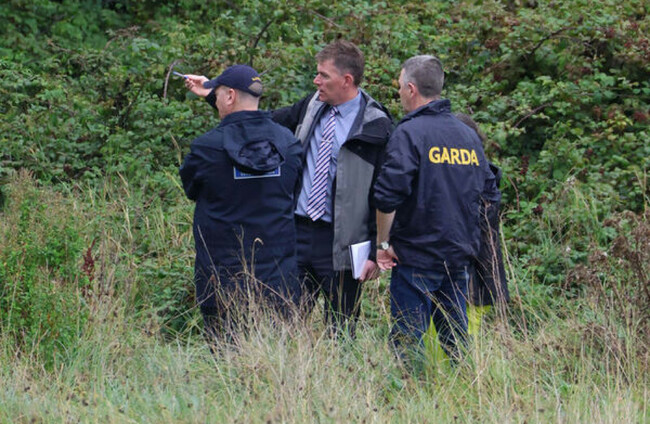

IMAGES FROM DONABATE flashed across all news channels yesterday show members of An Garda Síóchána searching waste ground in North County Dublin.
A grim scene in any news package, but the gardaí in Donabate are looking for clues about something that should be unimaginable. The body of a toddler, not missing a few hours or a few days, but possibly missing for years, who may or may not be buried between the wild high grass and brush.
It should be unimaginable, but it’s all very real because it’s the second time such a scenario has played out in the State in just over a year.
Like any society, there are layers of family life not visible to everyone. Vulnerable children can fall through the cracks of those layers – but Tusla was established to fill those gaps.
It emerged last night that the child and family agency was in contact with the family of the Donabate child, who has yet to be named, before his disappearance. The child had been placed in care but was then sent back to the family.
The Journal understands that Tusla were involved because the boy was classified as at-risk due to dysfunctional family dynamics.
Tusla, which is very rarely far from controversy, will say very little on the matter but there are serious and many questions for the agency: questions about its interactions with the Donabate child, and questions about how he seemingly dropped off the agency’s radar.
The Dublin case has unsettling echoes of Kyran Durnin in County Louth – a vulnerable child supposedly being watched over by the same State agency, but also now missing presumed dead.
Garda detectives in Dublin and Louth are now left with cold investigative trails to find evidence of the truth, years after the disappearance.
The Journal has learned that Tusla had been in contact with Kyran’s school, which he had not attended since a date in 2022.
But beyond the resonance of the case of Kyran Durnin, there are still other cases that come to mind.
Not least, there is the horrific Munster abuse case, in which gardaí, as in the Kyran’s case, were forced to obtain warrants to get access to information because Tusla blocked them because of an interpretation of data retention laws.
The courts have heard how throughout the period of offences in the Munster abuse case in the 2010s, social workers were assigned to the family. One of the victims, a little boy, had come to the notice of various teachers and gardaí who had contacted Tusla to raise their concerns.
But a garda probe found that the abuse continued during this time.
In total, five family members were found guilty by a Central Criminal Court jury on all but one of the 78 counts against them following a 10-week trial held at Croke Park in the summer of 2021. They were all found guilty of sexually abusing multiple children, while the parents were also found guilty of wilfully neglecting five of the children, aged between one and nine at the time.
There are also older high profile cases, that pre-date Tusla, which also highlight how the State’s child protection functions are lacking.
The Grace case from the 1990s represented an abject failure by the State to protect a vulnerable teenager. Just this year, the final report of the Farrelly Commission, which was meant to provide some answers, has been eviscerated by well-informed experts including Special Rapporteur on Children Caoilfhionn Gallagher.
Last year, 19 children known to Tusla died, including four by suicide.
These figures are contained in the 2024 annual report of the National Review Panel (NRP), an independent body commissioned by Tusla but independent of the agency.
The deaths decreased by 10 in comparison to 2023 when the NRP was notified of 29 deaths.
We spoke to sources, many of them gardaí, about their interactions with Tusla.
These discussions painted a picture of exasperated police officers finding no social workers available to deal with emergencies outside of office hours, and of a bureaucracy that stalls time-critical enquiries.
One source said that the protocols for investigators to liaise with Tusla are insufficient, despite there being a 52-page document outlining how it is supposed to work.
While Tusla, in its statements in the wake of the Donabate case, has said it wishes to be transparent with the public, behind the scenes it’s a different picture with sources telling The Journal social workers have been instructed to not speak to the media.
One source said it is a classic case of “protect the brand, limit the scandal”.
Another well-placed source said that the volume of work and the constant turnover of staff at the agency is at the root of many of its failings.
A contact with knowledge of the area said that a lot of case management was disturbed during the Covid-19 pandemic – but other sources have said this should not have impacted the agency’s critical work.
At all levels, these discussions with sources, tell of hard working social workers trying to do their best in an incredibly difficult scenario.
The Health Information and Quality Authority (HIQA) launched a stinging criticism of Tusla in August.
An inspection report by HIQA exposed numerous service delays in the Dublin South Central area.
Cases of children in danger of sexual and physical abuse were found to have been incorrectly rated as low risk or had been not adequately or expeditiously followed up on.
Overall, HIQA found that social services in the Dublin South Central area was understaffed, as the scale of demand continued to challenge the service.
Now an urgent review has been launched into the handling of the Donabate case with Children’s Minister Norma Foley directing Tusla to check in on all active files also.
Those reviews will likely result in recommendations for how the state can better protect children, and raise concerns about governance and systems, just like other reviews that have gone before – but because of the secrecy of Tusla, little is ever said afterwards about what is actually being done to prevent the same thing happening again.
The children in Tusla’s care have a legal and proper right to anonymity, but this shouldn’t be used as an excuse for the veil of secrecy that shrouds this critically important state agency’s work. Or as a useful tool to evade questions.
The Minister for Children Norma Foley is the Cabinet member with responsibility. We await what questions she will ask, and which she will answer.
If you are a social worker or someone working with vulnerable children and want to highlight how the system is working – or failing – get in touch with The Journal‘s correspondents working on this story: nialloconnor@thejournal.ie or eimermcauley@thejournal.ie

To embed this post, copy the code below on your site












have your say