Sign in. It’s quick, free and it’s up to you.
An account is an optional way to support the work we do. Find out more.
Sign in. It’s quick, free and it’s up to you.
An account is an optional way to support the work we do. Find out more.
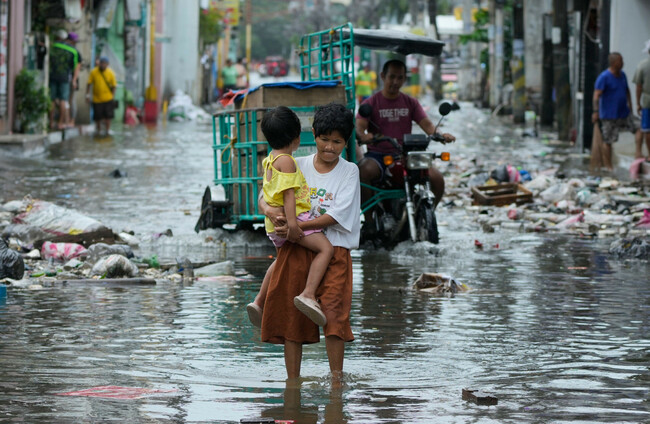
A WEAKENING TYPHOON Fung-wong departed the Philippines over the South China Sea on Monday morning, after its driving winds and heavy rain killed at least two people and forced more than a million to evacuate.
Fung-wong, with a footprint that spanned nearly the entirety of the archipelago, slammed into the country’s eastern seaboard Sunday evening as a “super typhoon” after uprooting trees and swamping towns further south.
It landed just days after Typhoon Kalmaegi swept through the islands of the central Philippines, claiming at least 224 lives.
Schools and government offices across swathes of main island Luzon, including Manila, were closed Monday, though predicted heavy rains had yet to materalise.
In Aurora province, where Fung-wong made landfall the night before, rescue worker Geofry Parrocha said officials were only now able to assess the damage.
“We’re seeing many damaged houses and some of our main roads were not passable due to landslides,” he said from Dipaculao town, where power had yet to be restored.
“We couldn’t mobilise last night because the rain was heavy and the volume of water was high.”
Aurora Taay, mayor of the province’s Dingalan town, told a Facebook Live audience that numerous houses and boats along the shoreline had been smashed amid massive waves.
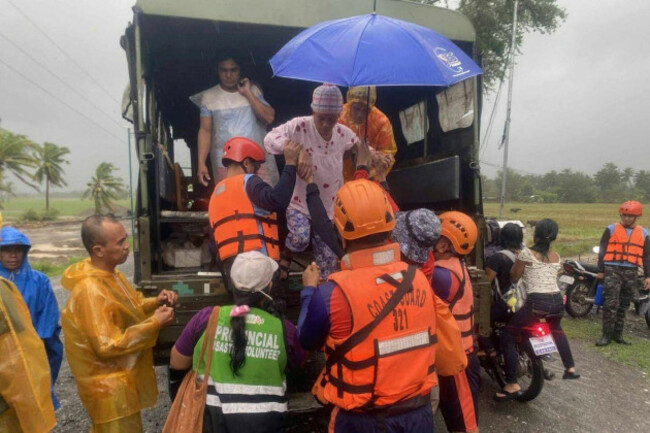
The state weather service said Monday that the typhoon, which saw 1.4 million people evacuated, was now expected to turn towards Taiwan as it continued to weaken.
On Sunday, Samar province, one of those hammered by Typhoon Kalmaegi last week, recorded the first known death from Fung-wong.
Rescuer Juniel Tagarino in Catbalogan City said the body of a 64-year-old woman attempting to evacuate had been pulled out from under debris and fallen trees.
“The wind was so strong and the rain was heavy… According to her family members, she might have forgotten something and went back inside her house,” Tagarino said.
The civil defence office later confirmed a second death, a person who drowned in a flash flood on Catanduanes island.
Further north, in Cagayan province, people sheltering in an evacuation centre said fear of flooding had convinced them to leave their homes.
“We often suffer flooding in our home, so when we were told to evacuate, we evacuated, because we would be trapped,” said Loretta Salquina.
Scientists warn that storms are becoming more powerful due to human-driven climate change. Warmer oceans allow typhoons to strengthen rapidly, and a warmer atmosphere holds more moisture, meaning heavier rainfall.

To embed this post, copy the code below on your site















have your say