Sign in. It’s quick, free and it’s up to you.
An account is an optional way to support the work we do. Find out more.
Sign in. It’s quick, free and it’s up to you.
An account is an optional way to support the work we do. Find out more.
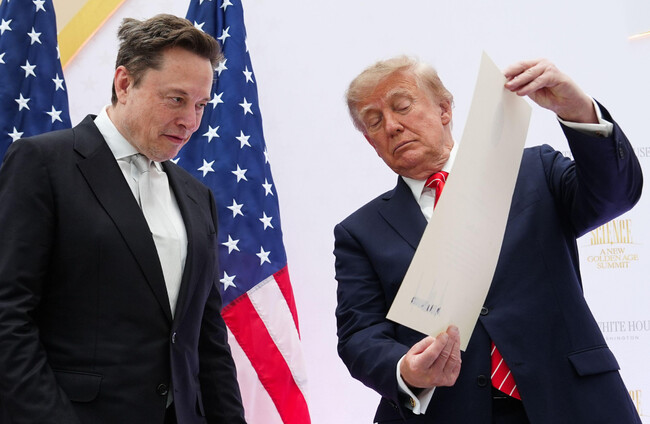
IT WAS A $1.7 billion bet that didn’t pay off.
The US midterms were billed as potentially the most expensive elections in the country’s history, with record spending on Super PACs and ads for candidates in the Senate and House races.
The largest donors were Republican-leaning, with the Washington Post putting GOP-aligned funding at $1.7 billion (€1.52 billion), compared to $832 million (€744.25 million) from Democratic-leaning donors.
However, sweeping victories for the Democrats in the House and Senate races show that voters didn’t follow the money this time around.
The Washington Post’s analysis outlines how 13 of the top 20 individual donors were Republican-leaning.
Two of the remaining seven donors on that list were cryptocurrency firms Coinbase and Ripple, which donated to technically unaligned special interest groups.
The highest donor by far was Elon Musk, who donated $446 million (€398.96 million) to Super PACs – groups which can raise and spend unlimited amounts of money supporting or opposing political candidates – that backed Republican candidates.
Only three other donors broke the $100 million (€89.45 million) mark.
Shipping magnates Elizabeth and Richard Uihlein donated $150 million (€134.18 million) to Republican-aligned groups.
Jeff and Janine Yass, a financier and philanthropist respectively, donated $110 million (€98.4 million) to outgoing Vivek Ramaswamy’s failed campaign in Ohio and other Republican groups.
And George Soros, the billionaire investor, philanthropist and frequent target of conspiracy theories, gave $102 million (€91.24 million) to a Super PAC linked to the Democrats – the only nine-figure donation made to the blue party.
Other familiar names featured among the top 20 donors.
Marc Andreessen and Ben Horowitz, Silicon Valley venture capitalists, gave a total of $92.2 million (€82.48 million) to an AI Super PAC, a cryptocurrency Super PAC and the Trump-aligned Super PAC Maga Inc.
Former New York mayor Mike Bloomberg gave $84.2 million (€75.32 million), mainly to three Democrat-aligned Super PACs.
And the Winklevoss twins – former Olympic rowers who sued Mark Zuckerberg over claims he stole their idea for Facebook – donated $55.9 million (€50 million) to Republican groups, including a Trump-specific Super PAC called Maga Inc.
Some of the biggest spending was concentrated on a handful of closely fought races – the biggest of which was one that Republicans would normally expect to win: Texas.
The Lone Star State has voted a Republican into the Senate since 1988, and the GOP’s candidate Ken Paxton got huge backing from donors to keep it that way.
Data shows that Elon Musk’s America PAC spent millions in an effort to back Paxton’s bid to hold the seat: around $5.9 million (€5.28 million) of that went on supporting his campaign, but that was dwarfed by the $41 million (€36.68 million) spent opposing his ultimately victorious rival James Talarico.
In the same race, the Trump-aligned group MAGA Inc was reported to have spent $10 million (€8.95 million) on ads in September, with a 50-50 split between those supporting Paxton and those attacking Talarico.
It should also be noted that Talarico’s campaign raised significant funds itself; however, his campaign reportedly made $146.3 million (€130.87 million) up to mid-October, compared with Paxton’s $22.3 million (€19.95 million).
Around $139.8 million (€125.06 million) of Talarico’s total came from individual contributions; his campaign said 97% of donations in the third quarter were below $100 (€89), although that referred to the number of donations rather than their total value.
He also benefited from separately funded super PAC support, though that was not included in his campaign’s fundraising total.
Overall, Musk spent around $224 million (€200.38 million) on Republican candidates in the state, including in the governor’s race won by Democrat Gina Hinojosa, who has pledged a statewide ban on data centres.
Texas wasn’t the only race where Musk spent money to back candidates that ultimately lost.
Anti-data centre Democrat Amy Acton won in Ohio, where Musk pledged $5 million (€4.47 million) on her rival Ramaswamy.
Money also poured into races from other curious places.
In that Ohio race for the Senate, Democrat Sherrod Brown won despite extensive spending by cryptocurrency-backed organisations against him.
One estimate suggested that crypto-backed groups Fairshake and the Digital Freedom Fund spent $63 million (€56.36 million) combined opposing Brown’s campaign.
Brown has been a critic of crypto deregulation, once saying that the industry ”has betrayed the public interest”.
Despite a significant spending advantage for Republicans from outside groups, Democrats were able to raise and spend fairly substantial sums on the races they won as well.
In fact, Democratic candidates raised more money than their Republican rivals overall and the Washington Post estimates that their campaigns raised four times as much from smaller donors.
Republicans had an advantage in spending by groups including Super PACs, as well as in advertising funding; however, Democratic candidates raised more money directly for their own campaigns.
There’s also another way that money played a part in the midterms: voters’ pockets.
The elections took place against a backdrop of widespread dissatisfaction with Donald Trump’s handling of the economy and the cost of living.
An Associated Press survey found that around two-thirds of voters believed that Trump’s policies had made economic conditions worse, while about six in 10 said they were very concerned about the cost of food and groceries.
When it comes to donations, there are questions about whether Republican groups spent their money as effectively as they could have.
The AP reported that some Trump-aligned organisations bought advertising time late in the campaign, when rates were considerably higher.
Of course, it’s impossible to know how the races would have played out without the money spent by wealthy donors.
But the results show that their financial advantage was no guarantee of victory.

To embed this post, copy the code below on your site










have your say