Sign in. It’s quick, free and it’s up to you.
An account is an optional way to support the work we do. Find out more.
Sign in. It’s quick, free and it’s up to you.
An account is an optional way to support the work we do. Find out more.
IRISH WATER SAYS there was a “significant and obvious” decline in demand for water in the Dublin region from 1 October — the day water charges were originally due to come in.
However, within two weeks — as the campaign of protest against water charges gathered pace — demand had returned to normal levels.
The water use figures were previously available on the Dublin City Council website — but that facility was removed during the summer as Irish Water took over responsibility for collating the data.
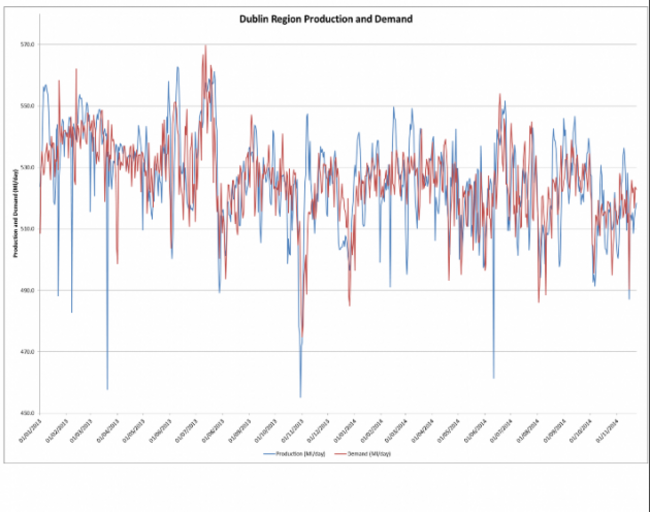
Click here to view a larger version.
The data — which covers the last 22 months — was released to Green Party Councillor Ciarán Cuffe.
In their email to the councillor, Irish Water themselves admit that the media and political focus on the issue may have influenced the water use pattern in October.
An excerpt…
There was a significant and obvious reduction in demand around 1/10/2014 but within 2 weeks this had returned to a more normal demand profile.
The potential influencing factors are:
- Publicity associated with introduction of domestic charges
- General heightening of awareness of water.
- Seasonal weather with quite mild weather (reducing number of bursts – Frost action increases bursts due to ground movement bursting old cast irin mains).
- Seasonal demand associated with increased rainfall ( this allows agricultural users to use rainwater as opposed to mains water)
At this remove it is not possible to determine which factors might have had a more dominant influence.
Changes
The Government had originally planned to introduce domestic charging from the start of October — but under the revised plan, announced on 19 November, charges were deferred until 1 January, with the first bills to issue in April 2015.
The first media reports that the coalition was considering a deferral of the charges only emerged late on 17 November.
A new system of capped charges was also announced as part of the Government’s ‘Irish Water 2.0′ effort — meaning no household in the country will have to pay more than €160 a year for water. The caps will remain in effect until January 2019.
“What this information clearly shows is that despite all the talk from both sides of the water debate about the need for conservation, we are yet to see any reduction in the amount of water that we are using,” Councillor Cuffe said of the Dublin figures.
There was an initial drop in consumption at the instigation of the new charging system, but that effect was lost in the last two months during a period of intense uncertainty about Government policy.
“The change of tack by the Government, with the switch to a flat rate charge, is not going to help conservation efforts.
“The figures also undermine the case of those on the other side of the water debate who argue that we should put the bill on general taxation and that people will have a natural instinct to lower water use.”
Cuffe also called for Irish Water to place full, transparent water use figures on their website. The semi-state said it was something they were looking into.

To embed this post, copy the code below on your site

















have your say