Sign in. It’s quick, free and it’s up to you.
An account is an optional way to support the work we do. Find out more.
Sign in. It’s quick, free and it’s up to you.
An account is an optional way to support the work we do. Find out more.

In this series, journalist and spoken word artist Cormac Fitzgerald travels to a different town or suburb each week to write about the gigs and cultural experiences you rarely see covered by Irish media outlets.
This week’s subject: Weaving a welcome in The Liberties
****
AT ABOUT 4pm on Tuesday afternoon, around the same time that gardaí were tackling and arresting people in Trinity College Dublin, protesting the presence of former US president Joe Biden, and as roads across the city centre were being blocked off to facilitate the arrival of EU leaders, a group of people were in a brightly lit room in The Liberties weaving together.
The group were practicing what is know as Alool weaving, a form rooted in the nomadic Somali tradition. Strips of textile material – in this case, waste wool from places like Botanic Weavers, Avoca Handweavers and Foxford Woolen Mills in Mayo – are woven lengthwise around upright sticks to create the colourful “walls” of a living room.
As traffic trundled past outside, pedestrians stopped to look in through the glass at the strange sight before them. Some carried on walking, but others were beckoned into the space, where they were warmly welcomed by those inside and invited to take part in the work.
The weaving was being led by Saada Osman, a Somali woman and a member of the Higsad Alool Weavers, who lives and works as a community organiser in Sheffield in England. Osman has worked with a local artistic group The Bare Project for the past three years to weave a living room outside on a busy shopping street in Sheffield, inviting members of the public to join in.
Called Common Threads, the project emerged out of conversations and workshops led by the Somali community in Sheffield, and sought to provide a safe, open space in which people could gather together.
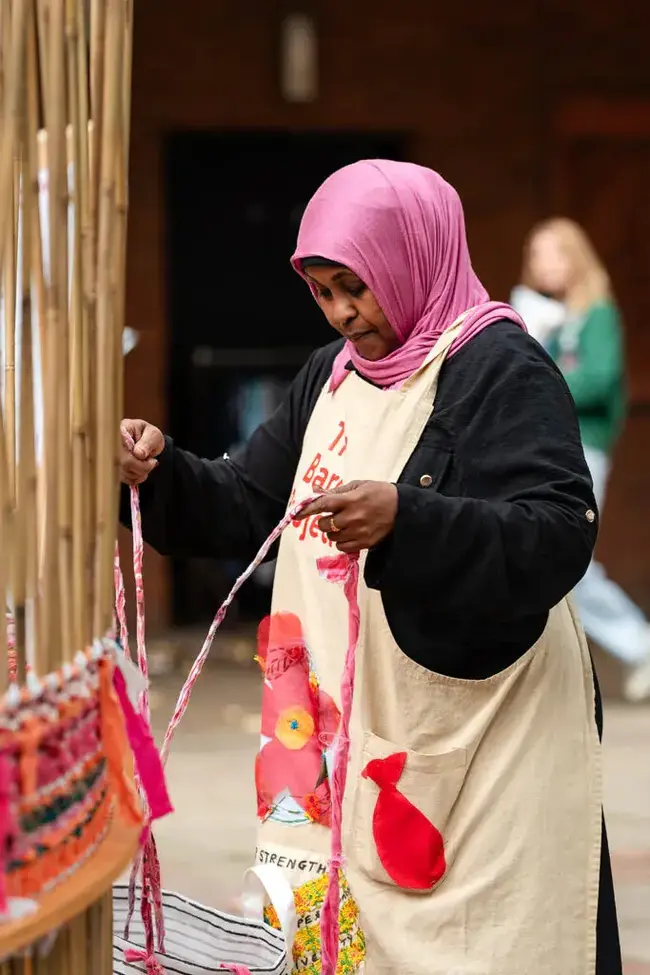
“And then we can do the different things inside the living room,” said Osman, taking a short break from the weaving.
“We can do different workshops – the artist workshops, storytelling, singing, eating food. Yeah, so it’s now like a gathering place for the people, somewhere to stay.”
Then, at the end of the festival, the room is taken apart again, leaving no trace.
According to Malaika Cunningham, artistic director with The Bare Project, Common Threads has been a great success, with members of the public from all walks of life gathering on the busy shopping street to weave, talk, sing, dance and eat together.
“There is something special about moments in the city centre that are not about buying something,” she said.
“Like, there’s moments of exchange in the space where people are just speaking to each other. And I’ve had so many conversations with strangers.”
It was this open, welcoming attitude, this invitation from strangers to strangers to come and share a space, that inspired artist Jennie Moran to invite Common Threads to bring their project to the gallery space of the National College of Art and Design in The Liberties, where it has been for the past three days.
Moran’s practice involves making use of hospitality to facilitate shared connection between people and groups.
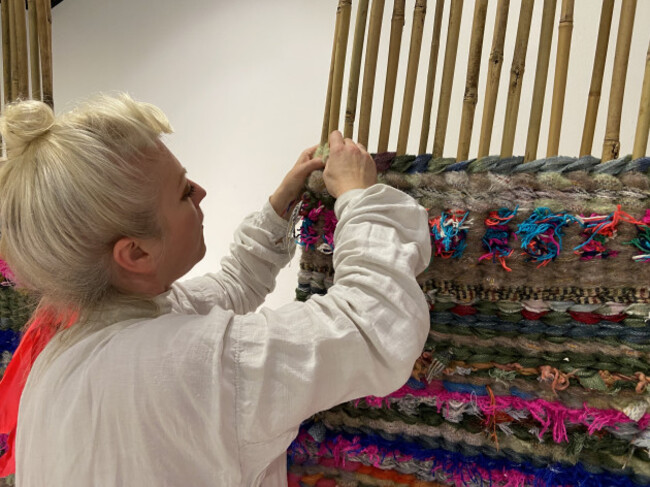
She worked for years running the café at NCAD, called Luncheonette, providing cheap, delicious meals to students and anyone else who happened to wander in off the street (which I did, a fair few times), and she is currently undertaking a residency at NCAD Field, a wild field that grows on a vacant site near to the college.
She is fully immersed in the theory, philosophy and practice of hospitality.
“I am always talking about hospitality not as an industry or not as anything related to hotels… but this crazy ill-advised system that humans in every single corner of the earth have created for welcoming strangers,” she said.
“And I find that really particularly urgent to think about now, when we’re all hoarding stuff, to remind us about an alternative methodology that we do have, by telling stories and talking about hospitality.”
This iteration of Common Threads is the first time it has taken place outside of Sheffield. It is indoors (because it is November), but the brightly lit space and floor to ceiling window tries to offer the same welcome to people to join in.
Moran visited the living room in Sheffield and was struck by how it put into practice the kind of open radical welcome to all people that she was focussed on.
“It’s incredible to have something like that in a city that anyone can drop in on,” said Moran, “you don’t have to book, you can just turn up and do a bit of weaving and contribute and give time.
“There’s a hospitality that we often associate with sharing space with someone, or letting someone into your space. But actually now we’re so we’re so stretched for time, and we’re so busy that in fact one of our most precious resources that we can give is our time.
“So for people to offer time to collectively do something like that together, which is making a shelter… I find that very profound.”
And had the experience been good in Dublin so far?
“Yeah, pure joy,” said Moran.
“Yesterday we were building and setting it up and starting weaving, and then the expectation of how much we would get woven yesterday was pretty low.
“But it was really busy with students and a lot of people coming on their own, and it’s lovely because you can just drop in for a few minutes, or some people were here last night for about two hours.
“These two friends were catching up with each other just while weaving, and they spent the whole evening there, and that was beautiful.”
Walking around the space as it came together, there was laughter and easy conversation. I was offered herbal tea and a big, delicious date.
Everyone was smiling as they worked. I even tried my hand at a bit of weaving myself with some help from Malaika Cunningham, and to my surprise the whole structure didn’t immediately collapse.
The three-day “gentle festival of welcome”, as it’s called, involved a number of different talks and events in the living room as it was being woven.
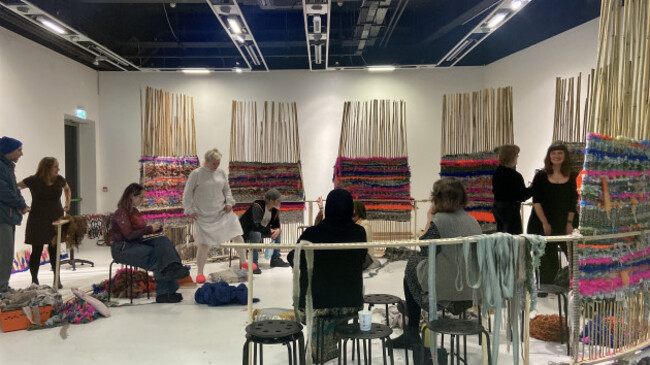
The three-day “gentle festival of welcome”, as it’s called, involves a number of different talks and events in the living room as it is being woven.
As I was getting ready to leave, the Traveller storyteller Oein de Bhardún was sitting in the middle of the space to begin telling stories of his own nomadic tradition.
Protests were ongoing in Trinity, roads were closed up and down the city, and every day it feels the world is closing itself off more and more. But for little while on Thomas Street, the door was open for anyone who wanted to come inside.
To embed this post, copy the code below on your site












have your say