Sign in. It’s quick, free and it’s up to you.
An account is an optional way to support the work we do. Find out more.
Sign in. It’s quick, free and it’s up to you.
An account is an optional way to support the work we do. Find out more.
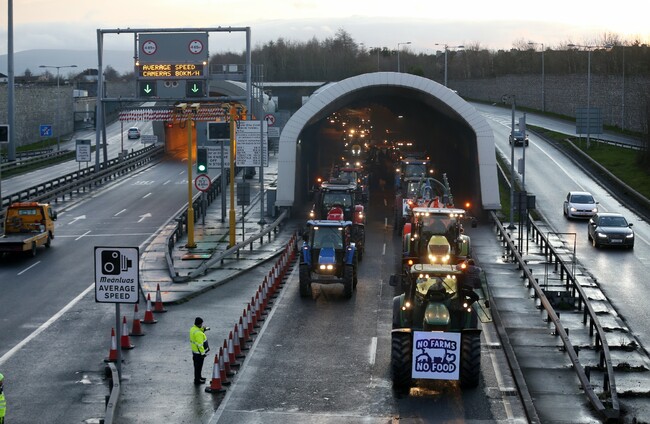
FARMERS DESCENDED ON Dublin city centre this week for the latest in a series of protests calling for reforms within the beef sector.
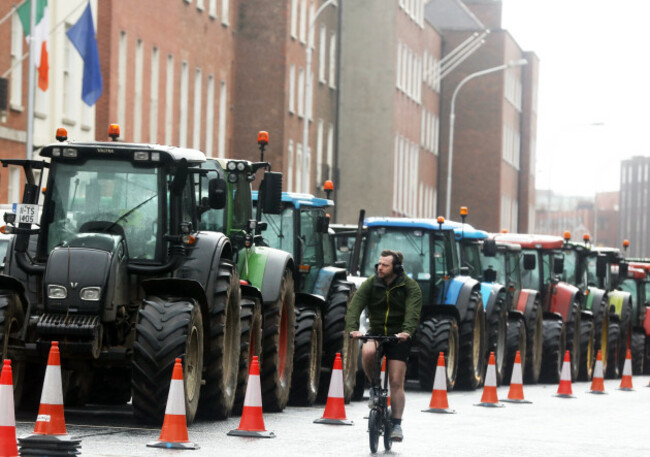
It follows weeks of blockades by farmers outside meat processing factories last summer, and a similar protest back in November when dozens of farmers arrived on tractors in the capital causing widespread disruption and shutting down streets.
For the past two days, the streets around Leinster House and St Stephen’s Green were closed to traffic, and farmers continued their protest at Dublin Port yesterday afternoon before they began a “slow protest” along the M50 as they left Dublin.
A beef task force was established by the Government following discussions with farming and industry representatives in September.
It has met twice in the past two months and despite a commitment to continue talks from both the farming community and meat processors, some farmers insist progress is too slow and they will continue to fight for a better deal.
Wexford farmer, Kevin Murphy told TheJournal.ie that farmers feel the beef task force is “a talking shop. It’s just all meetings, meetings, meetings” and further “civil disobedience” will be planned for the coming months.
So as the farmers continue to voice their concerns around beef prices and the impact on of carbon taxes on them, and with a general election just weeks away, we’re asking: What’s next for the farmers and will there be more protests?
The task force
The beef task force, established last September following weeks of negotiations between farming and industry reps, was proposed to be the solution to the long-running dispute.
It included representations from all stakeholders including the Department of Agriculture, meat processors, retailers and farmers.
It was part of a broader agreement that involved a reviewed bonus structure which set out how much farmers would be paid based on the age and weight of their cattle.
It also promised the commissioning of two reports into pricing, and a promise to keep the beef sector under review to ensure farmers would get a fair deal.
But that hasn’t solved the problem in the way farmers and their supporters expected, and plans are afoot to continue protesting in a bid to catch the attention of politicians who will be campaigning for votes ahead of polling day on 8 February.
“They don’t ask the ordinary Joe Soap if this is working for you on the ground,” James Thompson, a farmer from Kildare said.
“They don’t ask ‘have you a living wage out of it?’… so until the politicians wake up and listen to their voters and to the people it affects, we’ll be back day in, day out again.”
In response to the protests this week, Agriculture Minister Michael Creed said: “I am very aware that the beef sector has experienced very challenging times with a sustained period of low prices, Brexit uncertainty and difficult market conditions – which is why this Government is deeply committed to supporting and developing Ireland’s beef sector.
“I want to see a very strong, robust and viable suckler sector that delivers a reliable and good income for farmers,” he added.
‘Last resort’
Farmers speaking to TheJournal.ie said they did not want to continue protesting but felt they had no other choice, claiming their voices were not being heard at government level.
“These protests are definitely not for nothing. We have more to be doing than up here in the city annoying the people of Dublin,” John Bawle, of the Individual Farmers group said.
Bawle said the protests over the past two days didn’t have the impact farmers wanted and when the Dáil returns following the general election, further protests will ensue.
“It didn’t have the effect that we wanted it to have because the Government wasn’t sitting, it’s as simple as that and it wasn’t possible for us to call it off because there was tractors going to Dublin when the Government stood down.
“Yesterday, we didn’t get what we wanted by coming to Dublin because the Government was gone to the hills.
“Now we go home and have to have a rethink of what our next step is but whoever is sitting in government in a few weeks time, we’re not going away because we have nothing left to lose.,” he added. ‘There could be 300 or 400 tractors here at any time in six weeks time.”
Farmers also warned that the protests could spread further than the areas around Leinster House, suggesting that other State agencies could be targeted, as well as business premises.
As farmers, who travelled from counties including Cavan, Monaghan and Wexford, returned home on their tractors, yesterday evening, they vowed to return in the coming months.
The onus will lie with the next government to pacify concerns and avoid further widespread disruption in Dublin and surrounding areas.

To embed this post, copy the code below on your site












have your say