Sign in. It’s quick, free and it’s up to you.
An account is an optional way to support the work we do. Find out more.
Sign in. It’s quick, free and it’s up to you.
An account is an optional way to support the work we do. Find out more.
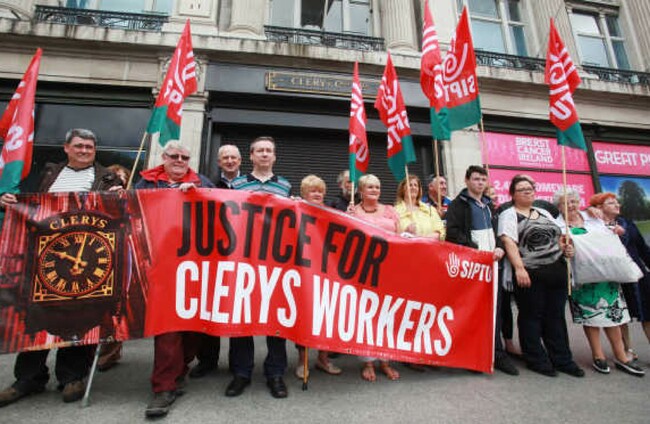

ON 12 JUNE 2015 the 130-strong workforce of Clerys was sacked without notice, with another 330 workers employed by the store’s concession outlets locked out of their jobs and facing an equally uncertain future.
The company that owned Clerys had been bought by Natrium sometime between midnight and 1.15am that day and declared insolvent that afternoon.
The workers did not receive the statutory redundancy lump sum from the new owners, nor were they paid monies owed in lieu of notice of redundancy and holiday pay.
The State was therefore obliged to pay those debts under the Insolvency Payments Scheme.
While none of this was illegal, it was obviously patently wrong.
Public outrage ensued, with the leaders of all the main parties, government and opposition, as well as independents, all condemning the closure and saying that something needed to be done.
Changes to the law required
Then-Junior Minister at the Department of Jobs, Enterprise and Innovation Ged Nash commissioned a report into the closing of Clerys.
It was written by Nessa Cahill BL and Kevin Duffy, Chairman of the Labour Court, and they presented their findings on 26 April this year.
I have drafted a Bill that would give legislative support to the main recommendations in that report.
It would provide protection for employees in collective redundancy situations where the employer is insolvent. It would give power to the High Court to return assets which have been improperly transferred and give preferential creditor status to employees. It would also require a 30-day consultation period in cases where it is known that a company’s liabilities are such as to trigger redundancies.
Looking for cross-party support
Although the bill has been drafted and is ready to go, I have not yet moved it.
Instead, I have sent a copy to all the major parties and groupings to seek support.
I also sent a copy to Patricia King of the Irish Congress of Trade Unions, asking that the congress facilitates cross-party discussion with a view to making this an all-party bill.
We are open to discussion and to working with others to perfect the legislation.
We have seen in this Dáil that parties and groupings are willing to support motions and bills that speak to the rights of employees.
We saw it with the Labour motion on workers’ rights, and with my own bill on banded hours which was passed by the Dáil, albeit delayed for 12 months.
Together we can produce legislation that will tackle the scandal of tactical insolvencies and protect the rights of people who have worked all their lives and who expect, with good reason, to have their hard-earned pensions protected.
If we are really to have new politics, this is a way of showing it.
David Cullinane is the Sinn Féin TD for Waterford and is the party’s spokesperson on workers’ rights.
To embed this post, copy the code below on your site














have your say