Sign in. It’s quick, free and it’s up to you.
An account is an optional way to support the work we do. Find out more.
Sign in. It’s quick, free and it’s up to you.
An account is an optional way to support the work we do. Find out more.

ALTERNATIVE FOR GERMANY’S success in the state of Saxony-Anhalt was predictable, given the far-right party’s consistent rise in the polls over the last few years, but the scale of their vote share in Sunday’s election came as a surprise.
Polling had projected the party would get 40 to 42% of the vote. In the end, it won just under 44% in the state of roughly two million people.
AfD was seeking an absolute majority in the state legislature so that it could get past the so-called firewall of mainstream parties that refuse to work with them.
They fell three seats short, with 39 members in an 83-member parliament. There remains a path to power for AfD in the eastern state, though, since one party that has criticised the firewall unexpectedly picked up five seats of their own.
So how did a party with documented ties to neo-Nazis manage to come out on top in a part of Germany once ruled by the Soviet Union?
One of AfD’s flagship policy proposals is “remigration”, a far-right plan to ethnically cleanse European countries of non-white people.
The idea comes from “Identitarianism”, a pan-European white nationalist movement whose lead advocate is an Austrian activist and former member of a neo-Nazi group named Martin Sellner.
AfD politicians have sought to distinguish their party’s interpretation of remigration from that of Sellner’s, although they use the same term.
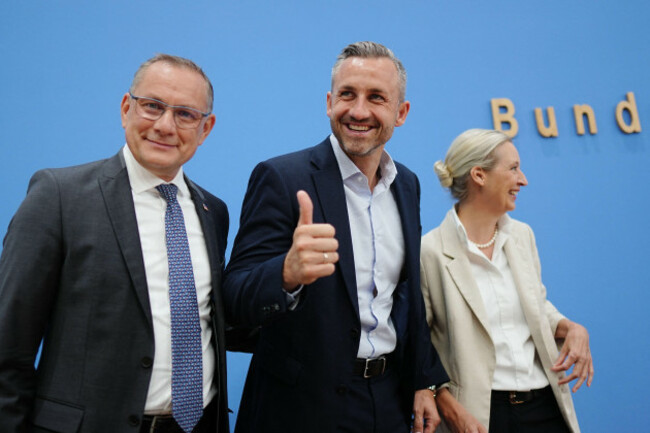
The party’s leader in Saxony-Anhalt, Ulrich Siegmund, has said he wants to target irregular migrants with a “remigration and deportation offensive” from day one.
The attendance of AfD politicians, including Siegmund, at a secret meeting about remigration where Sellner was the keynote speaker, is one reason why Germany’s national security service has categorised the Saxony-Anhalt branch of the AfD as part of a right-wing extremist group.
Sellner’s version of remigration would see not only the deportation of immigrants without legal status, but also non-white legal immigrants and their European-born children.
AfD also has a favourable view of Vladimir Putin’s government in Russia, and has said it would remove refugee status from Ukrainians in Germany.
The party is also outrightly anti-Muslim, saying it would ban the call to prayer, minarets on mosques and the wearing of the burka.
AfD has also touted its “anti-woke” agenda, which includes vows to replace LGBTQ pride rainbow flags at public schools with German ones.
Siegmund also wants to stop school attendance being compulsory and rewrite school history books, which focus too much on the crimes of Adolf Hitler’s Third Reich for his liking.
Four members of Siegmund’s inner circle were members of a now-banned organisation that modelled itself on the Hitler Youth, despite former members of the Homeland-Loyal German Youth being officially barred from joining AfD.
There were a couple of elements that marked AfD’s campaign in Saxony-Anhalt as different from those the party has run before, according to historian and journalist Katja Hoyer.
“The campaign was new and different,” she told The Journal, explaining that AfD’s rhetorical approach has traditionally been more of an “angry” one.
The party used to use slogans like “Enough”, but this time round its campaign slogan was “Everything is possible”.
She also said that in the party’s regional leader Ulrich Siegmund AfD have found someone who is genuinely popular by himself, rather than simply being a part of a popular party.
A former perfume salesman, Siegmund (35) was originally a member of the Christian Democratic Union (CDU) party, which is currently led by Germany’s chancellor, Friedrich Merz.
He switched to AfD at the age of 24 and entered the Saxony-Anhalt parliament two years later.
As one of AfD’s most recognisable representatives and a kind of poster boy for the party, Siegmund’s popularity is undeniable.
He has hundreds of thousands of followers across multiple social media platforms and during a campaign event last week people queued for hours to get his autograph.
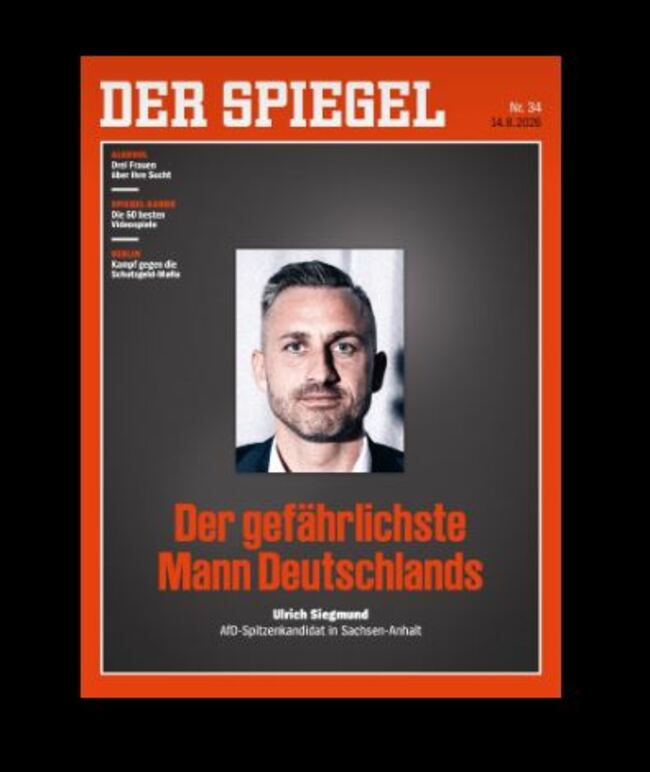
Many brought copies of the front page of an edition of the weekly news magazine Der Spiegel that labelled Siegmund “Germany’s most dangerous man”.

Another feature of the campaign was a two-sided approach to the eastern state’s communist history, which Hoyer said was distinctively “regional”.
On one hand, she said, AfD cast their campaign as a political revolution like the one against Soviet rule that brought down the Berlin Wall.
“We fought a dictatorship once and we can do it again,” she said, summarising that aspect of the campaign.
But on the other hand, she said the party also tends to use “people’s positive experiences as well”, tapping into their regional identity.
She said AfD is “internally quite split” along eastern and western lines and that the party takes a different tack depending on where they are seeking election.
One campaign stunt featured Siegmund at the head of a motorcade of thousands of supporters riding Simson mopeds, a model known as the “Vespa of East Germany”.
The adoption of the Simson bike as a campaign symbol has been criticised by the descendants of the original Jewish owners of the company who were forced to flee the Nazis.
AfD is more popular in the former Soviet east of the country than it is in the west, but according to Hoyer states like Saxony-Anhalt are “just ahead of the curve”.
Nationally, AfD is the most popular party – currently polling at 27.6% – and the main rival to the woefully unpopular CDU, which is lagging six points behind.
CDU leader Merz admitted today that his party had its worst election result in decades at the weekend, picking up just 15 seats.
Merz himself is very unpopular and acknowledged today that his own standing among the German public contributed to the CDU’s losing about half its previous support over the weekend.
“I know that I personally was a constant topic in this election campaign. We know that the reforms were a constant topic in this election campaign,” he said.
Siegmund said Merz had been “a very good campaigner for us in this election campaign”.
With the parliament seats now filled, all eyes will be on negotiations over the formation of a state government, which Siegmund said today are already underway.
The Bündnis Sahra Wagenknecht (BSW) party, which Hoyer described as “fundamentally an anti-establishment party”, has been critical of the firewall maintained by all other established parties in the past.
Founded in 2024 as a breakaway from The Left party, its politics are economically left but socially and culturally conservative, which Hoyer described as “a very east German thing”.
She said they could “potentially” lend their votes to AfD and therefore give a far-right party governing power in a German state for the first time since World War II.
With reporting from AFP

To embed this post, copy the code below on your site













have your say