Sign in. It’s quick, free and it’s up to you.
An account is an optional way to support the work we do. Find out more.
Sign in. It’s quick, free and it’s up to you.
An account is an optional way to support the work we do. Find out more.
(Seo alt ónár bhfoireann nua Gaeltachta. Is féidir an bunleagan as Gaeilge a léamh anseo)
IT WAS A strong year for Irish-language theatre and An Taibhdhearc, the national Irish-language theatre based in Galway, is aiming to reach more people in 2026.
That’s according to Muireann Kelly, the artistic director of An Taibhdhearc, when she was speaking to The Journal about the year just gone.
“An Taibhdhearc produced five shows this year. We went on tour in May with the show Dathanna Geala Amháin and we travelled around the country, from Gweedore to Belfast and down to Dublin, and audiences turned out,” she said.
“I think there is now a strong interest in Irish-language drama because of things like An Cailín Ciúin (A Quiet Girl), but the quality has to be high and there must be clear engagement between the audience and the theatre.”
An Taibhdhearc is working on accessibility measures such as providing live subtitles for audiences and including Irish Sign Language (ISL) interpretation as part of their productions, in hopes of reaching a broader audience.
“As a national theatre, we must be open and the work on stage must be accessible to everyone,” Kelly said.
“We’ve started using the Sibrwd app, which was developed by Theatr Cymru in Wales to provide subtitles. It’s very easy to access on your phone and you can get a live translation of the dialogue happening on stage in real-time.
“An Taibhdhearc belongs to the people of Galway and to the people of Ireland, just like the language itself, and we are trying to give people the opportunity to come and support us.”
An Taibhdhearc is not only trying to attract new audiences, but also hope that artists will want to come and work with them as well.
“We want to develop artists and provide opportunities for people to be able to work through the medium of Irish in the arts,” Kelly said.
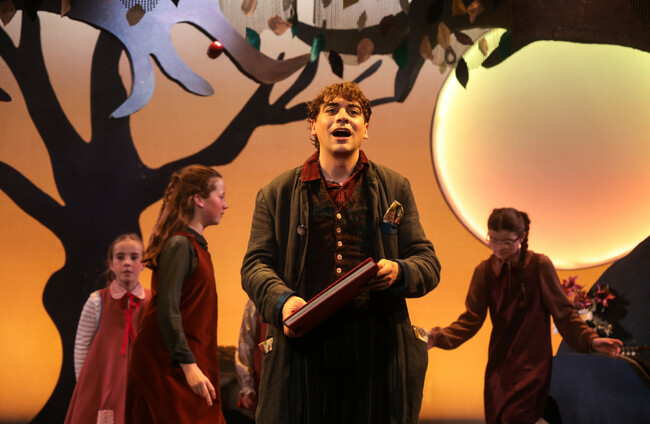
An Fathach Leithleasach was the final show An Taibhdhearc staged this year — a translation of Oscar Wilde’s fairy tale The Selfish Giant which was translated by Bríd Ní Dhonnacha, a writer from Connemara.
The story is about a grumpy, selfish giant who drives children out of his beautiful garden, and his life is turned upside down afterwards.
“We wanted all the colours that are in the story to exist in Irish — words like smóilín (meaning little darling), for example — and for them to be heard on stage. I think Bríd did an excellent job with that,” Kelly said.
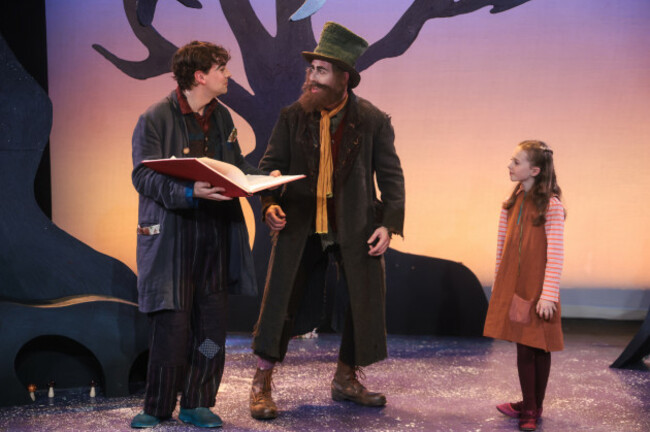
“When the children came in to watch the play, they were asking questions about what Fathach meant, and it’s likely they didn’t know that word beforehand.
“But when the character Oscar, the narrator, began reading the story, the children were learning and shouting out in response to what was happening on stage. They were completely absorbed in the story.”
Many children were part of the cast on stage, as well as several adults, and drama workshops were held in November to bring the group of actors together.
“I am very hopeful that the children who took part in this production will want to be writing and performing on stage in the future,” she said.
“They are the next generation, and it is important that they have inspiration to work in the arts. I hope that inspiration came from An Taibhdhearc.”
The Journal’s Gaeltacht initiative is supported by the Local Democracy Reporting Scheme

To embed this post, copy the code below on your site












have your say