Sign in. It’s quick, free and it’s up to you.
An account is an optional way to support the work we do. Find out more.
Sign in. It’s quick, free and it’s up to you.
An account is an optional way to support the work we do. Find out more.
LAST UPDATE | 23 Jan 2024
OLIVER BOND HOUSE residents in Dublin city have said that many have “given up” in trying to remedy damp and mould issues in their flats, as a new study has shown that people in the complex are almost twice as likely to have asthma.
“The council keeps saying that residents won’t let them in to fix the mould, but that’s because they just want to put up more plasterboards that will only work temporarily, and will make the rooms smaller by bringing the walls in by three inches, they aren’t offering real solutions,” life-long resident Natasha O’Keeffe (51) explains.
A study has found that residents of the Oliver Bond Flats in Dublin city are 1.9 times more likely to have asthma as other patients in the same GP practice as them.
The research from Trinity University College follows on from an earlier report that showed over one in three residents had experienced sewage problems, over 30% had water coming into their homes, 83% are living with mould and damp, and over 55% have been told by a medical practitioner that damp, mould or sewage is contributing to ill-health in their families.
The complex was built in 1936 and consists of 391 apartments in 14 blocks, making it one of the largest in Dublin city.
Gayle Cullen, the chairperson of the Oliver Bond Residents’ Group, said that people in the flats are “literally sick waiting, physically and mentally”.
She explained that it is “impossible” to keep the flats warm due to “ill-fitting windows”.
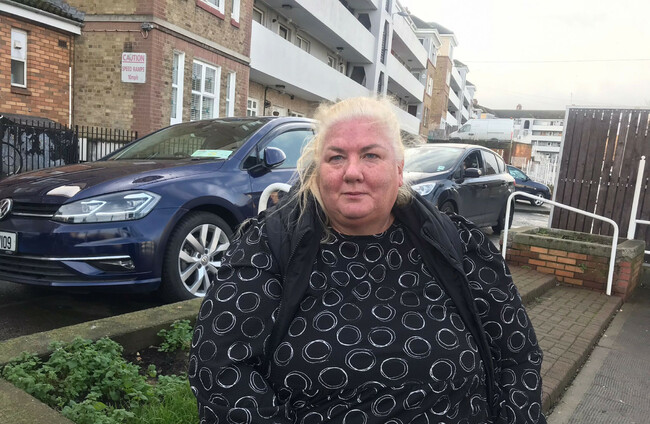
Gayle and Natasha were amongst a handful of residents that stood out on the football pitch at the complex today, in wet and windy weather, to speak about how their living conditions are affecting their health.
Gayle said that while “fancy housing complexes and student accommodation” is being invested in across Dublin city, the “thriving, inner-city community” in Oliver Bond House is being left “to decline”.
Natasha said that most people are “embarrassed” to speak about the conditions they are living in.
“They don’t want people thinking they aren’t clean, or they won’t put money into the flats themselves. A lot of us have put money in, and then it is no use, because the damp keeps coming back,” she explained.
Natasha lives with her partner, her two adult daughters and her 20-month old granddaughter in a two bedroom flat in the complex. Her mother and father also lived in the complex for years.
She loves living in Oliver Bond, but says that she is struggling with breathing problems that a doctor has said are related to the damp in her home, and she is also worried about the amount of times her granddaughter has fallen ill.
“I couldn’t tell you how many antibiotics she’s been on,” she says.
Her flat is next to a staircase – called a shoot in the flats.
“Water comes down them and it ends up in your house. We have vents installed in the front now that are basically holes you can just put your hand through, it means the flats are freezing and impossible to heat,” she said.
Sinead Moran and Edele are sat on a wall outside of the football pitch, watching on as an academic gives a presentation on building solutions.
“No one from Dublin City Council is here though,” Sinead notes.
She brought a case against the council last October over the extent of mould in her flat. The damp was so extensive that her mattress was black with mould.
The judge in the case ruled that she was living in conditions that were unfit for human habitation.
“There were big holes in the bathroom a rat could just run through,” Sinead says.
Now, she has been moved into temporary accommodation while the council carries out essential repairs to her flat.
“I kept washing down the walls and repainting it, but the black mould always came back. I’m in a respiratory clinic now for my breathing problems, I know that the flat has done that to me,” she said.
Mum of two Edele has also lived in Oliver Bond House her entire life. She was living in a one bed apartment with her two kids, a girl and a boy now aged 6 and 8, before she secured a transfer into the two bed flat she’s in today.
“I was like a dog with a bone, because that is the only way you’ll get it. The flat we’re in is my cousins old place. It’s been worked on recently by the council, but already, I have to put up those damp bags in the window around my little boy’s window. The condensation is crazy every day,” she says.
Gareth* lives in a small apartment on one of the top floors in a block within the Oliver Bond complex. When you walk into his flat, the smell of damp is immediately evident.
He has been living in these conditions for ten years, and has been raised the issue of his living conditions with the council multiple times. The damp is so extensive that the insides of his kitchen cupboards’ are blackened with it. His older sister cooks for him and drops in meals when he gets home from work.
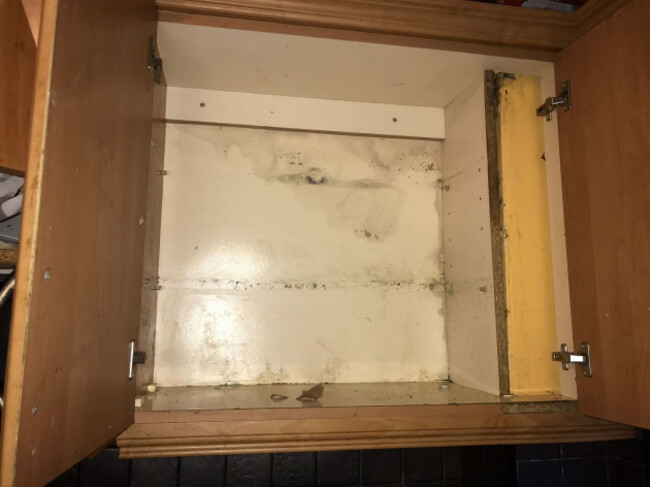
“The damp drips down the walls. It’s come out of the sockets before. I can’t cook anymore because the extractor fan fell down and smashed the hob. That’s expensive to replace, we told the council about it, but nothing has been done,” he said.
“I have sneezing fits in this place, and I’m on the inhalers. My kids are older now, but they don’t like coming in here because of the damp. You don’t like having people think it might be your fault. I work, and I pay €650 euro.
“I spent thousands having the electric fireplace put in, and I tried and get rid of the mould, but nothing I did worked. I am years waiting on a transfer – I need to get out and into a different place,” Gareth said.
His sister Catherine said that she worries about the impact of the conditions Gareth is living in on his health.
For many in the Oliver Bond flats, better living conditions isn't just a matter of scrubbing off mould - although they're doing that on repeat. One man who works full time and pays €650 per month in rent has had water dripping from plug sockets. He says the damp is relentless. pic.twitter.com/wyorbMakWf
— Eimer McAuley (@eimer_mcauley) January 23, 2024
“My kids don’t even like me going in there because of it, but I make sure he is okay. He comes home from a 12 hours shift and that’s what he has to come back to, and what he’s paying to be in,” she said.
New research on health outcomes
The ‘Respiratory Health Among Residents of Oliver Bond House’ report also found that 34% of residents have problems with pest infestation, and that 64% don’t have access to bins that are free of vermin and pests.
Rose Wall, the CEO of the free legal advice service Community Law and Mediation, said that the “substandard living conditions” that residents are living in shows the need for proper enforcement of local authority obligations, and a stronger recognition of the right to adequate housing in national legislation.
“Adequate housing that is, at a minimum, fit for human habitation is fundamental to the vindication of other rights such as the right to health and the right to a healthy environment,” Wall said.
Austin Campbell – one of the study’s authors – said that the research does not “prove” that the living conditions at the flats are “causing” asthma, but it does show that there is an increased instance of the condition amongst residents.
The study was produced in collaboration with the Robert Emmet Community Development Project.
Dublin City Council has committed to a long-term regeneration plan which will “transform and modernise” the Oliver Bond House complex.
*Gareth and Catherine have been give different names to maintain their anonymity.
To embed this post, copy the code below on your site













have your say