Sign in. It’s quick, free and it’s up to you.
An account is an optional way to support the work we do. Find out more.
Sign in. It’s quick, free and it’s up to you.
An account is an optional way to support the work we do. Find out more.
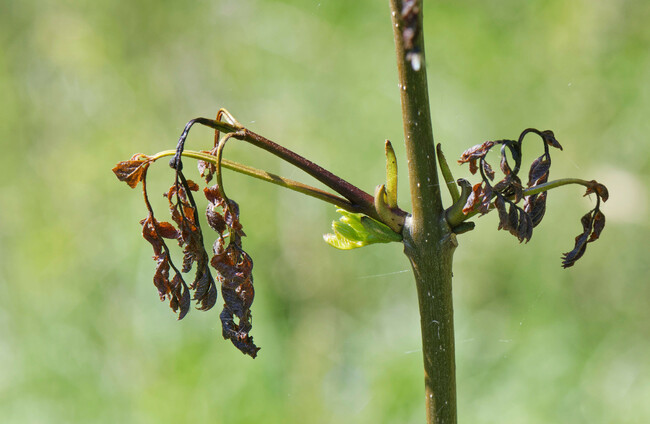
AN INDEPENDENT REVIEW into the government’s response to ash dieback disease has labelled the issue a “national emergency requiring a national and State-led coordinated response”.
Ash dieback is a serious disease of ash trees that is caused by the fungus Hymenoscyphus fraxineus.
The disease first emerged in Europe in the 1990s and has spread across the continent via wind-borne spores and the transportation of infected young trees.
Ash trees have been monitored in Ireland since 2008 and the disease was first detected in 2012.
It’s believed that the disease came to Ireland via infected saplings.
Once the fungus infects a tree, the dead or dying branches become brittle and fall.
Over time, the tree loses nutrition, water and the leaves which produce its food, which ends up killing the tree.
The disease now affects approximately 16,000 hectares of ash forests in Ireland.
The independent review of the Department of Agriculture’s response to ash dieback disease was established by Minister of State for Land-use and Biodiversity, Senator Pippa Hackett, in June.
Its purpose was to review the existing and previous supports available to landowners with ash plantations which are now infected with the disease.
The Independent Review Group report stated that there “is an acceptance that the disease is irreversible and that the action required is the urgent clearance of the diseased woodland”.
The Department opened two reconstitution schemes, one in 2013 and the other in 2020, to assist affected owners by covering the costs to clear and replant trees on their sites.
Earlier this year, site clearance rates were doubled to €2,000 per hectare.
To date, €10 million has been spent on these schemes.
However, today’s report said “speed and urgency is of the essence” to “reduce the risks associated with large numbers of dead and dying trees”.
The report outlined 13 recommendations for action and Senator Pippa Hackett said she is “now working with my officials to implement its recommendations”.
Hackett noted that “a number of the recommendations are already in hand” but added that some recommendations require “further examination and investigation”.
Hackett said this is of particular importance “in the context of the application of EU State Aid rules”.
One of the report’s recommendations is that “ash dieback needs to be treated as a national emergency requiring a State-led national and rapid coordinated response”.
This would involve establishing a task force led by the Department and involving landowners and forest industry stakeholders to oversee the “safe and comprehensive clearance” of diseased plantations.
The report adds that this “co-ordinated approach to clearance should be undertaken at County or Regional level to increase efficiency, led by the Task Force”.
Another recommendation calls for a “simplified approval process” and that it should be “more clearly communicated that plantation owners are eligible for all available schemes in the new Forestry Programme”.
The new €1.3 billion Forest Programme has as one of its aims the increase of forest cover in order to meet the State’s Climate Action Plan.
The report adds that the “cost of site clearance and regeneration should be borne by the State”.
While the report states that the current clearance grant of €2,000 per hectare “appears reasonable in the main”, it notes that additional “exceptional costs” should be considered for “particularly challenging sites”.
Elsewhere, the report calls for maintenance costs to be reviewed to take account of the need for “more intensive and regular maintenance due to the particular challenges associated with re-establishment”.
Other recommendations include a bespoke ash dieback re-establishment annual payment, as well as a “one-off ex gratia payment to be paid to each landowner as recognition of the absence of an effective scheme between 2018 and 2023”.
The Irish Farmers’ Association (IFA) has called on the government “to act urgently on the ash dieback review”.
Responding to the publication of the review, IFA president Tim Cullinan said the “central conclusion” is that “farmers must be compensated for the losses they have suffered through no fault of their own”.
“Farmers with ash dieback have been waiting too long, the time for talking is well and truly over,” added Cullinan.
He said the Department needs to introduce “as a matter of urgency” a new scheme that “properly supports and compensates farmers with ash dieback as per the recommendations”.

To embed this post, copy the code below on your site












have your say