Sign in. It’s quick, free and it’s up to you.
An account is an optional way to support the work we do. Find out more.
Sign in. It’s quick, free and it’s up to you.
An account is an optional way to support the work we do. Find out more.
LAST UPDATE | 18 hrs ago
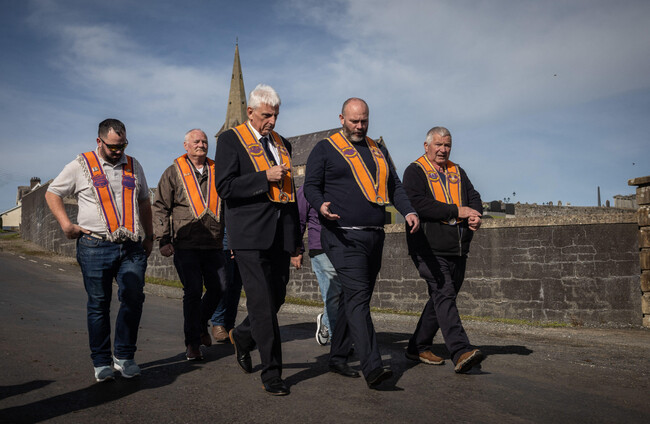
A LEGAL CHALLENGE to the decision by Northern Ireland Secretary Chris Bryant to ban the Drumcree Orange Order parade along the Garvaghy Road has been dismissed at Belfast High Court.
Bryant intervened on 9 October following a 13-day stand-off between Orangemen and residents of the mainly nationalist road in Portadown, Co Armagh.
A member of the Orange Order sought a judicial review of his intervention, with the challenge also concerning the role of PSNI chief Constable Jon Boutcher.
At hearings last week, Judge David Scoffield heard a challenge to the “legality of the decision-making route” used to ban the procession.
Counsel for Bryant argued that he could have taken “no other decision” than to halt the march.
Dismissing the application for a judicial review of the decision by Bryant to stop the parade, Mr Justice Scoffield said the decision was lawful.
“The Secretary of State’s decision was lawful and within the margin of discretion properly afforded to him, although it was highly regrettable it was required in the circumstances in which it arose,” he said.
Mr Justice Scoffield went on to say those opposed to the parade “should take no particular joy in the outcome of this case”.
He added: “The Secretary of State’s decision was lawful but the position which has now been reached has been brought about at very significant cost to the people of Northern Ireland, financially, through the diversion of police resources and in terms of community relations.”
Meanwhile, Taoiseach Micheál Martin said there is a need to “strengthen and develop” community relationships following the High Court’s ruling.
Speaking outside Government Buildings in Dublin, Martin was asked about the court’s ruling.
He said the “most important thing now is to try and develop and build stronger community relations in the area”.
“In my view, there is no need for that parade to go down the Garvaghy Road,” he added.
“So we need to broaden the conversation into community relationships and strengthening those and developing those, and see what additional assistance and support we can give to the broader community in the area.”
Elsewhere, spokesperson for the Garvaghy Road residents, Breandán Mac Cionnaith, said those living in the mostly nationalist area were “fully vindicated” by the High Court ruling.
He told reporters outside the High Court: “The position of the community of the Garvaghy Road, the men, women, and kids who live there has been fully vindicated today.
“The position we took in relation to this Orange March was fully justified. All we sought was the right that was promised under the Good Friday Agreement, the right to live free from sectarian harassment. That right has been vindicated and upheld today.”
However, loyalist activist and legal adviser to the Portadown district of the Orange Order Jamie Bryson insisted the organisation “will walk the Garvaghy Road”.
Also speaking outside the High Court in Belfast, Bryson said: “The Portadown District will set out their next approach in the coming days, but let me be very clear about one thing, which that approach will include: the Portadown District will walk the Garvaghy Road.
“They will exercise their legal entitlement and they will do so sooner rather than later.”
The Parades Commission had approved an early-morning, silent procession by 35 Orange Order members along the Garvaghy Road on 27 September, without accompanying bands.
It was the first approval for the disputed route in almost 30 years, but large crowds of residents and supporters gathered in opposition and the parade did not proceed.
Police assessed that officers could not safely escort the procession along the road while the crowds remained.
Orangemen stayed on Drumcree Hill for almost two weeks, making repeated approaches to the police line in an attempt to complete the route.
Bryant hosted talks between the two sides at Hillsborough Castle, but efforts to reach an agreed resolution were unsuccessful.
Announcing the ban, he said Boutcher had advised that facilitating the procession would require a major intervention carrying “an unacceptable risk of serious injury, disorder and a wider contagion effect across Northern Ireland”.
The court also heard last week that PSNI intelligence indicated dissident republicans might have mounted gun attacks on police if officers had cleared a route for the parade.
Bryant’s intervention was welcomed by residents and nationalist politicians but criticised by unionist representatives.
At the time, Garvaghy Road Residents Coalition representative Breandán Mac Cionnaith described stopping the parade as the only “sensible, reasonable and logical outcome”.
DUP leader Gavin Robinson said the decision had “fundamentally undermined” the rule of law.
Additional reporting from PA

To embed this post, copy the code below on your site













have your say