Sign in. It’s quick, free and it’s up to you.
An account is an optional way to support the work we do. Find out more.
Sign in. It’s quick, free and it’s up to you.
An account is an optional way to support the work we do. Find out more.
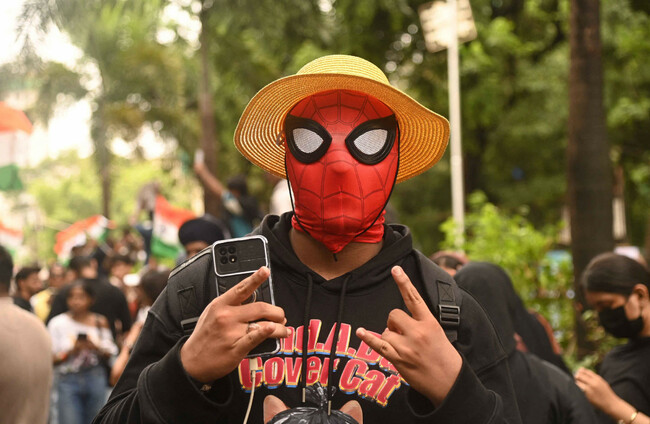
ON SATURDAY, INDIA’S education minister Dharmendra Pradhan resigned following a series of national protests known as the ‘cockroach protests’.
But what were these protests, what is their significance and what is next for India?
The Cockroach Janta party (CJP) is a Gen Z movement that was founded in May this year by Abhijeet Dipke, a 30-year-old Indian man studying in the United States.
The movement was started in response to a comment by India’s chief justice of the Supreme Court during a hearing in May, who compared the country’s young people to “cockroaches”.
“There are youngsters like cockroaches, who don’t get any employment or have any place in the profession,” said Surya Kant, as reported by Al Jazeera.
“Some of them become media, some of them become social media, RTI activists and other activists, and they start attacking everyone.”
RTI activists are those who demand transparency and the right to information and accountability.
Although Kant later clarified his remarks, saying that he had been referring specifically to some people who had acquired fraudulent degrees and not to young people more broadly, his comments attracted significant outrage.
Many young Gen Z internet users started to speak out, frustrated by 12 years of Prime Minister Narendra Modi’s Hindu nationalist government and rising unemployment, inflation, and sectarian divides.
“Get ready to swarm the streets of Delhi with peaceful and loving dissent,” said a social media post by Dipke at the beginning of June.
And they swarmed the streets in their thousands. This was just the beginning.
6 June, 9 am - Milte hain kal fellow cockroaches 🪳
— Cockroach is Back (@Cockroachisback) June 5, 2026
Dharmendra Pradhan ka isteefa le kar rahenge!
Time to turn this tiny joke into a revolution
Get ready to swarm the streets of Delhi with peaceful and loving dissent.
But remember what to do and what NOT to do. All eyes are… pic.twitter.com/XjmVmRaX1s
Protests in Delhi turned violent on 20 July when huge crowds attempted to march on the Indian parliament. They were dispersed by police firing tear gas and hitting protesters with batons, which led to several people being detained.
One of the main demands of the cockroach movement was the resignation of the education minister.
This was catalysed by the leaking of exam papers for the National Eligibility cum Entrance Test (NEET), which happened in early May.
The exam, which is the main exam for undergraduate medical students, has the largest number of applicants in a single exam. Over 2.2 million students battle it out for around 130,000 spots, but the leaked papers led to the initial exam being cancelled and the test rescheduled.
The associated stress led to over a dozen students dying by suicide.
The cancellation of the NEET test was just one of the things that triggered the nationwide cockroach protests.
While there had been exam paper leaks in previous years, this time it coincided with the formation of the CJP, which provided a place for people to channel their frustrations.
One student protester told the BBC that while the country had cracked down on some social media such as Facebook and TikTok, it had largely missed Instagram.
The movement amassed millions of Instagram followers within days of being formed, with commentators saying it harnessed the concerns of many under-30s, who make up more than half the country’s population.
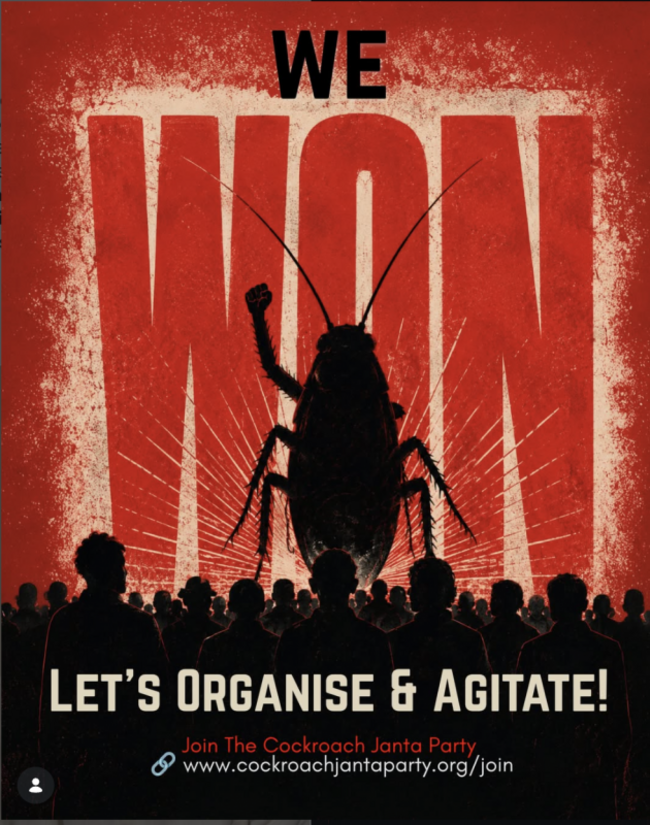
As of today, Modi’s party, the Bharatiya Janata Party (BJP) has 9.6 million followers on Instagram, while the CJP, launched only in May, has more than 26 million.
After the exam leaks, the government initially responded by saying that those responsible would be punished through fines and jail terms. However, this was not sufficient for the protesters, who demanded the education minister’s resignation.
A new education minister, Pralhad Joshi, was appointed on Monday. He is seen a close ally of Modi.
Joshi already serves in Modi’s government as the minister of new and renewable energy, as well as the minister for consumer affairs, food and public distribution. He will now also handle the education portfolio.
While the protesters called off the main sit in central Delhi following Pradhan’s resignation, another core demand remains: compensation for the families of those students who died by suicide.
According to Al Jazeera, the demands are around 10 million rupees (about €92,000) each for around 20 affected families.
Protesters have also asked that no criminal case is pursued against anyone involved in the protest, and have demanded an apology from Delhi Police and the Rapid Action Force, a paramilitary force, for the crackdown on protesters.
However, on Monday, the CJP accused the government of reneging on promises. The Guardian reported that hundreds of students have been detained or “harassed” by police, according to the CJP.
A CJP spokesperson said: “If the government does not honour the agreement and release everyone detained or arrested, we will be compelled to resume the protest.”
Earlier today, India’s lower house of parliament approved a bill that would toughen penalties for leaking exam papers. The bill will next be put to a vote in the upper house, where Modi’s ruling alliance holds a majority.
Analysts told AFP that the resignation of the education minister marks a rare reversal for a leader whose brand has for more than a decade projected strength and an unwillingness to back down.
They say that Modi’s carefully built image of invincibility is facing its toughest test yet.
“The resignation is definitely a surprise, because it is not in Mr Modi’s temperament to take a back step,” analyst Nilanjan Mukhopadhyay, who has written Modi’s biography, told AFP.
“Twenty-five years of brand building, a lot of it has been very heavily damaged,” he said.
“I am not very sure whether he will be able to recover (from) it immediately.”
“These young people have shown that if you stand up, you are likely to succeed,” political commentator Ajay Bose told AFP. “They’ve broken through that barrier of fear.”
The unrest comes at a sensitive moment for the BJP, which is preparing for electoral battles in Punjab, Gujarat and Uttar Pradesh.
To embed this post, copy the code below on your site














have your say