Sign in. It’s quick, free and it’s up to you.
An account is an optional way to support the work we do. Find out more.
Sign in. It’s quick, free and it’s up to you.
An account is an optional way to support the work we do. Find out more.
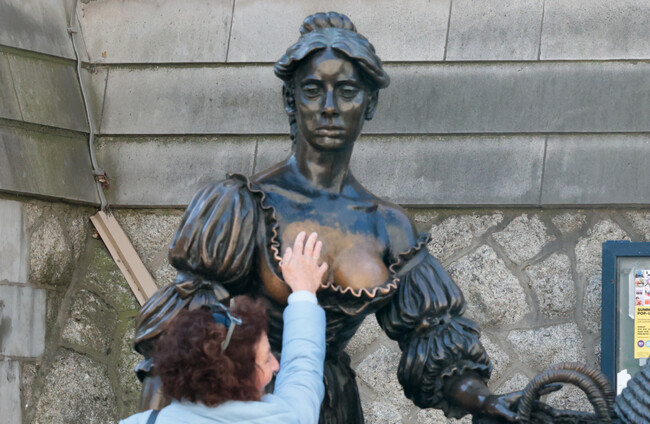
DUBLIN CITY COUNCIL will no longer employ stewards to stop tourists groping the Molly Malone statue, and is instead considering installing flower beds around the base to act as an obstacle.
Posing while grabbing the Suffolk Street statue’s “lucky” breasts has become a popular photo opportunity for tourists in recent years.
DCC told The Journal the tourist habit has become “ingrained”.
A spokesperson said: “When approached not to touch the statue, people were generally cooperative, but without stewards the behaviour returns and is ingrained, apparently, as part of [a tourist's] visit to Dublin.”
“It is difficult to change this behaviour, so we are exploring other avenues of protection for the sculpture, including installing flower beds around the base,” they added.
The story was first reported by the Irish Daily Star.
The council had employed stewards to patrol around the statue for one week in May to protect the statue and prevent further damage.
Tourists touching the statue’s breasts has caused discolouration and Dublin City Council is now organising for restoration of the statue as the patination is damaged.
The origins of rubbing Molly Malone’s chest area for good luck is suspected to have begun in 2012 by a tour guide, or guides.
‘Molly Malone’ by Irish sculptor Jeanne Rynhart was erected at the northern end of Grafton Street in 1988. It was moved around the corner to Suffolk Street a decade ago to make way for the Luas.
Social Democrats councillor Cat O’Driscoll, chair of Dublin City Council’s sub-committee that covers arts and culture, told The Journal that tour groups are more likely to ‘molest’ the statue than individual tourists.
Tour guides are now asking tourists not to touch the statue.
Councillor O’Driscoll said installing flower beds is the strongest solution available to protect the statue.
She said: “It takes away the possibility of people climbing up.”
The Arts Council considered different options to protect Molly Malone, including raising the height of the statue, adding a fence around it, or moving it. However, O’Driscoll believes flower beds will have the most impact.
She said planting flowers at the base of the statue will not take away from it, but add colour to an otherwise grey area.
She said many statues in Dublin frequently have to be repaired due to public interaction, including the Phil Lynott statue on Grafton Street and the Luke Kelly statue at the Point; however statues of women are the most targeted.
“I do believe women’s statues are much more likely to be sexualised compared to male statues, and we don’t commemorate enough women in our public art. When we do, they tend to be more mythical people. Why can’t we celebrate women the way we do with men?” she asked.

To embed this post, copy the code below on your site















have your say