Sign in. It’s quick, free and it’s up to you.
An account is an optional way to support the work we do. Find out more.
Sign in. It’s quick, free and it’s up to you.
An account is an optional way to support the work we do. Find out more.
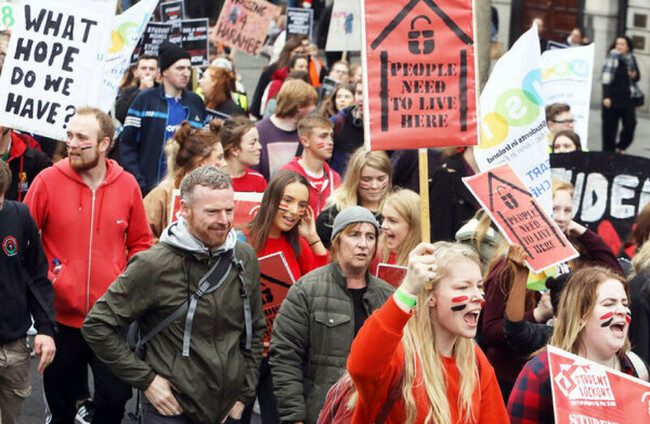

The Housing Essay is a weekly deep dive from a rotating variety of voices into issues impacting the property crisis in Ireland. Are there potential solutions that may be currently overlooked or traditionally ignored by policymakers?
YES, IT’S THAT time of the year again. The Leaving Certificate results are not long out, the mad clamour for CAO offers is underway, followed by the frantic rush to find accommodation near to the chosen college.
For a few weeks every August, national media is full of stories of students struggling to find somewhere to live. Papers gets their articles shared, social media gets its viral posts, commentators put in our tuppence worth and politicians have a chance to share how shocked they are at the scale of the student accommodation crisis. All the while insisting they will do everything in their powers to ensure solutions are found.
There might be the odd protest on campuses, in urban centres, or online, but within a few weeks the noise quietens. By October it drops off the news agenda and – surprise, surprise – it rears its ugly head again the following August.
We are now a decade into this repeated cycle. Like anything to do with housing in Ireland, the lack of student accommodation has become a broken record. And every year another cohort of students suffer.
Sadly, this cycle is going to be with us for another decade. Although there are no consistent estimates of how many more student beds are needed, the figures have ranged from 15,000 to 38,900 and up to 50,000. Learning nothing from the wider housing crisis, the government is once again turning to private developers. Mirroring the housing crisis again, the government’s target to build just 42,000 new profit-driven student beds over the next decade only meets the current deficit. It does not account for any growth in student numbers.
The lack of student accommodation shouldn’t come as a surprise. The amount of third-level students in Ireland has skyrocketed in the last two decades. In 2006 there were 138,362 full-time students attending higher education, in 2016 this had risen 31% to 181,039 students. In the last academic year this rose by a whopping 54% to 278,880 students.
So what have third-level institutes done to ensure all their students have access to affordable, safe and secure accommodation? Currently they provide 15,600 student beds across the country, raising the question where did they ever expect their students to sleep? Especially the 44,500 students they recruited from overseas. They very happily take their money through high fees but clearly take no responsibility in ensuring they have a place to call home away from home while they attend college in Ireland.
So why aren’t the universities planning ahead? Why are they putting new programmes in place, and recruiting more students, if the accommodation is not there. Surely they have an ethical responsibility to act differently? And ensure any recruitment is matched with available accommodation.
Maybe Irish universities are so conservative that they still believe third-level education is only for the wealthy? It is only affluent families who can afford to pay up to €20,500 for nine months of private rentals in Dublin or up to €12,000 in Cork. Yet, according to a survey by the Bank of Ireland just 23% of students get financial support for rent and bills from parents.
Or maybe universities are expecting wealthy families to buy homes for students, a practice which seems to be becoming more common here. It’s been suggested to us a few times, even on national radio, that it’s okay for parents to buy up homes and leave them empty for a few years while they wait for their children to start college.
This level of wealth is beyond the grasp of so many families who struggle just to get an affordable and secure roof over their own heads, let alone buy a spare property to let it sit empty for years.
Inequity in Irish education is baked in at school level.
Back in 2020 a report from the Higher Education Authority concluded that “students [in higher education] are twice as likely to be from affluent backgrounds than disadvantaged ones”. Now, six years on, with accommodation costs soaring, as well as exorbitant cost of living, a degree is no longer an option for a lot of people.
For those students who have worked so hard to beat the inequality odds, just to get the points to go to third level, they now face an even tougher job to stay there. If their families don’t live close to campus, they may have to spend hours every day travelling to and from college. Leaving them too tired, not just to socialise but also to study and find a job to help pay their way. Of course, it also means students have no time to protest against this injustice.
For those who are lucky enough to find somewhere to live but do not have parents to who can afford to pay their rent, the reality is they will have to work. In many cases this means a full time job, again leaving little time to socialise or study. They may even have to skip classes to work to pay the rent. Currently 8% of students are already working full-time jobs.
And what if commuting is not an option, and a full-time job still won’t pay the rent Where do these students go?
Unable to afford mid-week stays in hotels or holiday lets, many will be left with little to no options. Sleeping in their cars, on friend’s sofas or even in tents or sheds. No one should have to enter the world of hidden homelessness just to get an education. Last year there were 346 students who declared themselves homeless to their colleges. We expect that this number is only the tip of the iceberg.
How do we expect students to learn if they are constantly worried about a roof over their head?
The situation is so bad many students are taking unnecessary risks and falling prey to scammers, leaving them out of pocket and still nowhere to live. It’s gotten so bad that the Gardai are doling out advice on how not to get scammed. And it’s not just the lack of availability, it’s the lack of choice, it’s the extortionate cost, it’s the ever-rising rents. And it’s the poor quality standard of what is available on the private market, eg, damp, mould.
So we come back to the urgent need for educational institutes to take responsibility to ensure all their students have access to affordable safe homes. Some universities own large amounts of land and empty buildings. As do so many other state-funded institutions and government departments. In fact, there is a scandalous amount of wasted property and land which could be put to use. So why aren’t the universities and other state bodies acting on this?
For instance, in 2019 UCC spent €17.5m purchasing a large derelict site in the centre of Cork City, and after developing plans for a new business school they decided earlier this year that it had enough space on campus all along. The site and buildings that accompany it remain empty.

A key component of the governments National Student Accommodation Strategy 2026-2035 is to open up this underused land to private developers. But this is not going to make third-level education any more affordable. It will either cut it off for many more families or provide students with a lifetime of debt.
Why doesn’t the government and educational institutes ensure that there are non-profit solutions? As declared centres of learning and innovation, when it comes to providing accommodation solutions, they clearly do not practice what they preach.
Models such as Student Housing Cooperatives are not being supported, yet they have clearly worked overseas. With cooperatives models being developed in Cork, Dublin and Belfast, surely it’s time to support them.
There have also been repeated calls for the state to build student homes, as well as the expansion of the government’s rent-a-room relief scheme. In a recent study, it was found that 63% of people who have a spare room and live within 5km of a college would consider offering up accommodation. And if students are lucky enough to live close to any other college there might be opportunity to room swap between students. Why are the universities not proactively promoting these options?
For so many students this is their first time leaving the family home, taking their first steps towards independent adulthood. A period that has so many challenges, but adding the complexities of finding a roof over your head makes it even more difficult.
We live with Dóchas that we are not witnessing commodification of education by stealth, and that the coming years will see a shift back to the mindset of education for all, recognising the significant benefits that this brings to wider society.
Jude Sherry and Dr Frank O’Connor are founders of anois.org, ffud.art and #DerelictIreland. They are part of a series of writers, academics and economists penning a weekly essay delving into the housing crisis and potential solutions.
To embed this post, copy the code below on your site













have your say