Sign in. It’s quick, free and it’s up to you.
An account is an optional way to support the work we do. Find out more.
Sign in. It’s quick, free and it’s up to you.
An account is an optional way to support the work we do. Find out more.
LAST UPDATE | 19 Jun

DEFENCE AND MONEY are what it all comes down to as EU leaders convene for the second and final day of a summit in Brussels – the last before Ireland takes over the EU presidency in a couple of weeks.
Leaders have begun the second day of the summit at the European Council, having stayed in meetings from Thursday evening until around 1.30am this morning, according to officials.
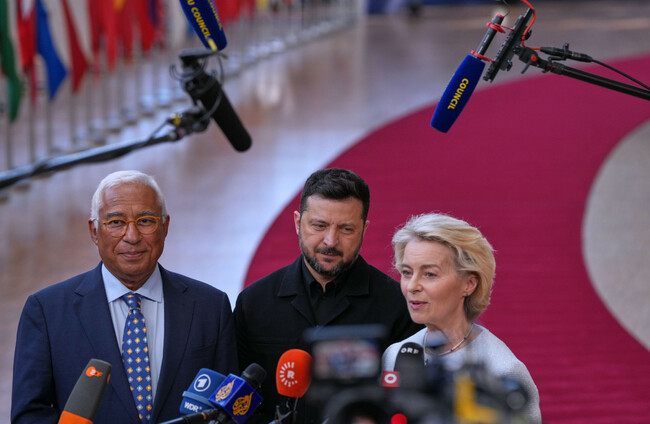
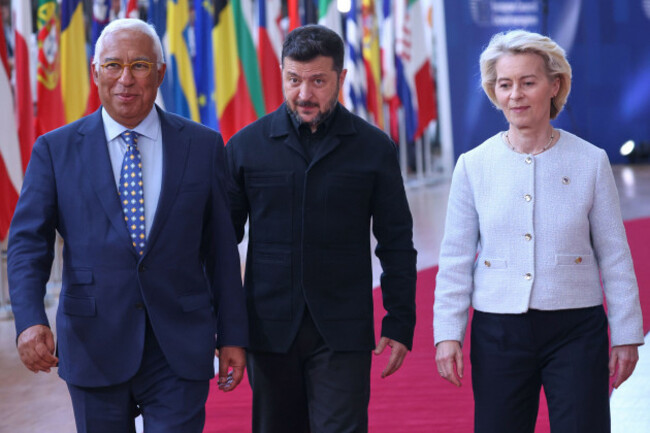
Also in town is Ukrainian president Voldymyr Zelenskyy, who rocked up to the red carpet preceding Thursday’s European Council meeting with the Council president António Costa and European Commission president Ursula von der Leyen.
Talks on Ukraine lasted well over its allocated time.
Taoiseach Micheál Martin said this morning that Zelenskyy presented a “heartfelt contribution that I felt was one of the more significant contributions” made to the EU Council.
In its conclusions released on Thursday night, the European Council reaffirmed its support for the embattled nation and said it would continue to provide support.
“The European Union and Member States are prepared to contribute to robust and credible security guarantees for Ukraine, notably through the Coalition of the Willing and in cooperation with the United States.
“This will include supporting Ukraine’s ability to deter aggression and defend itself effectively, also in the long term, including through the European Union Military Assistance Mission in support of Ukraine (EUMAM Ukraine) and the European Union Advisory Mission in Ukraine (EUAM Ukraine), as well as support for ceasefire monitoring through the EU Satellite Centre.”
There are a few crucial differences at this summit – not least the fact that Hungary are at the table in a different form than they have been for the past 16 years.
A talking point in Brussels is former Hungarian prime minister Viktor Orbán’s absence – he was replaced by pro-EU conservative Péter Magyar, an appointment widely regarded to provide relief to senior EU figures.
Orbán was a self-described “thorn in the side” of the EU. Magyar’s appointment has seen Hungary drop its block on Ukraine beginning the process of joining the EU, as well as freeing up EU funds previously kept locked away.
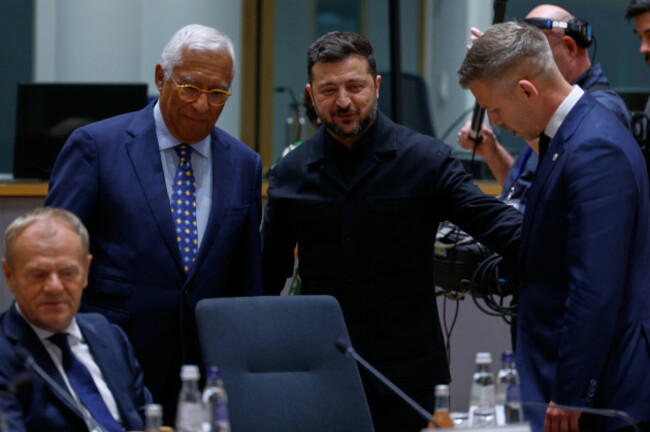
Zelenskyy had earlier on Thursday met with European leaders in Nato’s Brussels headquarters to urge them to step up with purchasing US arms for Ukraine’s use in its fight against Russia.
“We have the tools, and they are strong enough to put Russia on a path where diplomacy becomes the only choice,” Zelenskyy told Kyiv’s backers at a meeting in the headquarters.
“We all see that Putin is now relying on one lasting thing: constant missile attacks, and he has ballistic missiles, so we need anti-ballistic capabilities.”
Countries including Germany, the Netherlands and Sweden have said they are willing to contribute to buying two more packages of US weaponry expected to be worth $1 billion (€872.52 million).
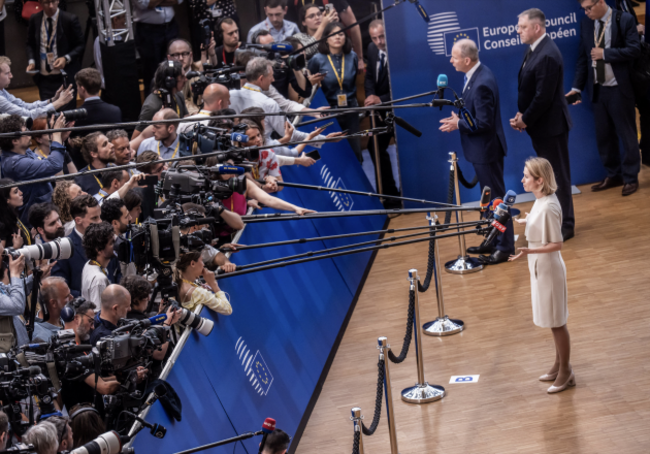
Thursday’s discussions were to focus mainly on the war in Ukraine and the economic threat posed by China.
Leaders grappled with how best to deal with the surge of Chinese exports deemed a threat to European industry.
Last year, China’s exports to the EU sharply exceeded those from the EU to China.
Leaders have differed on whether creating a new tool to allow the EU to impose sector-specific tariffs on China is worthwhile. Some, like France, have pushed heavily for this, while other member states are more cautious, fearing the impact retaliation from China could have on their domestic economies.
It was agreed over a summit dinner that the bloc must develop beefed-up trade defences to curb the surge of Chinese exports, while simultaneously seeking “constructive dialogue” with Beijing.
There is a long list of priorities for the summit, and the leaders have the benefit of privacy to hold their discussions, which happen behind closed doors.
Today, the council will be discussing key issues like the multiannual financial framework (MFF), which is the EU’s long term budget to cover 2028 to 2034. It amounts to close to €2 trillion.
The Taoiseach told media in Brussels this morning that it’s “imperative that we continue to make progress on agreeing a budget for the next seven years for Europe”.
One of the uses for this money is a contribution to Europe’s fund for defence, security and space – an amount five times of that allocated by the EU in the last MFF (this time it will be €131 billion).
A chunk (€34 billion) will be allocated for migration management. This includes the strengthening of external European borders and the bolstering of its internal borders, the council said.
From lunchtime, conversations shift towards the Middle East, the Taoiseach said.
Today’s meeting comes following the Swiss announcement that planned talks on implementing a US-Iran agreement to end the Middle East war have been postponed.
The Taoiseach has made it clear that he intends to keep Gaza and the Middle East on the agenda with his fellow leaders, telling Irish journalists Thursday evening that he feels Europe’s credibility has been damaged as a result of its inaction on war crimes perpetrated by Israel.
Earlier this week, the EU’s top diplomat Kaja Kallas said the EU would explore options for restricting trade with Israeli settlements. It followed calls from several member countries – including Ireland.
Martin said today he thinks Europe has to send a “very clear signal” that what has been happening in Gaza, the West Bank, and Lebanon is unacceptable.
This summit will lay down the structure for Ireland when it takes on the rotating EU presidency next month. One of these other issues is that of the enlargement of the EU, something Ireland has championed.
Montenegro in the Western Balkans is next set to join the bloc, and it’s expected it will advance along on its accession journey during Ireland’s presidency. In the queue behind it is Ukraine and Moldova, which share a border and an EU bid.
They are at the beginning of their EU accession journey and hope to join the bloc in 2030. Again, they will advance through some of the process while Ireland holds the presidency.
Additional reporting by AFP

To embed this post, copy the code below on your site







have your say