Sign in. It’s quick, free and it’s up to you.
An account is an optional way to support the work we do. Find out more.
Sign in. It’s quick, free and it’s up to you.
An account is an optional way to support the work we do. Find out more.
A YEARS-OLD video of a robbery in a suburb of Johannesburg, South Africa, has been re-shared online alongside false claims that it shows an attempted kidnapping in Ireland.
The footage shows a woman jogging down a street towards a parked car. As the woman nears the car, another jogger runs up to her and grabs a bag she is carrying.
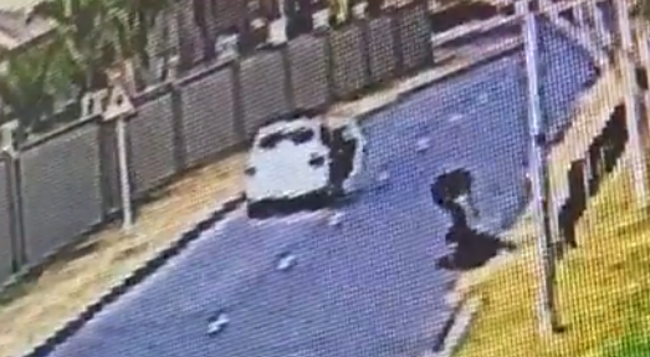
The woman resists and, after a struggle, the attacker runs off and jumps in the back of the car as it drives off.
“This woman out jogging in Ireland and this creature that the regime allowed in to Ireland tried to pull her into a car,” reads a 28 February post on the Facebook account Garda Checkpoints Dublin.
However, the footage is not recent and there is no indication in the video that the description is accurate (it is not).
A version of the video was posted on Twitter (now X.com) by a South African user in August 2022. It was soon spread by influential social media accounts, described as showing an incident in Johannesburg. These posts were soon shared hundreds of times on Twitter and one post featuring the video was more than 50,000 times on Facebook.
😭😭😭😭😭Runners and pedestrians be extra vigilant for such traps... pic.twitter.com/dmTEroXAtU
— Mphiki_za 🇿🇦 (@Mphiki_za) August 5, 2022
So, what indications are there that show the location where it was filmed?
The grass in the video has turned yellow, a sign of high temperatures which are more typical of South Africa than Ireland.
The getaway car is parked to, and drives off on, the left-hand side of the road. However, this is standard in both South Africa and Ireland.
There is also a road sign that appears to show a triangle with a red border.
This is not typical for Ireland, which tends to use inverted triangles on pole signs, but is standard in South Africa.
There also appears to be a tall wall with an electric fence shown in the video, which would be unusual for Irish suburbs, but which are quite common in areas of South Africa.
There is no indication of a suburb or street name in the video, so finding this required trawling through hundreds of images of South African suburbs.
We found that the video was taken at the northeastern end of Fountain Road, in the suburb of Sandton, between Johannesburg and Pretoria — more than 9,300 km from the nearest part of Ireland’s coastline.
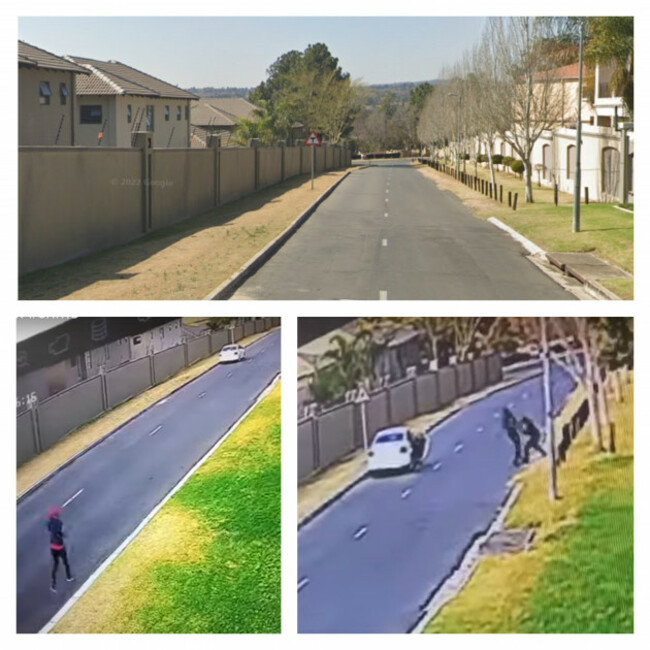
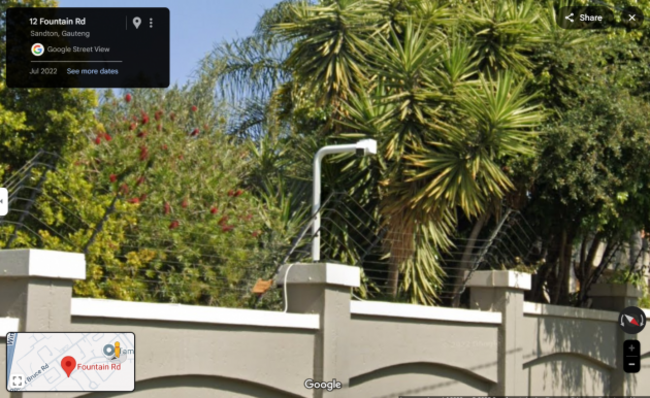
The location is confirmed by images from Google Street View, which show the same road layout as seen in the video, as well as the same high wall spaced out with unusual pillars, the same buildings behind the walls, the visible road drain, an area of grass outlines in short wooden stakes, as well as the triangular road sign.
Even the security camera that recorded the video is visible on Google Maps.
The post saying that this video showed someone who had been “allowed in to Ireland” appears to be the latest in a series of false claims that immigrants into Ireland are violent, especially to women or children, or otherwise criminal.
Last year, The Journal debunked claims that most prisoners in Ireland are foreign nationals; that asylum seekers were wanted for an incident that left a man in critical condition in Mullingar; that a non-Irish couple tried to snatch a child from its mother’s hands in Cork City; that a video of a man smashing up screens at an airport was a non-Irish person in Dublin Airport; that a “black man” tried to drag a child from their bike in Dundalk; and that a man charged with firearms offences in Dublin City was not Irish.
This year, to date, we have debunked claims that Irish citizens receive longer prison sentences than foreign nationals; that a man arrested at Connolly Station for carrying a decommissioned gun was a foreign national, and outlined how far-right agitators exploited an information vacuum after a knife attack in Dublin to spread misinformation.
The Journal’s FactCheck is a signatory to the International Fact-Checking Network’s Code of Principles. You can read it here. For information on how FactCheck works, what the verdicts mean, and how you can take part, check out our Reader’s Guide here. You can read about the team of editors and reporters who work on the factchecks here.

To embed this post, copy the code below on your site













have your say