Sign in. It’s quick, free and it’s up to you.
An account is an optional way to support the work we do. Find out more.
Sign in. It’s quick, free and it’s up to you.
An account is an optional way to support the work we do. Find out more.
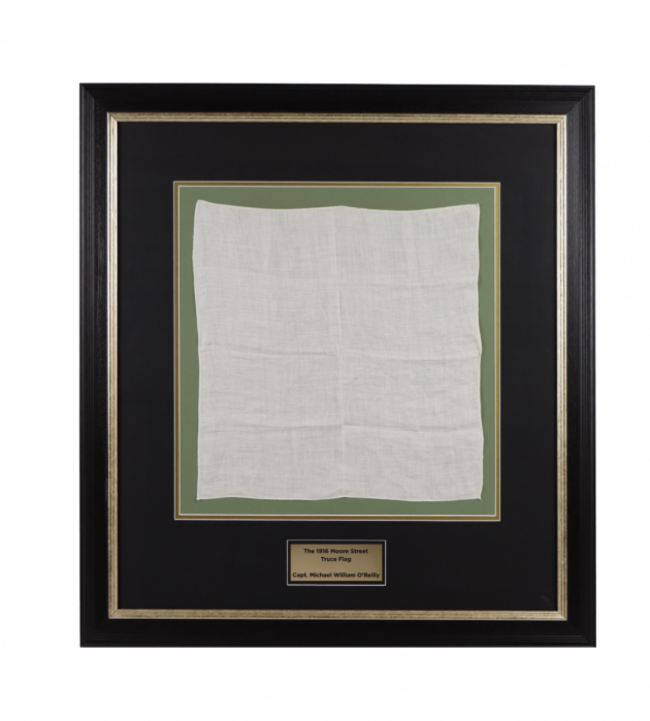
FIANNA FÁIL TD Cathal Crowe has urged the government to bid on a handkerchief believed to have been the original flag of truce during the 1916 Rising at Moore Street.
Referred to as The Moore Street Flag of Truce, the artefact is being auctioned on Wednesday by Kilkenny-based auctioneer Fonsie Mealy’s. It is estimated to fetch a price of between €10,000 and €15,000.
The linen handkerchief is believed to have been the one waved by Captain Michael William O’Reilly at Moore Street in Dublin on the afternoon of 29 April 1916, to indicate that the Volunteers wished to surrender their final position there.
O’Reilly was appointed aide-de-camp to Joseph Plunkett on the Easter Monday of the Rising. After time at the Imperial Hotel, the GPO, and evacuating the wounded to the Coliseum Theatre, he then retreated to 16 Moore Street with Pearse and Connolly.
After it became clear the Volunteers were surrounded, Plunkett instructed O’Reilly to show a flag of truce to allow for talks to take place. O’Reilly took his handkerchief from his pocket, tied it to a stick, and waved it from the door of 16 Moore Street.
Crowe said the handkerchief “is at the heart of the story of their last stand and it would be a shame to allow this artefact to slip into a private collection”.
The estimated price was described by Crowe as “relatively modest” considering its historical significance. He told the Fianna Fáil parliamentary party that the State should step in and secure it, bringing it into possession of the State.
Crowe said he has engaged with Junior Minister for Heritage Christoper O’Sullivan on the matter.
“I am strongly urging the Minister and his Department officials to act swiftly before tomorrow’s auction to ensure this piece of our revolutionary heritage remains in Ireland and in public ownership,” he concluded.
Do you think the state should purchase the artefact?

To embed this post, copy the code below on your site












have your say