Sign in. It’s quick, free and it’s up to you.
An account is an optional way to support the work we do. Find out more.
Sign in. It’s quick, free and it’s up to you.
An account is an optional way to support the work we do. Find out more.

The Housing Essay is a weekly deep dive from a rotating variety of voices into issues impacting the property crisis in Ireland. Are there potential solutions that may be currently overlooked or traditionally ignored by policymakers?
HOLIDAY HOMES ARE theft. Thought that would get your attention.
We were a little nervous writing this piece as we know holiday homes are now seen as a contentious issue in Ireland.
Maybe your internal monologue is already shouting, “You hammered the blight of vacant and derelict homes for years, can you please leave our holiday homes alone”, even before you’ve read any further. Whether it’s the case or not, it often seems taboo to question the proliferation of holiday homes in Ireland. So please bear with us as we flesh out this important matter.
As we face into the colder weather, many homes across the country are now being closed up for the year, another holiday season over.
Fridges emptied, windows locked and energy supplies turned off. There’s a lot of work prepping a house to be left empty. And in the case of holiday homes this can mean the property lying empty for all of autumn, winter and spring. Some holiday homes are used for an odd weekend or during the mid-terms, but many will be left empty for a large chunk of the year.
Of course, holiday accommodation is a better solution than leaving properties empty and decaying in places where there is no demand for actual homes. But it would be a hard stretch to find a place in Ireland that matches this description.
“But we need the tourism money,” we hear you cry, and of course that’s true for some individual businesses, especially if they just sell to the tourist trade. However, when it comes to the wider economy, at a certain tipping point too many holiday homes can do more damage to local communities and local economies than the benefits they provide.
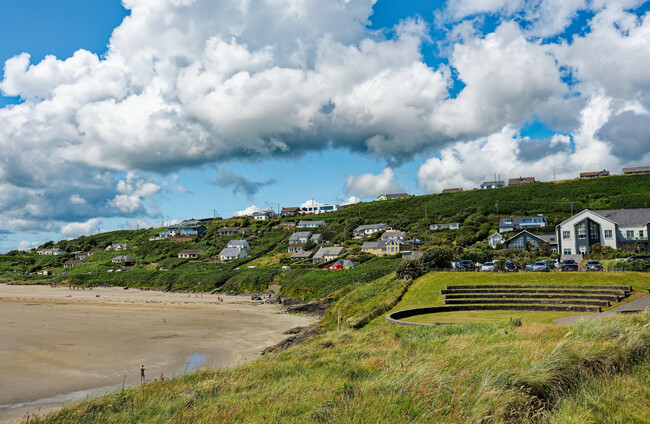
Imagine what it’s like to live in a town or village that is mostly empty during autumn, winter and spring. For instance, 25.1% of homes in Belmullet, Co Mayo are holiday homes, while another 13% are vacant homes. And consider Inch in Co Kerry, where over half of the homes are either holiday homes or vacant.
Instead of developing a housing system that would allow existing communities to thrive and grow, in parallel with a healthy tourist industry, we have allowed some areas of the country to become so dominated by holiday homes that many locals are simply unable to live there, forced out.
Unlike other European countries, we have no restrictions on turning existing homes into holiday homes.
In essence, the community has been sacrificed for the greater good of a few wealthy people to have spare homes. This is especially the case along our west coast.
According to the 2022 census there were 66,956 holiday homes in Ireland, a 70% rise over two decades earlier when there were only 39,383 holiday homes in 2002. If home construction had grown at a similar rate we’d have roughly 365,000 extra homes today. Enough to alleviate the worst of the housing crisis, but alas that is not the future we created. Instead, we have let holiday homes cannibalise the existing housing stock, reducing market supply even further. But what will happen if we let this trend continues?
What happens when the workers in the local businesses can’t find anywhere to live as more and more homes are being turned into holiday homes? They move to where they can get a home, and unfortunately, this might mean a form of forced emigration.
It’s worth remembering that you can’t have a decent local economy if there aren’t enough workers. Likewise, you can’t run essential public services if those needed to deliver them can’t live close enough to take up the jobs.
Also, you can’t run essential public services when there is not enough demand.
Some communities in Ireland are losing teachers because they haven’t enough students. Some services deemed essential to the community such as the GAA can’t field a team because there aren’t enough players. We know this is because of demographic changes, but what are the root causes to these changes and why, in a time of remote working, are these trends not reversing?
Without a doubt, the housing crisis is a significant factor and in some communities the ever-increasing number of holiday homes is an aggravating factor. So when is enough enough? Let’s consider the communities impacted. Concerns over too many holiday homes were raised in a local survey in Ballybunion, Co Kerry last year.
Their neighbouring Dingle community has also raised the alarm on the negative impacts of too many holiday homes.
Some of the most impacted communities are in our precious Gaeltacht districts, where it is estimated that a fifth of homes are holiday homes, with 20% only available for tourist rental.
When you add the fact that vacant homes account for another 11% of homes, it leaves very little available for use as actual homes. How do we expect our native language to survive if a diminishing number of gaeilgeoirí can live in the Gaeltacht?
Let’s be clear, it’s not a lack of demand that’s depopulating these communities. It’s the inability to compete against wealthy international holiday speculators. This is also restricting the ability of new community members moving in. Rob O’Sullivan summarised this very well on the Claire Byrne Show when he described what living in a holiday town is like, saying, “all I see is the missing people”.
Unsurprisingly, allowing wealthy people to buy up homes just to use them a few times a year is causing tensions across society. Take the case of local government where a Wexford councillor claimed “there is a serious moral question around owning a holiday home during a housing crisis”. A senior manager at Mayo County Council called for a boycott of holiday homeowners but later apologised for these remarks. Maybe they are not alone with their viewpoints?
As always, the data around how many homes are used as holiday accommodation and how many of these would be suitable as full-time homes is debatable. But since you can’t manage what you don’t measure, we urgently need a home registration system which we previously called for. An essential tool to measure demand for public services when areas are depopulating.
Back to our original provocation ‘holiday homes are theft’, an adaptation of French anarchist Proudhon’s famously misunderstood quote ‘property is theft’. Proudhon didn’t literally mean that owning your own home is theft, but he did raise valid concerns about property accumulation and hoarding. We have the same concerns with holiday homes.
As you will know from our campaign work, we believe everyone should have a home. When it comes to holiday homes, we live with Dóchas that the government will eventually come to its senses and prioritise communities over wealthy holidaymakers.
Jude Sherry and Dr Frank O’Connor are founders of anois.org, ffud.art and #DerelictIreland. They are part of a series of writers, academics and economists penning a weekly essay delving into the housing crisis and potential solutions.
To embed this post, copy the code below on your site














have your say