Sign in. It’s quick, free and it’s up to you.
An account is an optional way to support the work we do. Find out more.
Sign in. It’s quick, free and it’s up to you.
An account is an optional way to support the work we do. Find out more.
EU LEADERS ARE bracing for a potential announcement by US President Donald Trump that the world’s largest economy will be placing tariffs on the world’s largest free-trade bloc.
It comes after tariffs placed on Canada and Mexico by Trump at the weekend were waived temporarily after the US President and his counterparts came to political agreements on border protections.
There’s concern that a decision to impose similar tariffs on the EU could be devastating to the Irish economy and pose major threats to Irish firms operating in the US.
But what does this all mean? How will the Irish economy be impacted? And what can we do to get out of it?
A tariff is a tax on goods and services imported from other countries.
Trump introduced a 10% tariff on China this week. For every $10 of goods shipped from China, the tariff adds an extra $1 in tax onto the price.
Companies will often increase prices relative to the tariff rate – offloading the price of the tax onto the consumer. This is because there are already very high costs associated with exporting goods and an additional tax threatens a company’s profit margin.
Tariffs, because of this, are used as a tool by governments that seek to change consumer purchasing habits, hoping that making imported products more expensive encourages people to buy local.
During the run up to Trump’s return to the White House, he promised to boost the local American economy by imposing tariffs on some of its largest trading partners that he accuses of ‘ripping off’ the US.
In many cases, the US has a so-called ‘trade deficit’ with its trading partners. This means it imports more goods and services from other countries than it exports.
While Trump’s aim is to try and get citizens to buy local, instead of importing, to boost the economy, the President is also using the tax threats as political leverage.
This weekend, the US paused tariffs on Canada for one month after Prime Minister Justin Trudeau pledged stronger border measures to stop crossings of migrants and illicit drugs.
A similar pause was introduced for Mexico, after President Claudia Sheinbaum agreed to send 10,000 troops to the US-Mexico border.
“It’s not clear what this is about,” Dan O’Brien, an economist at the Institute of International & European Affairs. “It’s a madman’s strategy, it seems, with no clear or explicit reasoning.”
It’s a form of bullying, according to Niall Moran, a trade lawyer and an economist with the Brexit Institute in Dublin City University. He added that any objective basis for imposing tariffs has been undermined by the treatment of Canada.
Flows of migration and fentanyl were the reason cited for the proposed tariffs but these are miniscule compared to those of Mexico.
“It’s a matter of when, not if, Trump turns his attention to the EU,” according to Moran.
Trump has said he thinks the EU has taken advantage of the US and that European leaders should expect heavy export duties on their goods and services in the near future.
He has threatened up to 25% blanket tariffs on all products into the US from the EU.
This raises concerns that the EU could then hit back and slap tariffs on American-made products – what’s known as a trade war.
While Trump has claimed in the past that trade wars are “easy to win”, many commentators on the issue in recent days have cited the example of the 1930 Smoot-Hawley Act, which was widely blamed for deepening that decade’s economic depression.
According to O’Brien, any tariffs on EU products would have a “detrimental impact”on the Irish economy.
If it goes as far as Trump has threatened, he said, “it would certainly have a very big negative impact” on Ireland.
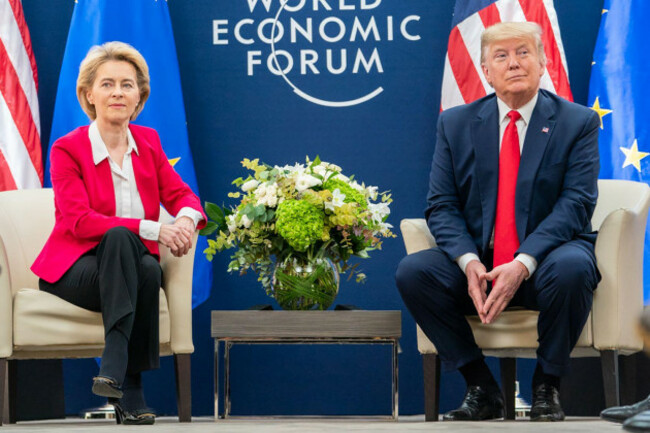
Trump massively overblew the trade deficit between the EU and the US on the day of his inauguration after he was asked about imposing tariffs on Europe – valuing it at nearly double of the actual amount.
However, the US President has also cited personal gripes with VAT, tech regulations and American companies being based in Europe.
Ireland – with the fourth-highest VAT rates in Europe, the most responsibility when it comes to regulating large tech companies and one of the largest multinational-reliant economies in the EU – could be in a bit of trouble.
For now, however, there is no suggestion that Trump will be seeking to target specific areas of the economy, such as the tech industry.
“There is no other country in the world who trades more on a per-person basis with the United States than Ireland,” O’Brien told The Journal.
This will be bigger than Brexit, in terms of trade, for Ireland.
Moran said that Irish companies that trade in the US would see their profit
margins squeezed if tariffs were introduced.
There may be a drop in demand for Irish dairy products – which has been a relatively successful market in recent years – and exporters could prioritise other markets, he added.
O’Brien said international companies based here may consider moving their operations away from the EU and into the US, which could have a lasting impact on local markets.
There are serious concerns at the highest levels of government about the impact tariffs would have on trade with the US, and it is understood that there is a significant amount of lobbying taking place in Washington DC to counteract such a move.
The government intends to lovebomb the US during the annual St Patrick’s Day trip next month, with plans afoot to increase the number of ministers visiting, The Journal reported last week.
In his most recent public comments on the issue, Taoiseach Micheál Martin said that Ireland and the EU must “act as one” in any dispute arising from the implementation of tariffs.
Slovenian European Commissioner Maroš Šefčovič warned today that if the bloc is hit “unfairly or arbitrarily, we will respond firmly”.
“We hope through engagement that we avoid the measures, which would bring a lot of disturbance to the most-important trade arrangement on this planet.”
“Anything is possible,” O’Brien said, suggesting that the European Commission might seek to issue targeted tariffs in Republican-run states in the US so that Trump comes under pressure from his governors.
“I can’t see the EU giving in,” he added.
Moran said that it would be best practice for EU member states to “speak with one voice” to avoid more measures being introduced that target one specific country or industry.

To embed this post, copy the code below on your site
















have your say