Sign in. It’s quick, free and it’s up to you.
An account is an optional way to support the work we do. Find out more.
Sign in. It’s quick, free and it’s up to you.
An account is an optional way to support the work we do. Find out more.
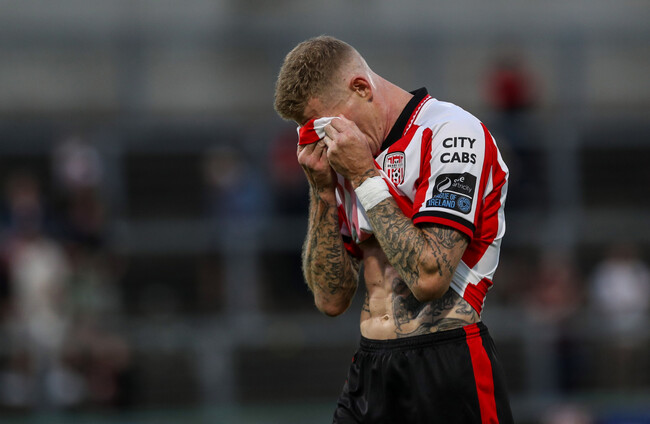
LIKE A LOT of people, I first encountered James McClean’s comments about therapy through a screenshot of quotes in a Sunday Independent interview shared on social media.
McClean, a 37-year-old footballer, returned to his hometown club Derry City this year from Wrexham, after a career in the UK that included Premier League spells with Sunderland and West Bromwich Albion.
His homecoming has become its own source of uncertainty: he has not played for Derry City since July and is embroiled in a contract dispute with the club involving concerns about a hip injury, although he insists he remains fit and wants to continue playing.
His memoir has just been released, which prompted the lengthy Sunday Independent Q&A with journalist Paul Kimmage.
During that interview, Kimmage asked McClean whether he had ever considered doing therapy.
McClean said that he recently overheard his brother Patrick having ‘a lovely chat’ on the phone with their club Derry City’s psychologist.
“And a lot of the players speak to him and for me that’s just weak,” he said.
“As a man I see that as weakness. I don’t need to open up. I see it as a weakness that I’d have to speak to someone about my feelings; my emotions…”
The characterisation of therapy as a sign of weakness led to an online backlash against the 103-cap Republic of Ireland international.
Many people saw the remarks as reinforcing the stigma around mental health, including people who had experienced mental health difficulties themselves.
The story was red meat to social media’s algorithms, which feed on this kind of criticism and forces it into the feeds of unsuspecting users to invite pile-ons.
But the screenshot that contained McClean’s quotes showed about 100 words – roughly 1% – of a 9,000-word article that covered a lot of ground about his life.
In a social media post of her own on Monday, McClean’s wife Erin added context that had been missing from the discussion.
“James made his comments in the context of admitting that I have been strongly encouraging him to seek therapy, to deal with issues from his early life as well as to face the end of his career,” she said, adding that she did not agree with her husband’s opinion.
“He is struggling at the moment, and has been for some time. He may not agree with me sharing that, but I’ve told him that I need to explain this.”
https://t.co/UFLaY9rS59
— Erin McClean (@Erineyy) October 19, 2026
The original Sunday Independent interview had already supplied some of that context.
Before he discussed his views on therapy, McClean explained to Kimmage how he discovered as a child that the man who raised him was not his biological father – a local man who, in McClean’s account, struggled with alcoholism.
McClean was mocked by older boys locally over his biological father’s alcoholism, and spoke to him only once, when he encountered him in the street and told him to stay away.
He told Kimmage that his wife Erin believes all of this has caused him “a lot of built-up anger and frustration” and that he has blocked it out and needs to go to therapy.
The irony is that McClean was discussing a painful experience publicly while describing the process of opening up as weakness.
In normal circumstances, when a person discusses a harrowing life experience like this – in the media or privately – most of those who hear it tend to treat the speaker with care and compassion.
The fuller interview did not make those words harmless, but it did make it harder to reduce McClean into a villain who had a single, objectionable opinion that therapy was a sign of “weakness” in men.
At one point, an AI summary was shared on X as evidence against McClean with fabricated quotes claiming that he said “men talking to psychologists makes them look weak”.
The post was re-shared by dozens of people and seen almost a quarter of a million times.
Challenging McClean’s actual words has a purpose, though I’m less convinced that taking a censorious approach helps anyone.
There is an entire genre of online slogans about mental health – “Be Kind”, “Let’s talk”, “End the stigma”- that often fall by the wayside when we encounter someone we don’t like or someone says something that we find difficult to hear.
That type of messaging encourages people to speak candidly, but the treatment of McClean shows how being honest can elicit a reaction that may make someone more reluctant to speak again.
This is not to say that his distress trumps the potential impact of what he said.
McClean may have been discussing his own preferences, but the reference to his brother and other players at Derry City using a psychologist gave people reason to hear his comments as a generalised judgement about men who do therapy.
And to be clear, there’s nothing there to judge: talking to a psychologist can be an extraordinarily beneficial process and nobody should ever be shamed for doing it.
All the same, there is nothing to be gained from scolding or humiliating McClean for his views either.
People’s views evolve, including most people who actually do therapy; I know from personal experience that deciding to talk to a psychologist can involve a long period of hesitation before you gear yourself up to actually do it.
McClean is on his own journey, and explained as much later this week.
Revisiting his comments, he described his use of the word “weakness” as “a weakness for me” while commending anyone else who seeks therapy themselves.
There was a reminder this week of what a compassionate response can look like when another sportsman from Northern Ireland, snooker player Mark Allen, spoke about his mental health.
In an extraordinary interview with TNT Sports after his defeat at the Northern Ireland Open on Tuesday, Allen questioned whether he would continue playing snooker and said he was just trying to survive.
This is heartbreaking to watch 🥺💔 Mark Allen admits he may never play snooker again. We’re all rooting for you, Mark 🙏❤️ https://t.co/9v6wvWMflE
— TNT Sports (@tntsports) October 20, 2026
Presenter Rachel Casey responded with warmth, reassuring him that he had people around him who cared, before embracing him.
The clip prompted an outpouring of support for Allen and deserved praise for Casey’s sensitivity.
Allen was describing his distress, while McClean had also said something others reasonably found hurtful. The situations were different, but both raised a question about how we respond to someone who is struggling.
Allen later said that the messages and support he received on social media had helped him.
McClean’s comments deserved scrutiny, and his clarification deserved attention too. We can challenge what he said while leaving him room to reconsider it.

To embed this post, copy the code below on your site












have your say