Sign in. It’s quick, free and it’s up to you.
An account is an optional way to support the work we do. Find out more.
Sign in. It’s quick, free and it’s up to you.
An account is an optional way to support the work we do. Find out more.
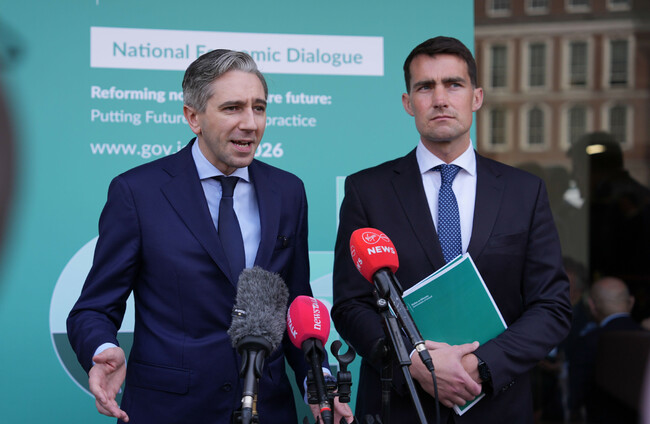
IRELAND WOULD BE better off creating its own fiscal rules to rein in spending instead of relying on the EU’s framework, which gives the government too much leeway, according to the Irish Fiscal Advisory Council (Ifac).
The fiscal watchdog issues a statement outlining issues and recommendations before the budget announcement every year. Last year it expressed concern about high levels of government spending and this year’s statement is no different.
In its pre-budget submission, Ifac said the EU rules – which use GDP to determine spending, debt and deficit limits – are “not appropriate” for Ireland because of the country’s heavy reliance on risky corporate tax receipts.
Essentially, assessing the health of the public finances using GDP does not make sense because so much revenue comes from a small number of multinational corporations, which gives a skewed picture of the “real” economy.
Corporation tax receipts currently make up 23% of total government revenue.
According to the EU rules, a government deficit is considered excessive if it is higher than 3% of GDP, and a government’s debt is considered excessive if it is higher than 60% of GDP.
In its Spring Economic Statement, the Department of Finance forecast a deficit of €1.2 billion for 2026 compared to a surplus of €7.1 billion last year. In the first quarter of this year, the government recorded a surplus of €0.8 billion.
But this July Gabriel Makhlouf, the head of the Central Bank, warned that Ireland’s budget deficit could reach €25.7 billion by 2030 if overspending and a reliance on tax from multinationals continue.
In its medium-term fiscal plan submitted to the EU in December last year, the Irish government set out economic predictions for a five-year period.
Ifac said the government’s medium-term projections allow spending to outpace the growth of the Irish economy.
“The government’s medium-term plan is the only framework currently in place,” Ifac said in its submission today.
“However, it is not an appropriate guide for budgetary policy. It allows net spending to grow faster than the economy’s sustainable growth rate.”
Ifac said that following the medium-term plan would result in “an even greater dependence on risky corporation tax receipts”.
The fiscal watchdog has projected that the government will need to spend €8 billion more in 2027 just to maintain the level of services it funded in 2026.
As it stands, the medium-term plan would see €7 out of every €8 collected in corporation tax used for ongoing spending commitments, with only €1 going into the government’s investment funds.
“Ireland needs its own domestic budgetary rule,” Ifac said today.
“This should be carefully designed and set out in legislation. Such a rule could help protect public investment, which was cut sharply after the financial crisis.”
Ifac also suggested that the EU would be unlikely to enforce its rules if Ireland breaks the spending limits because the public finances appear healthy when measured by GDP and the size of the deficit.
Ifac’s recommendation that the government rein in spending comes after it warned last June that the state would have to borrow to keep to its saving commitments.
In July, former finance minister Michael McGrath, during whose tenure the savings funds were set up, said that borrowing to fund saving commitments was always a “very real possibility”.
“It’s not black and white that it’s always wrong for a country to borrow at low rates to put into a fund that can grow at a higher rate and can meet long term commitments that you have,” he said.
In its June report, Ifac said: “Some of these funds were created as a vehicle to save volatile revenues for future spending. But the government is now planning to spend most of these risky revenues, rather than save them.
“Planned surpluses are not large enough to fund contributions to these funds,” it said.
Government spending is back in the spotlight again this week as the Dáil has been recalled to extend cuts to fuel taxes that the government introduced in response to protests against high petrol and diesel prices.

To embed this post, copy the code below on your site










have your say