Sign in. It’s quick, free and it’s up to you.
An account is an optional way to support the work we do. Find out more.
Sign in. It’s quick, free and it’s up to you.
An account is an optional way to support the work we do. Find out more.
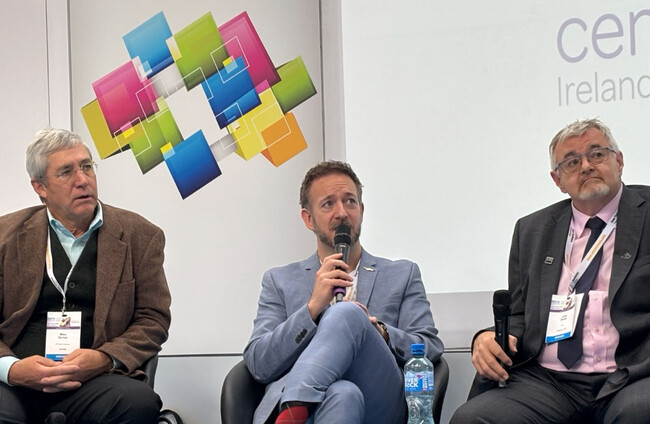
WHATEVER THE TOPIC – from private-wire connections to the building of next-gen ‘AI factories’ – the designers, CEOs, managing directors and consultants taking to the panels at this week’s Data Centres Ireland conference in Dublin’s RDS kept returning to one overriding concern: the industry’s ‘public perception problem’.
Multiple speakers put this down to a misunderstanding on the part of the public. As Stefanos Gkougkoustamos, director with data centre design firm Bryden Wood, put it: “They think these are big closed-off buildings, and they destroy the community. But if they can start understanding that no, this is a facility that can generate power, it can give something back.”
The conversation centred around two main arguments. The first was that data centres need to become an integral “part of the grid”, contributing to it and helping build renewable energy sources that, in their view, Ireland would otherwise be much slower to develop.
The second was that the backlash against data centres in the US is spreading internationally, and that unless the industry can sway public opinion, more moratoriums on new developments will stall its growth.
(In the US midterms, Democrats flipped five governorships, including in Texas, Georgia and Ohio, where opposition to data centre complaints featured in their campaigns, as the rate of data centre development in those states has sparked concern about grid destabilisation, increased pollution and water use).
There were also concerns from conference speakers that without further steps to facilitate development here, such as legislation allowing private-wire connections – electricity links that would allow centres to source power directly from generators rather than relying solely on the grid – Ireland’s position as a leading EU country in the sector could come under threat from the likes of the Nordics and Spain.
The director of the Swiss Datacenter Efficiency Association stressed the urgent need for data centres to become “more transparent” about “energy, water, whatever it is”.
“When I came here this morning, it felt like in my LinkedIn feed there were two parallel universes,” Matthias Haymoz told a rapt audience of data-centre adjacent professionals.
“One set of posts was on the data centre boom, ‘The success story continues’, buildings here, buildings there, and on the other side there’s the criticism of AI, data centres, moratoriums. It’s like two parallel worlds where there’s us as an industry on one side, and the backlash on the other side. I hope we can bridge that divide,” he continued.
“The US backlash is coming to Europe even though it has nothing to do with us in Europe,” another panellist chimed in.
Haymoz agreed, saying that even in Switzerland, “the friendliest, most neutral country in the world, we had a protest camp against a simple colocation data centre, just because they dared to build a data centre, and that’s turned into a national movement which is asking for a country-wide moratorium”.
“They say AI is bad, water use is bad, everything is bad,” he went on.
This prompted another panellist, John Booth, managing director of Carbon3IT, which audits data centres and prepares government-mandated carbon disclosures, to make perhaps the most extraordinary claim of the conference.
“Two weeks ago we had a global weekend of protests, then there was a march in Scotland, it is definitely being coordinated. I’m wondering… I’m just going to put this out there – it’s just a notion – that maybe this is being funded by bad actors in other countries, whose names begin with an R and a C and end in an A, [I wonder] whether they are trying to put a dampener on the industry here, because we are in an AI arms race”.
When a journalist pressed him on whether he had any evidence to support what he was saying, Booth said there were people monitoring various websites and Telegram chats across Russia and China.
“There is definitely something about data centres that is being noticed, it’s probably something to do with the hybrid war that Russia is undertaking in Europe at the moment,” he added.
It’s certainly an interesting claim.
It’s clear that the industry is grappling with the momentum behind anti-data centre movements and growing public anger. That anger is, of course, being fuelled by the reality that data centres currently consume almost a quarter of the energy produced by Ireland’s grid.
Ciarán Ahern, Labour Party TD, whose party is calling for legislation requiring data centres to provide 100% of their own energy through on-site renewables, posted an Instagram reel showing the three “worst things” he found at the conference.
“I’m currently undercover at maybe the worst place in the world. It’s hard to pick just three things that are the worst,” he told his followers.
Ahern cited greenwashing (companies selling fossil-fuel-powered equipment with wind turbines on their banners), ‘AI slop’ posters, and the presence of sustainable businesses with “great ideas” for decarbonisation attending the conference because they want to work for data centres, rather than decarbonising Ireland’s existing energy use.
Meanwhile, Fine Gael TD James Geoghegan, who spoke at the conference, told attendees that lots of infrastructure in Ireland has been built “in the teeth of opposition”, and that the data centre companies need to convince local communities of the “contribution” they can make, beyond a “cheque to the local GAA team”.
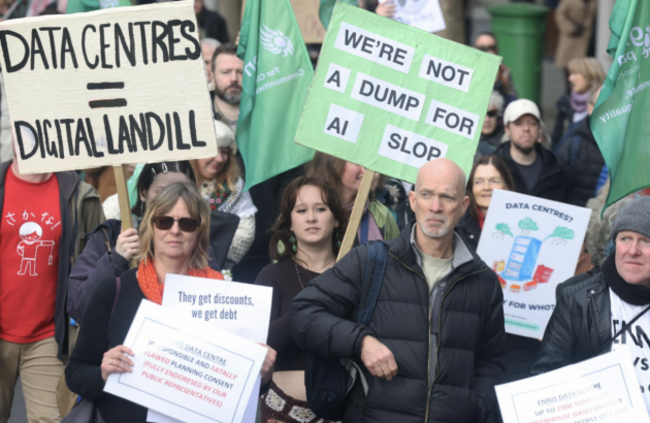
A protest group issued a statement calling conference-goers “energy vampires”, a description picked up by national news sites and radio stations. One organiser remarked that the protest was probably organised on Twitter, which itself relies on data centres.
While the sector has woken up to the threat posed by growing public opposition, some may be naive to think that simply giving up their tendency to be “private” will solve their problems.
Michael Martin, director of design with Echelon Data Centres, offered perhaps the most ambitious vision of how the sector might change its image.
He sees the new regulations coming from the Commission for Regulation of Utilities, which will require new buildings and major expansions to have the capacity to produce 80% of their power through on-site renewables, as an “exciting” opportunity.
“It’s going to cost a hell of a lot of money, and it’s going to take a huge amount of design and engineering and effort to deliver it, but we want to deliver sustainable data centres, we were already planning for onsite generation before.
“We want to be good grid citizens, and we’re prepared to walk the walk.
“It’s where we can leave a positive legacy with data centres. We are going to improve the grid. Data centres are going to bring new products onto the grid and they are going to reinforce it and completely integrate as one single system. That’s a paradigm shift,” he said.
“It’s where we can leave a positive legacy with data centres. We are going to improve the grid. Data centres are going to bring new products onto the grid and they are going to reinforce it and completely integrate as one single system. That’s a paradigm shift,” he said.
Martin also spoke about the emergence of next-generation AI data centres, which he described as facilities that “generate intelligence” rather than simply store data, requiring increasingly dense computing infrastructure and more sophisticated cooling systems.
It’s an ambitious vision, but while the sector is keen to stress its role in Ireland’s transition to renewable energy, an increasing number of people are questioning whether powering data centres, particularly those built to meet the demands of AI, is the best use of those resources.
That opposition is already being felt in places like Naas, Kilmeaden and Rochfortbridge, where proposed developments have faced significant local resistance, and was on full display at Ireland’s first national anti-data centre protest on 7 November, which drew around 2,000 people and renewed calls for a nationwide moratorium on new developments.

To embed this post, copy the code below on your site













have your say