Sign in. It’s quick, free and it’s up to you.
An account is an optional way to support the work we do. Find out more.
Sign in. It’s quick, free and it’s up to you.
An account is an optional way to support the work we do. Find out more.
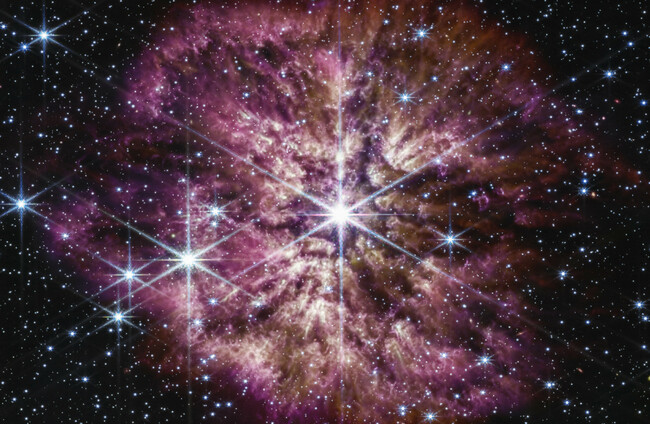
THE JAMES WEBB space Telescope has captured the rare and fleeting phase of a star on the cusp of death.
Nasa released the picture today at the South by Southwest conference in Austin, Texas.
The observation was among the first made by Webb following its launch in late 2021.
Its infrared eyes observed all the gas and dust flung into space by a huge, hot star 15,000 light-years away.
Cosmic spring is in the air! The latest image from @NASAWebb features a blooming Wolf-Rayet star, 15,000 light-years away. This rare phase is as fleeting as the cherry blossom it resembles. Luckily, Webb can study its "petals" of dust in detail: https://t.co/z9dlzgKmAh #SXSW pic.twitter.com/sAOrZkX0Wl
— NASA (@NASA) March 14, 2023
A light-year is about 5.8 trillion miles or 9.3 trillion kilometres.
Shimmering in purple like a cherry blossom, the cast-off material once comprised the star’s outer layer.
The Hubble Space Telescope snapped a shot of the same transitioning star a few decades ago, but it appeared more like a fireball without the delicate details.
Such a transformation occurs only with some stars and is normally the last step before they explode, going supernova, according to scientists.
“We’ve never seen it like that before. It’s really exciting,” said Macarena Garcia Marin, a European Space Agency scientist who is part of the project.
This star in the constellation Sagittarius, officially known as WR 124, is 30 times as massive as our sun and has already shed enough material to account for 10 suns, according to Nasa.

To embed this post, copy the code below on your site















have your say