Sign in. It’s quick, free and it’s up to you.
An account is an optional way to support the work we do. Find out more.
Sign in. It’s quick, free and it’s up to you.
An account is an optional way to support the work we do. Find out more.
LAST UPDATE | 30 Aug
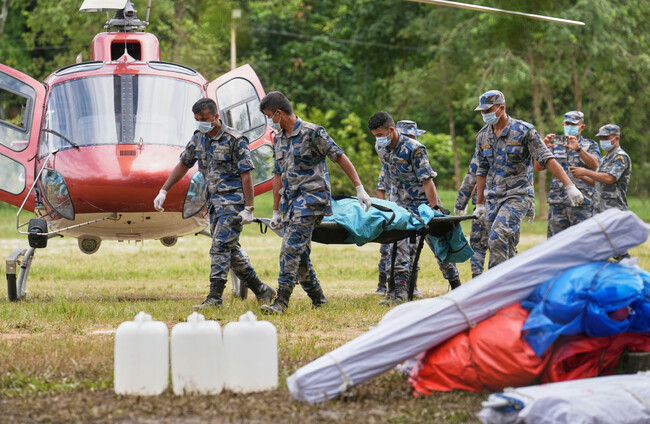
NEPAL HAS BEGUN burying some of the hundreds of bodies recovered after devastating floods, after taking DNA samples and marking them so families can later retrieve them.
The dead are traditionally cremated on funeral pyres in Hindu-majority Nepal, so the burials are viewed as long-term storage until families can retrieve them.
Foreign Secretary Amrit Bahadur Rai told reporters that all those buried were carefully recorded, but also appealed for international support, saying Nepal needed “more than a thousand” freezer units to store bodies.
“Medical teams took DNA samples from every victim prior to the burial so that families can match-reference later, and would be allowed to exhume for necessary rituals,” Rai said.
Nepal’s disaster ministry said the death toll in the country has now risen to 781, with 2,502 people still missing.
That list includes 589 foreigners unaccounted for.
उद्धार कार्यमा नेपाल प्रहरी । pic.twitter.com/a36HKeBQgD
— Nepal Police (@NepalPoliceHQ) August 30, 2026
Two Irish citizens, 46-year-old Santosh Sahu and 18-year-old Spandan Sahu, are among the missing. Ireland’s Department of Foreign Affairs has said it “continues to closely monitor the situation” and is providing consular assistance.
In Tibet, the official death toll is 16 while 546 are said to be missing, according to Chinese state media.
It brings the overall toll to 797 dead and 3,048 unaccounted for.
Nepal has called for freezer storage units and DNA testing kits, as it is overwhelmed with the number of bodies to store safely.
“We have requested different countries for freezers; we will need more than a thousand,” Rai added.
“Many dead bodies have been collected, and they have started decomposing. To preserve public health, we had to bury the decomposing bodies.”
Rescue operations have entered their fifth day since the floods, with teams battling difficult conditions at the disaster sites.
Nepali army troops and engineers have drilled through debris towards hydropower workers believed trapped in a tunnel at the Trishuli 3A hydroelectric site in the Himalayan river valley after they successfully inserted a pipe into the passage.
They have “started sending air through the small opening”, Nepali Home Minister Sudan Gurung said in a statement.
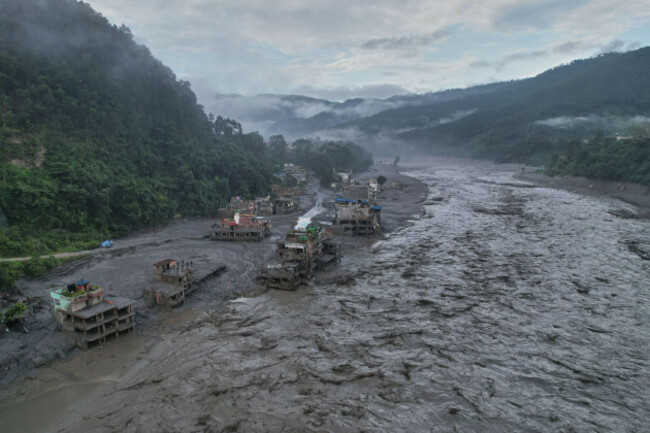
Overnight rain and rising river levels hampered efforts early on Sunday, filling the excavation area with water, before conditions eased.
Nepal’s disaster authority listed 933 hydropower workers among the missing in an area home to vast energy infrastructure projects.
The prime minister’s office said teams faced “difficult conditions” but were “making tireless efforts to search for and rescue those who may be trapped”.
The rescue teams are using advanced search cameras and specialised monitors, it said.
Meanwhile, rescuers near the Tibet border port that was hit by a deadly mudslide were “moved to a safe location” this morning, after a new lake was formed by a landslide, state media reported.
The US Geological Survey said the disaster on the China-Nepal border was caused by a glacial collapse.
Specialised Indian and Chinese tunnel-rescue teams have also joined the efforts.
Nepal’s expert mountain rescue teams – who regularly aid climbers on the world’s highest peaks, including Everest – are also joining the search for missing people at another damaged hydropower site.
Flood survivors from other hydropower sites described a terrifying rush of water that had engulfed them within minutes.
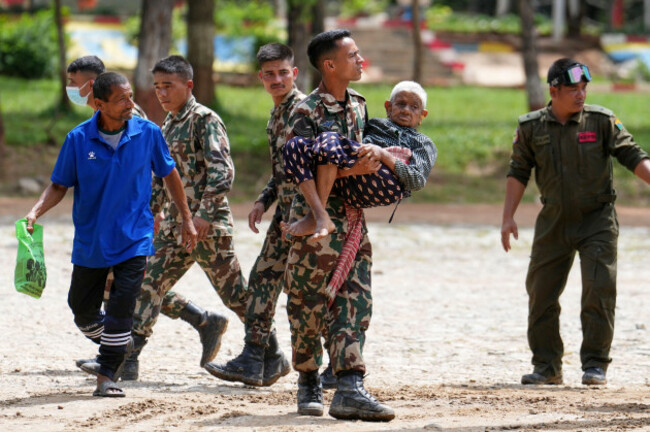
Hydropower worker Surendra Dowluri from India’s Andhra Pradesh state, described how raging water swamped the Upper Trishul-1 site where he was working.
“We heard a very loud sound… and saw that the turbine floor was submerged with slush, and six workers were stuck in that,” Dowluri told AFP in Kathmandu after being rescued the day before.
“We managed to rescue five of them, but one person lost his life,” he said, describing how some workers reached higher ground or construction areas out of reach of the torrent.
The Nepal Electricity Authority said 11 hydropower stations and one solar power station, with a combined capacity of 431.1 megawatts, had stopped operating.
That represents about 10% of Nepal’s installed electricity generation capacity, according to the authority.
Another 15 power projects under construction, with a combined planned capacity of 470 megawatts, have also been damaged.
The UN has released $2.5 million (€2.15 million) in emergency funding, while the US and Canada have said they will provide $3.6 million (€3.09 million) each in humanitarian aid to Nepal.
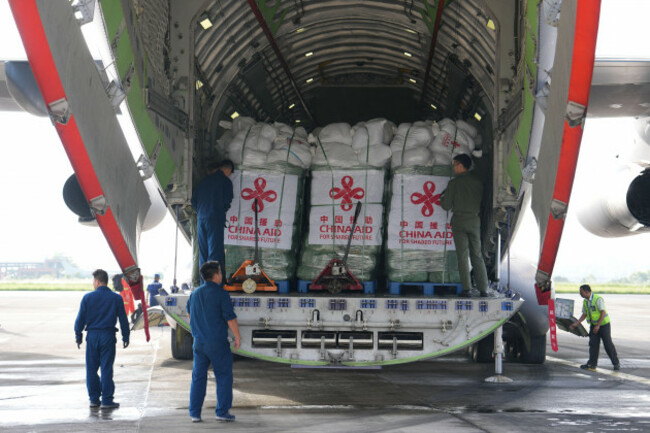
The UK has offered $6.8 million (€5.84 million), while the EU promised €2 million.
The International Federation of Red Cross and Red Crescent Societies (IFRC) said it had allocated more than $1 million (€859,000) and launched an emergency appeal for $31 million (€26.63 million).
Nepal’s economy is already under pressure, with limited resources to respond to a disaster of this scale and Foreign Minister Shisir Khanal saying the reconstruction bill could run into “billions of dollars”.
He appealed for specialised assistance, including heavy-lift drones and technology to help locate people who are trapped.
Khanal also called for forensic testing kits to identify bodies and freezer units to store them, saying bodies that have been in water could decompose at a faster rate.
The deluge of ice and mud caused huge lakes, and one of these formations has become a risk of further floods.
The Chinese and Nepali foreign ministers spoke Saturday and discussed sharing satellite and hydrological data, both sides said.
In Tibet, where Chinese authorities are the only source of information, rescue operations were temporarily paused at the hardest-hit area of Gyirong because of the risk of more flooding from a newly formed lake.
But state broadcaster CCTV said late Saturday that the lake was “discharging naturally” and had been “essentially drained”, citing China’s ministry of water resources.
A total of 2,141 rescuers were near the Gyirong site, the Xinhua state news agency reported, including the more than 500 in the worst-hit area.
With reporting from © AFP 2026

To embed this post, copy the code below on your site
















have your say