Sign in. It’s quick, free and it’s up to you.
An account is an optional way to support the work we do. Find out more.
Sign in. It’s quick, free and it’s up to you.
An account is an optional way to support the work we do. Find out more.
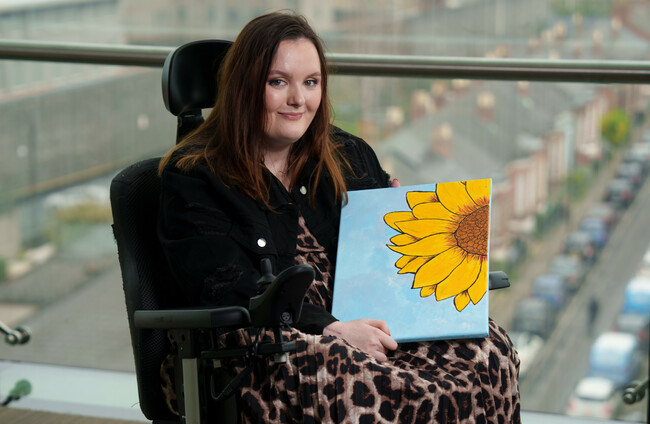
“YOU DON’T HAVE to rely on someone for everything.”
These are the words of Meath woman Niamh Highfield, 28, who is one of twelve spinal cord injury patients who have regained hand and arm movement from a “cutting-edge” programme in Dublin’s Mater hospital.
Niamh broke her neck and suffered a significant spinal cord injury in “a freak accident” after falling off a set of monkey bars in her early 20s.
The accident left her with very limited mobility and unable to complete daily tasks such as brushing her hair.
“I could do everything for 22 years, and then I couldn’t do anything. I couldn’t even move my head when I first woke up,” she said.
Now, two surgeries and six years later, Niamh has made strides in her recovery and regained significant movement in her arms and hands, allowing her to live independently and perform daily tasks on her own.
Niamh took part in the Mater’s surgical and rehabilitation programme, which involves transferring healthy nerves and tendons to paralysed areas to regain function in the hands and arms. It aims to give patients the ability to use their hands, restoring key upper limb functions such as grasp, pinch and the ability to bring the hand to the mouth.
With the programme, Ireland is one of the few countries now offering a spinal injury unit with on-site access to reconstruction surgery.
Speaking to The Journal at the Mater Hospital, Niamh said taking part in the programme wasn’t too hard a choice for her.
“I kind of had everything to gain, and I didn’t have anything to lose,” she said.
The programme involved two long surgeries and extensive rehabilitation, but Niamh said it was worth it for the movement she now has.
“I have gained a lot, even just playing with my nieces and nephews. If they give me toys, I can take them and play properly with them. It gives you a lot.”
“I can do my make-up, brush my hair, put in my earrings. For the most part, I’d be independent. I can cook, clean, look after my nieces and nephews, I can do art.”
After undergoing surgery, Niamh worked with the rehabilitation team from the National Rehabilitation Hospital and made a list of goals she wanted to reach, and then practised them every day.
“You don’t even notice that you’re getting [function] back. Then all of a sudden you can just do something, like, I can open jars now and do bits of everything.”
Niamh now makes hand-crafted resin artwork that she sells at local markets in Meath. Her medical team plan to carry out two more surgeries to further increase Niamh’s mobility in her right hand.
Each year, around 20 to 25 people in Ireland sustain a high spinal cord injury.
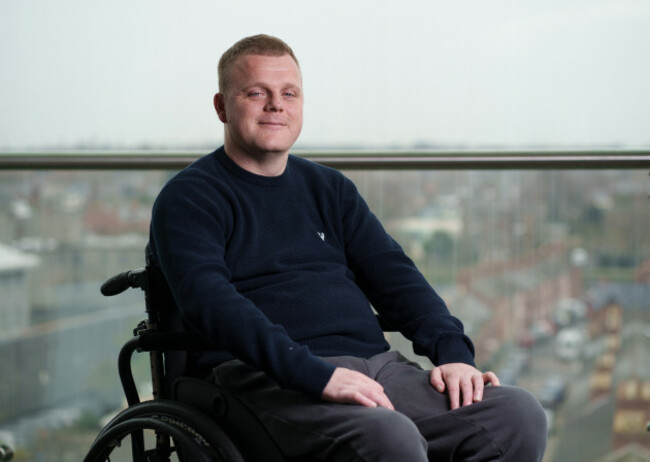
Brian Millar, 29, from Co Clare, is another patient who took part in the programme.
“I’ve got massive results,” he told The Journal.
Before undergoing surgery Brian could only move one finger on his left hand, and has since gained significant movement in the hand, allowing him to carry out daily tasks.
“It’s brilliant just to see it,” he said, adding that progress can take some time and requires patience.
The medical team behind the new programme includes practitioners from rehabilitation medicine, orthopaedics and plastic surgery, as well as the general hospital staff and nurses at the Mater.
Gráinne Colgan, consultant hand surgeon at the Mater hospital, said one of the most valuable parts of the programme is that it is free and available for all patients with spinal cord injuries.
Speaking to The Journal, she said the only necessity is that patients have at least one active tendon and nerve to transfer for surgery.
Colgan said: “What we would like is that every patient who has a spinal cord injury unit gets access to us.”
“They don’t all want or need surgery, and some patients will choose not to have it and that’s fine, but we want all patients to have the opportunity to make that decision for themselves, rather than have it made for them.”
“If you’re paralysed, your hands are your life,” Colgan said, quoting pioneering surgeon Eric Holmberg. “You communicate with your hands, you type, you phone, you feed, you wash.”
Consultant on the rehabilitation team, Dr Eimear Smith, agreed that hand and arm movement is a lifeline for people living with paralysis.
“What the patients tell us is that not being able to walk isn’t actually the biggest problem they face. Your hand function is so important. You do so much more with your hands,” she told The Journal.
For Smith, seeing the progress patients like Niamh have made is “one of the best parts” of her job.
“I see [patients] on day two or day three after a catastrophic injury has occurred and it’s just awful for them. They’re often in a really horrible place, and they’re really struggling. And then you see as they move through the national spinal injuries unit, then into the national rehab, they start to make progress.”

To embed this post, copy the code below on your site











have your say