Sign in. It’s quick, free and it’s up to you.
An account is an optional way to support the work we do. Find out more.
Sign in. It’s quick, free and it’s up to you.
An account is an optional way to support the work we do. Find out more.
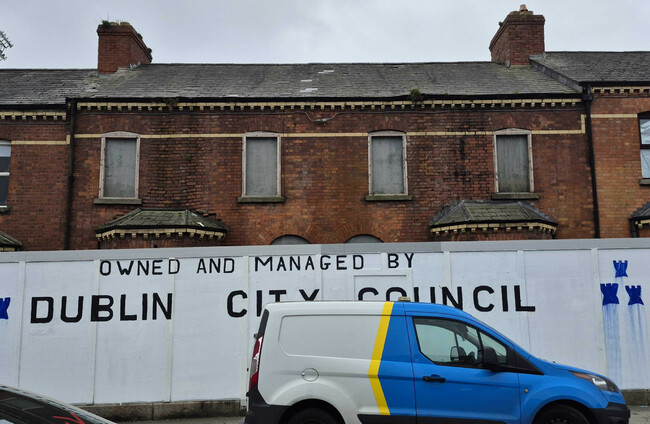
ON A BUSY stretch of Connaught Street in Phibsborough, people and cars stream past almost constantly.
Pedestrians weave along the footpath between Dalymount Park and the nearby shops, occasionally slowing as they pass two boarded-up red brick houses that have stood empty for decades.
This week, something new has caught their attention. Painted in large black letters across a freshly primed wall in front of the derelict buildings are the words: ‘OWNED AND MANAGED BY DUBLIN CITY COUNCIL’.
Several locals from the north Dublin suburb gathered to paint the mural earlier this week. A few passerbys stopped to admire the work, and one said it “looks much better than the graffiti that was there before”.
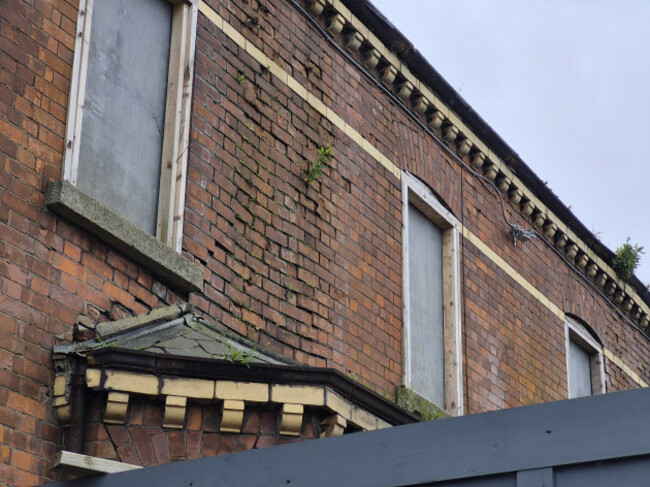
The mural is the latest attempt by residents to draw attention to numbers 19 and 21 Connaught Street, two derelict Victorian houses that have become a symbol of long-running frustration in the area.
Earlier this month, reporting by The Irish Times revealed that plans to redevelop the buildings as social housing have been abandoned by Dublin City Council.
The council bought the adjoining houses using compulsory purchase powers in 2019 for €700,000, hoping to renovate them and bring them back into use as two social homes.
However, structural surveys later found the buildings were too badly damaged to refurbish.
Instead, the plan became to demolish and rebuild the houses while retaining their original front façades, a proposal that received planning permission in 2023.

However, a problem arose when costs spiralled.
By last year, the council estimated the project would cost €1.7 million to complete. Combined with the purchase price, that would bring the total to around €2.4 million, or roughly €1.2 million per home.
The council ultimately decided the cost was excessive and said there are currently no plans for the properties.
Locals have launched an online petition, which has garnered more than 550 signatures, demanding the council repurpose the houses.
For residents on Connaught Street, the news came as a shock.
Anne Marie Dunne, who lives on Connaught Street and is involved in the local residents’ association, said neighbours only discovered the decision through the newspaper report.
“That’s how we found out,” Dunne said.
“We really believed Dublin City Council were doing something when the buttressing went up. When we saw engineers going in and out, we thought it was getting sorted.

“Every single time we thought, ‘They’re definitely looking after it now.’ And every time we’ve been let down.”
Dunne said the dereliction has had a lasting effect on the street.
“Our street is full of really interesting people and really kind, hardworking people,” she said.
And they’re living beside something that says their contribution to society doesn’t matter.
Standing beside the mural, Dunne gestures towards the houses.
“This isn’t our fault,” she said, “but we live with the consequences of it.”
Jeremy Smyth, who lives across the road, said the houses were already derelict when he and his wife moved into the area 14 years ago.
“The estate agent told us when we bought the house that they’d be done up soon,” Smyth said, laughing.
“Here we are, 14 years later.”

Smyth says the buildings have frequently appeared in news reports about dereliction in the capital.
“I’ve seen RTÉ filming here, I’ve seen photographs of these houses used in news articles,” he said.
They’ve become the image of derelict Dublin.
During storms, he says loose slates have fallen from the roof onto the street.
“I’ve had to ring the council before because slates were flying off,” Smyth said.
“The buildings are getting worse and worse.”
Smyth added that his wife, who is housebound for medical reasons, is “stuck with that as her view every day.”
“That’s a big incentive for me to campaign on this, so she can at least look at something across the road that isn’t completely depressing.”

Despite the frustration, residents are determined to highlight the community that exists around the empty buildings.
Dunne lists off upcoming plans on the street: a spring clean, an Easter egg hunt and other events for local children.
“There’s a huge age range of people living here, from toddlers to octogenarians,” Dunne said.
“The one thing we all have in common is the feeling that this isn’t fair.”
The mural, she says, is about making that clear.
“It lets people driving through know that we didn’t do this,” she said.
“Our houses aren’t like this.”
Local Green Party councillor Feljin Jose, who lives nearby, says the buildings are one of the issues residents raise most often with him.
“Every single time I talk to people here they ask about these houses,” Jose said.
“It’s one of the main issues in the neighbourhood.”
Jose said he was told only weeks ago that redevelopment was still expected to proceed.
“I’m incredibly annoyed,” he said.
“I was told four or five weeks ago that this was still happening.”
He believes the council still has a responsibility to act.
“These houses have been taking value from this area for 20 years, it’s time to put something back into the community,” Jose said.
Jose is set to bring a motion on the issue to Dublin City Council’s local area committee next week, calling for a plan.
“We want the housing department within Dublin City Council, who’s managing this, and the property section, and us sitting down together and figuring out ‘what are we going to do with this?’
“Not six months from now or another year from now. Let’s move quickly, act quickly and decide on what the future of this site this month.”
For now, the council says it is exploring options, including potentially selling the properties.
Jose says if that happens, strict conditions should be attached.
“It can’t be a case of 25 years of neglect by Dublin City Council and then another 25 years by a private developer,” Jose said.
“If it’s sold, whoever buys it has to redevelop it quickly.”
Residents say they don’t particularly mind what the buildings become; homes, community space, even offices.
What matters, they say, is that something finally happens.
“Anything that stops it taking away from our community,” Dunne said.
“Because that’s what it’s been doing for 20 years.”

To embed this post, copy the code below on your site












have your say