Sign in. It’s quick, free and it’s up to you.
An account is an optional way to support the work we do. Find out more.
Sign in. It’s quick, free and it’s up to you.
An account is an optional way to support the work we do. Find out more.

IT LOOKED LIKE the final scene from a prison movie, where the wrongly convicted hero finally earns his freedom as cheering inmates throng the walkways of the multi-tiered cellblock to celebrate his departure.
Except disgraced Nvidia chief executive Jensen Huang was returning to continue his life sentence as the world’s most powerful CEO. After just 11 days on the outside, his return was greeted by thousands of cheering Nvidia workers at the Silicon Valley headquarters that bears a remarkable similarity to a prison that got the Extreme Makeover treatment.
In the most astounding – and concerning – reversal of fortune in US corporate history, the same board that emphatically ruled out his return to the company he founded a week ago was apparently equally euphoric about its decision to reinstate him.
Wall Street reflected its joy by adding $950 billion (€868.45 billion) to Nvidia’s market value in a single-day surge of historic proportions. Talk about irrational exuberance.
Huang’s return came after US President Donald Trump, by his own admission, browbeat the Nvidia Board of Directors into submission. This presidential pardon of sorts represented a spectacular return on Huang’s $25 million donation to Trump’s ballroom; aside from his $36 million a year salary, the 31.6% surge in Nvidia stock means his worth has soared back to its resting place north of $140 billion; he’s regained the $30 billion in stock value that his affair and brief ouster cost him.
News of his reinstatement added a combined $124 billion to the tech emperors’ worth in less than 24 hours.
A rising tide lifts all super yachts.
And Trump hasn’t done too badly either. CBNC and Bloomberg analysts value the US President’s personal stake in Nvidia at $62 million. The Financial Times estimates his stake in Nvidia could have increased by as much as $15 million following Huang’s return.
Don Jr’s, venture capital firm, which invested $100 million in an Nvidia-backed AI start-up won’t have done too badly either. Nor will Commerce Secretary Howard Lutnick, whose investment bank, brokerage and wealth management firm – currently being run by his two sons – holds around $362 million in Nvidia stock.
Even if further self-enrichment wasn’t Trump’s motive, his meddling represents a staggering conflict of interest. The word unprecedented has lost any significance in the context of all things Trump, but no US president has come close to an abuse of power of this magnitude.
At best, he forced the board of America’s second-largest company to reinstall a CEO who has been doing an end run around US export controls to China. At worst, as seems more likely, Huang’s alleged affair with a suspected Chinese spy, who was in contact with Chinese intelligence agencies throughout, poses a direct threat to US national security and economic interests.
In any other era, under any other president, Huang would be impounded in a SCIF, undergoing a forensic debriefing from the CIA, FBI and assorted intelligence agencies.
Recall the endless Congressional furore and the year-long FBI investigation sparked by Hillary Clinton’s use of a private email server when she was Secretary of State? This is orders of magnitude worse. Nvidia advanced chips are used in every area of US defence and military intelligence.
They’re used in nuclear weapons simulations, eliminating the need for live testing, they’re embedded into military drones, submarines, satellites, they underpin US surveillance activity around the globe; they’re used to break codes, train military, detect cyber-attacks.
Restricting the sales of advanced chips prevents China from developing similar capabilities. Or at least that’s the idea. The US-China Economic and Security Review Commission issued a report last week, warning that the Chinese military and intelligence have been actively seeking to obtain Nvidia’s most advanced semiconductor chips to develop China’s AI military capabilities.
To what degree was Alice Huang able to facilitate this goal during her yearlong affair with Huang? We know she was in regular contact with officials from China’s Ministry of State Security – a sort of Chinese CIA and FBI hybrid – and her business partner worked for the MSS.
Trump would have been briefed on the report’s findings ahead of his meeting with Xi. And yet, he continues to insist, before the Congressional hearings have even got underway, or the current investigations by the FBI, the CIA and the Office of the Director for National Intelligence are close to being concluded, that Huang’s affair with a Chinese does not pose a security risk.
This may stem partly from a desire to limit his own exposure. It has been documented that Trump was warned twice about Huang’s affair, including by Marco Rubio, who serves as national security adviser and Secretary of State, but blithely chose to do nothing. Instead, he invited Huang to accompany him on his state trip to China.
During his strongman sleepover with Xi and Putin last week, he never raised the issue – or China’s attempts to surreptitiously obtain Nvidia’s most advanced chips, focusing instead on the seating placement at Xi’s table.
The Nvidia Board, in its CYA statement announcing Huang’s return, made it clear it had done so on foot of assurances by ‘senior government officials’ that Huang posed ‘no national security risk’. It seems clear from Trump’s own account of dialling into a Board meeting to press for Huang’s reinstatement, that any assurance could only have come from him – or Vice President JD Vance who was also pushing for Huang’s return. There goes the last remnant of Vance’s 2028 nomination prospects. He’d better hope Peter Thiel can find him a gig at Palantir.
But Treasury Secretary Scott Bessent’s U turn represents an all-time low in the spineless subservience of Trump sycophants. A week ago, Bessent was insisting that Huang’s return was a non-starter and further, that he had to be replaced by someone from outside the company. Now he supports Huang’s return, on the basis that he was outside the company – until his reinstallment by Trump.
Last week, the Board likewise made it clear Huang wouldn’t be returning under any circumstances. Given the legal jeopardy this decision exposes its members to, it would have seemed prudent to await the outcome of the tsunami of Congressional, intelligence and national security investigations that await its CEO. The conclusion of these investigations could lead to a world of pain for the Board members – unless Trump has promised cast-iron protections. But even preemptive pardons or pledges of immunity from investigation won’t prevent shareholder lawsuits, should revelations about Huang’s Chinese dalliance morph into a major national security threat.
At Trump’s prodding, Attorney General Todd Blanche and Director of National Intelligence Jay Clayton have noted that investigations into Alice Huang and her former company, Megaspeed, are ongoing and have not definitively concluded she was an active spy. But neither have they concluded that she wasn’t.
There’s a real possibility that America is heading into what may yet turn out to be the biggest national security scandal since the Iran-Contra affair, if not in modern US history. But this time around, it’s not a bunch of misguided military types trying to free some hostages while beefing up the capacity of a Nicaraguan militia to inflict atrocities on its fellow citizens.
There’s not even a screed of misguided patriotism about this affair.
The tech emperors declared that Huang was essentially too big to fail. That his stewardship of Nvidia was so essential to the AI industry, the stock market and the US economy that the threat his affair with a Chinese spy represents to national security pales is of no consequence.
Trump and Vance’s willingness to submit to the pressure of the tech emperors, and prioritise stock market gains over national security risks suggests that we are truly on the way to – if we haven’t actually arrived at – a post-government era. A point where the infrastructures of state and international institutions and alliances that shaped the post World War 11 era are being dismantled by a handful of individuals whose control over finance, technology and communications.
Given Trump’s admission that he, JD Vance and a war room of like-minded tech oligarchs came together to ‘save Jensen’, it will be very interesting at some future point, should an independent-minded Securities and Trades Commission ever decide to analyse who was trading Nvidia shares before and after Operation Huang went down.
Anyone who bought Nvidia shares last Friday will have been popping champagne corks on Monday. During Trump’s jaw dropping interview with the financial news channel CNBC, he openly took credit for reinstating the deposed Emperor of AI. And high on his own power supply, he boasted that he had done the same for Elon Musk during his first term.
“You wouldn’t have an Elon if it wasn’t for me. I protected Elon in my first term … you wouldn’t have Elon if it wasn’t for me. And a certain incident took place, which was a tough incident,” he told the clearly astounded anchor.
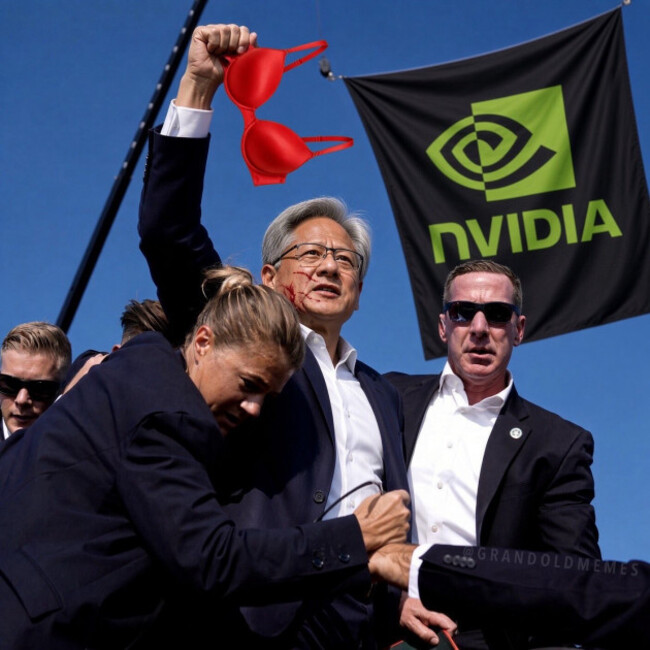
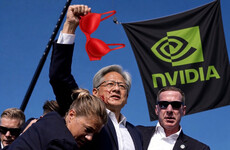
And as if to underscore the nihilism of this new era, Trump posted an AI generated meme, a doctored version of the iconic photograph taken after the failed assassination attempt in Butler, Pennsylvania, which showed Huang, his face splattered with blood, clutching a red bra in a raised fist with a flag bearing the Nvidia logo instead of the Stars and Stripes. This juvenile parody serves as a chilling omen for the post-government nihilism predicted by Peter Thiel.
The plot that has inspired dozens of dystopian movies may already be here; are we witnessing the start of an era when a handful of tech oligarchs, who already exert an outsize control over finance, technology, defence and communications systems, shape an AI-dominated future?
Marion McKeone is an award-winning journalist, writer and documentary maker. She is a columnist with The Journal.
To embed this post, copy the code below on your site











have your say