Sign in. It’s quick, free and it’s up to you.
An account is an optional way to support the work we do. Find out more.
Sign in. It’s quick, free and it’s up to you.
An account is an optional way to support the work we do. Find out more.
THE PRESS OMBUDSMAN has said her office is receiving “a lot of complaints” related to protests and demonstrations that are taking place.
The Office of the Press Ombudsman receives complaints from members of the public in relation to member publications of the Press Council of Ireland and seeks to resolve them by conciliation or mediation.
Where conciliation or mediation is not possible, the Press Ombudsman will make a decision on the complaint based on the Code of Practice.
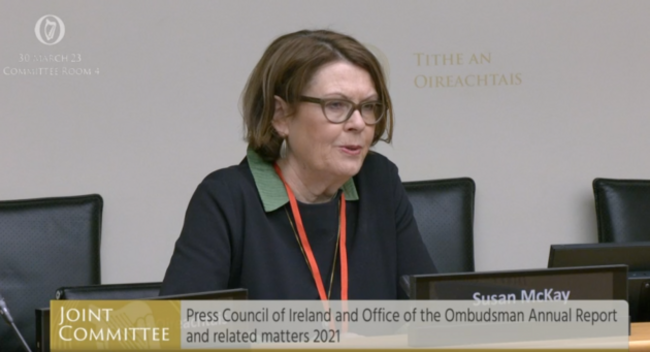
Appearing before the Oireachtas Committee on Public Petitions today, Susan McKay, who was appointed to the role five months ago, said while the number of decisions from her office is relatively small – 31 decided upon in the 2021 report – the number is constantly growing. In total 527 complaints were made for that period.
“There seem to be a lot of complaints coming in at the moment… which are related to protests and demonstrations at the moment,” she said.
One thing McKay said she wanted to make clear is that although a person must demonstrate that they have been personally affected by an article that has been published in order to make a complaint, it is possible for organisations to make a complaint on behalf of those they represent.
“So for example, say a civil society organisation that represents travellers or women or whoever, would be able to make a complaint on behalf of those who they represent. So it’s not just a matter for individual complaints,” she said.
“I think it’s interesting that quite a lot of complaints are made about prejudice. You know, I think that’s really, really important that we should highlight that function is there,” added McKay.
Distinguishing fact and comment is an area where her office is also receiving a lot of complaints, she said.
“It’s an area of confusion for people, because Irish law allows for some pretty strong commentary to be made. And I think that people who are offended by that often complain to us, without realising that actually, you know, people are allowed to express strong opinions,” said McKay.
The problem arises where the person is reading the comment piece as if it was fact, she said.
“It is very important that that people distinguish these two things. You can’t make wild claims, for example, about the number of migrants who are coming into this country without stating that it’s simply your opinion that is the case, and that you don’t actually know what the number is, you know, there is a degree of accuracy still required within commentaries,” said McKay.
She said some complaints are being made to her office about publications that are simply reporting a comment or statement that has been made by someone, often times in a privileged setting.
The newspaper or online publication “is simply reflecting what was said often in a privileged setting”.
“Obviously things will be said which are going to cause offence and are going to cause people to be angry and are going to cause people to say ‘that’s not true’. But it’s not the press’s fault that the statement, which they believe, to be not true has been made.
“So clarifying those kinds of things, I think would would stop a lot of complaints that aren’t going to be able to proceed because obviously we don’t want to be adding to people’s frustration. We want to be helping them,” she said.
Speaking about press freedom and the threat to it in some countries, McKay said Ireland has a lot to safeguard.
A functioning press is important to the proper functioning of our democracy, she said.
“There is a lot of very, very dangerous stuff circulating on social media now, which is being believed by people who are not reading credible material which has gone through an editorial process,” she added.

To embed this post, copy the code below on your site












have your say