Sign in. It’s quick, free and it’s up to you.
An account is an optional way to support the work we do. Find out more.
Sign in. It’s quick, free and it’s up to you.
An account is an optional way to support the work we do. Find out more.
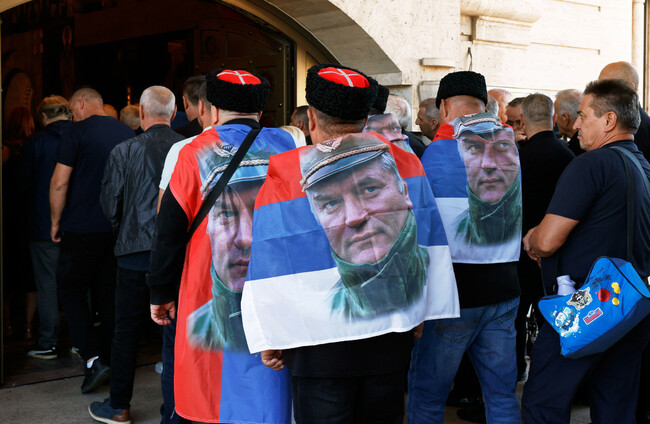
CROWDS HAVE GATHERED in the Serbian capital Belgrade this morning for the funeral of convicted war criminal Ratko Mladic, who died in prison in The Hague in late August at the age of 84.
Mladic was serving a life sentence for genocide, war crimes and crimes against humanity committed during the war in Bosnia during the break-up of the former Yugoslavia in the early 1990s.
His crimes, which included the 1995 massacre of 8,000 mostly Bosnian Muslims in Srebrenica, earned him the moniker “Butcher of Bosnia”.
Despite his convictions, some in Serbia see him as a national hero.
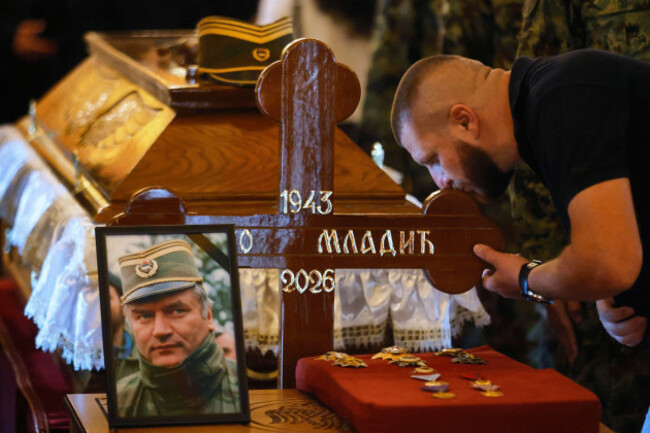
Mourners streamed into St Luka church in Belgrade early this morning to pay respects, with many kissing Mladic’s closed coffin, as Serbian Orthodox priests read prayers.
Police had closed off streets in the surrounding part of the city as crowds began arriving.
AFP news agency reporters saw large crowds outside the church, many wearing shirts praising Mladic, as doors opened with aerial images showing hundreds already queuing to enter.
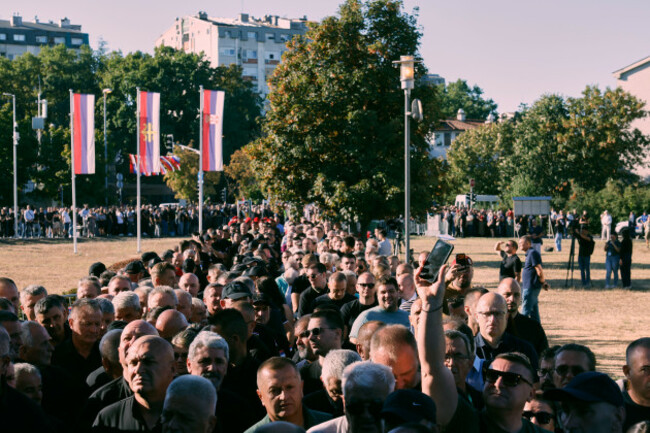
Serbian flags had been hung nearby, and a huge banner unfurled across the street read: “Welcome, General, thanks be to your mother for bearing a hero, so that Serbdom’s glory may return.”
“I am here to see off the general, a national hero,” pensioner Radojka Visic, who had travelled from Bosnia’s Serb entity, Republika Srpska, told AFP.
“They couldn’t defeat us on the battlefield, so they sent him to prison and tortured him there instead,” Visic said, referring to the “international community”.
Mladic’s casket arrived in the country last week aboard a government plane, where it had been carried by six soldiers and draped in flags.
As it was driven from the airport in a motorcade, groups of young men held banners praising the former general, and some police were seen saluting as it passed.
Last week’s scenes drew condemnation from the European Union’s enlargement commissioner, Marta Kos, who cancelled a forthcoming visit to Serbia on Friday, saying the “glorification surrounding his death is incompatible with the values on which the EU path is built”.
Denis Becirovic, chairman of Bosnia’s tripartite presidency, called it “an act of identification by Serbia’s leadership with one of the worst killers in European history”.
“This has unforeseeable consequences for the future of the entire region,” he wrote on Facebook on Friday.
The Bosnia war, which raged between 1992 and 1995, left around 100,000 people dead and displaced 2.2 million.
Mladic was the military figurehead of the Bosnian Serb leadership alongside former Yugoslav president Slobodan Milosevic and Bosnian Serb leader Radovan Karadzic.
Fadila Efendic, whose son and husband were killed in Srebrenica, told AFP earlier that it pained her “to know that his ideas are not dead”.
In addition to genocide, Mladic was convicted of persecuting and forcibly expelling Bosnian Muslims and Croats, terrorising civilians during the siege of Sarajevo and taking UN peacekeepers hostage during Nato air strikes in 1995.
Mladic was arrested in 2011, 16 years after he was first indicted, and sentenced to life in prison in 2021 after a nine-year trial.
Despite the verdicts, he is still hailed as a hero by some Serbs, particularly in Republika Srpska, where his death was marked with vigils and gatherings.
Fans of Serbia’s biggest football club, Red Star Belgrade, paid tribute to Mladic over the weekend.
🫡
— FK Crvena zvezda (@crvenazvezdafk) September 6, 2026
🔴⚪️ #fkcz pic.twitter.com/n0IwG1NDTu
Mladic’s son Darko, who is officially organising the funeral, said he was “proud of the role” his father played.
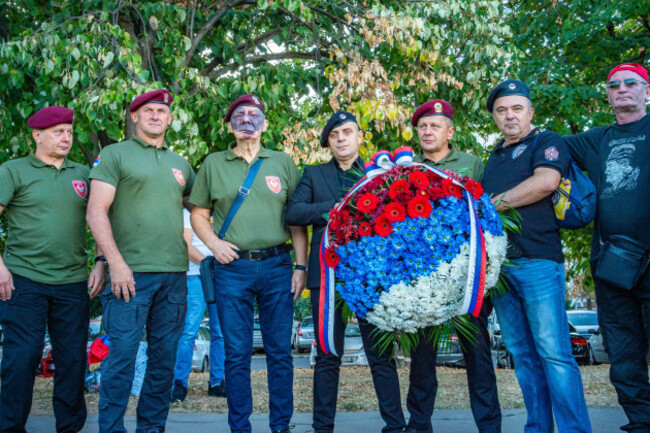
On Saturday, around 300 people gathered at a commemoration for Mladic at a military facility in Belgrade, organised by an association of retired and active Serbian army generals.
Darko and other family members also attended alongside Serbian Justice Minister Nenad Vujic and officials from Republika Srpska, including President Sinisa Karan.
Speakers at the ceremony praised Mladic’s wartime role, describing him as a “towering figure both as a man and a soldier”.
Serbian President Aleksandar Vucic said that tens of thousands of people were expected to attend the funeral and that the state would ensure the event passed “safely”.
He would not attend in person due to a prior engagement, he said.
With reporting from AFP

To embed this post, copy the code below on your site



have your say