Sign in. It’s quick, free and it’s up to you.
An account is an optional way to support the work we do. Find out more.
Sign in. It’s quick, free and it’s up to you.
An account is an optional way to support the work we do. Find out more.

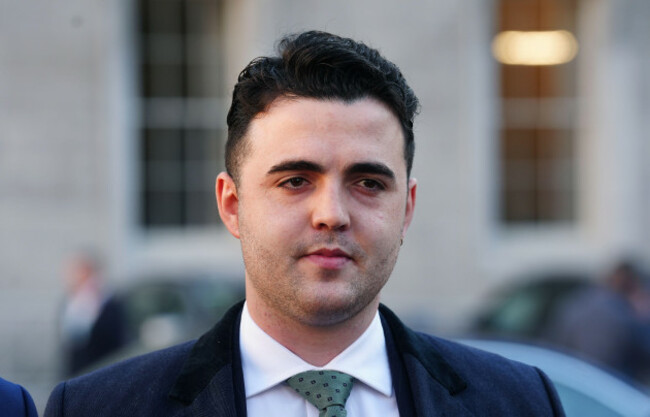
LAST WEEK, THE Dáil closed for its summer recess. Right before things wrapped up, Dublin Bay North TD Barry Heneghan managed to squeeze in one final question, on a very unexpected topic: Raw milk.
Heneghan brought the question to Deputy Martin Heydon, minister for agriculture, food and the marine. He outlined how anyone can walk into a shop and purchase an “apple-flavoured vape” or a packet of cigarettes, but that consumers will not find unpasteurised, unhomogenised milk on the shelves of shops in Dublin.
Admitting that he may be “out of [his] depth as a Dublin TD”, the Clontarf native highlighted that some of his constituents have had to travel to the North to access milk that has not been heat treated for consumer safety.
In response, Deputy Heydon outlined that it is indeed possible to buy and sell what has now become known as ‘raw milk’ in Ireland.
In his response, he outlined that there is legislation that governs the production, processing and sale of raw milk in Ireland, detailing the high safety standards and transparent labelling that are necessary.
Clontarf, and the wider Dublin Bay North constituency, are agriculturally barren and densely populated urban areas. In fairness, Clontarf does have plenty of high-end supermarkets full of expensive oddities, which raw milk wouldn’t stand out amongst.
Beyond the decadence of Clontarf, Dublin Bay North is a constituency where many of today’s major political issues are particularly heightened: community tensions, the combined pressure of the housing crisis and the cost of living crisis, the concentration of data centres, and so on.
With that in mind, unpasteurised milk seems like the last thing that would be on people’s minds at present. The majority of us would have learned in primary school that the whole milk processing thing was solved in 1862, and we haven’t looked back since.
Yet, at least one of Heneghan’s constituents felt compelled to bring the issue to the independent TD. For right or wrong, Heneghan did his job and brought the question to the relevant minister. Yet, I couldn’t help but think that there might be signs of a bigger issue below the surface.
To be as clear as possible, the Food Safety Authority of Ireland (FSAI) strongly advises the public not to drink raw milk, as it presents a significantly higher risk to those who consume it than pasteurised milk does.
It’s particularly dangerous for children, pregnant and elderly people, and those with compromised immune systems. Even with the best hygiene practices in place, there’s a possibility that raw milk is contaminated with pathogens that are harmful to humans.
Pasteurisation is a net good: heating the milk doesn’t interfere with its flavour or nutritive value, and it significantly lessens your likelihood of getting sick.
Despite all of this, some are still choosing to ignore the warnings, perhaps as a result of misinformation.
There are some concerning trends that coincide with the surge in popularity that raw milk is seeing.
Firstly, it’s clear that advocates of unpasteurised milk tend to think that natural = good, which is an overly simplistic approach to food safety.
This attitude could be rooted in genuine concern. People are far more conscious of what they’re eating, as there’s an abundance of convenience food available, full of ingredients that few of us can define. We’re warned about all kinds of new problems with food and the supply chain on a regular basis, ranging from pesticides like glyphosate to microplastics.
However, given the political, social and scientific context that this trend is emerging within, we should take online information about “natural” foods with a pinch of pure, unrefined sea salt.
The unpasteurised milk boom seems to sit at the intersection of some of the internet’s most harmful communities. It appeals to those who adhere to “carnivore diets”, dodgy wellness culture, the proponents of trad-wife domesticity and the anti-establishment science deniers.
It’s quite easy to link this trend to the anti-vax communities that flourished during the Covid pandemic, a movement that cultivated a huge amount of scepticism towards the advice of health professionals.
This obsession with dairy isn’t an entirely new phenomenon. Even before the pandemic, Lund University professors had linked the active promotion of dairy and milk to far-right communities. For a decade now, alternative milks have been associated with emasculation and notions of weakness. The pejorative “soyboy” has been thrown around throughout this period, as a result of disproven claims that consuming soy raises estrogen levels.
For a long time, this whole topic has existed in niche (and often dangerous) internet subcultures, but it has insidiously crept into Ireland’s political dialogue, and it’s driving Irish residents to travel hours to access unpasteurised milk. It’s not only Ireland that has been impacted by this discourse, however.
The United States Secretary of Health and Human Services, Robert F. Kennedy Jr, has been a prominent supporter of raw milk and offered support to farmers who want to sell it, in contradiction of public health advice in the States. The US Centres for Disease Control maintains that “pasteurisation is crucial for milk safety” and noted that raw milk exposes people to Campylobacter, cryptosporidium, E. coli, listeria, brucella and salmonella.
It’s hard to imagine why anybody would willingly want to expose themselves to these harmful bacteria and all of the symptoms they induce: nausea, vomiting, diarrhoea, abdominal cramps, fatigue, fever, convulsions and even miscarriage.
The dishonest online marketing of raw milk as a nutrient-rich, invigorating miracle drink comes from just one limb of the complex beast of social media’s far-right communities. What underlies this culture of deliberately sown mistrust is an ideology that promotes deregulation, regardless of the human cost.
Kelly Earley is a writer and podcaster from Coolock, who has a deep interest in culture, technology, community and social justice. She writes for The Journal every week.
To embed this post, copy the code below on your site











have your say