Sign in. It’s quick, free and it’s up to you.
An account is an optional way to support the work we do. Find out more.
Sign in. It’s quick, free and it’s up to you.
An account is an optional way to support the work we do. Find out more.


A PARENT DESCRIBED the start of the school year to me recently. Her daughter was beginning first year, which should have been an exciting milestone for the whole family. Instead, they found themselves trying to work out how they were going to pay roughly €700 for the iPad package she needed for school.
On top of the cost, there was the job of setting it up, navigating unfamiliar software and trying to understand a system they had never used before. It is an experience that will be familiar to parents around Ireland and one I hear frequently in Cork.
Whether it is an iPad, tablet or laptop, the issue is much the same. At a time when government is rightly highlighting free schoolbooks, many families are still being asked to find hundreds of euro for a device their child is expected to use every day.
The Free Schoolbooks Scheme is a good policy. Labour supported its introduction, and it has made a real difference. But nobody looking at the bills arriving in family homes at the start of the school year could seriously argue that education is now free. Parents are still paying for uniforms, transport, activities and other school costs. For a growing number of families, a digital device has been added to that list.
Technology has an important place in education and digital skills matter. Schools and teachers need to be able to use technology where it improves teaching and learning. The problem is not the use of technology itself; it is the way the cost of providing it has been allowed to fall on individual families without a clear national approach.
Research published in July by the ESRI and University of Limerick examined the policies, websites and purchasing arrangements of more than 720 post-primary schools. It found that more than three in 10 had arrangements mandating the purchase of digital devices.
The sums involved can be significant. The researchers found packages approaching or exceeding €700 in some cases, with the final cost extending beyond the device itself to items such as cases, software, device management, technical support and warranty cover.
Parents may also have little opportunity to shop around. In some schools, they can be directed towards a particular device or purchasing arrangement via a private company. A perfectly usable device already in the family home may not meet the school’s requirements and buying a refurbished alternative may not be an option.
Barnardos’ Back to School Survey 2026 gives another indication of the pressure families are under. Some 57% of secondary school parents who responded said they had to pay for digital devices, at an average cost of €447. One parent reported being asked to pay €850 for a compulsory tablet.

For most households, that is a substantial expense. For a family getting two or three children ready for school at the same time, it can become extremely difficult to manage.
The government points out that there is no national requirement for a student to own a personal digital device. Decisions about the use of technology are generally made by individual schools and their boards of management.
That is formally true, but it doesn’t solve the issue. If a parent is told that a particular device is what their child’s class will use for textbooks, schoolwork or homework, there is very little sense of choice about the purchase. No parent wants to send their child into first year knowing they are the only student without the equipment being used by everybody else, and finances should not be a barrier.
The minister for education herself recognised the difficulty earlier this year when she wrote to schools about the financial burden associated with digital devices. She asked schools to engage with parents and noted that some families were being asked to spend considerable sums, in some cases through school-facilitated arrangements with third-party providers. If the Department of Education recognises that the cost can be a serious burden on families, then this cannot be treated solely as a matter for individual schools to sort out.
Schools themselves are in a difficult position. There are sensible reasons for wanting students to use devices and for teachers to have technology that can be properly supported and managed. We therefore need a national response rather than hundreds of schools trying to solve the same problem separately.
Procurement should be part of that discussion. Public procurement frameworks for digital devices already exist, and schools can use them when purchasing equipment themselves. The Competition and Consumer Protection Commission has also advised that where an exclusive supplier is used, the appointment should follow a competitive process and schools should explain to parents how the arrangement was chosen.
That creates an obvious question for government. If digital devices are becoming an increasingly routine part of public education, could the State make better use of central or coordinated purchasing arrangements to reduce costs and give schools and parents greater certainty?
There are other options too. Government can set clearer national rules about when a device can be required and what support must be available to families. It can increase Information and Communication Technology (ICT) funding for schools. It can also ensure there is funding for maintenance and repairs, because providing a device is of little use to a student if a broken screen or battery takes it out of circulation for months.
Before the summer, Labour brought a motion to the Dáil calling for enforceable guidelines on school device requirements, restoration of the school ICT grant to at least €50 million, a separate funding stream for maintenance and repairs, and access to a national loan scheme where devices are needed for school project work.
The government did not oppose the motion. That should now provide a basis for action rather than another acknowledgement that families are under pressure.
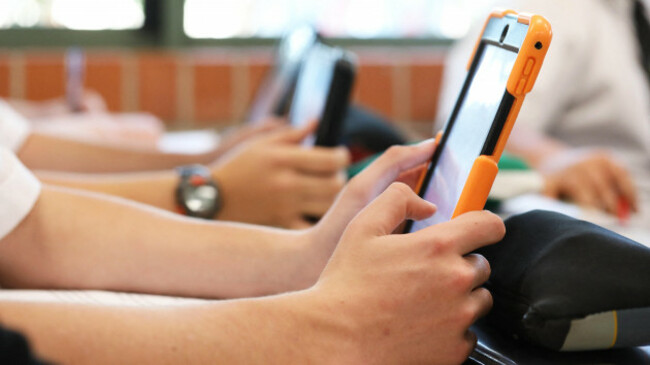
My Labour colleague Eoghan Kenny TD, our education spokesperson and a former teacher, has warned that the digital divide risks becoming an educational divide. That is the central issue here. A child’s ability to participate fully in a classroom should not depend on whether their parents can find another €500 or €700 at the beginning of the school year.
There is also a wider conversation to be had about the use of technology in schools. Parents are being encouraged to think carefully about screen time, schools are restricting mobile phones, and we are having a necessary debate about social media and online safety. At the same time, more teaching, research and schoolwork is moving online.
Those positions are not necessarily contradictory, but they do require a more considered approach to technology in education. Devices should be used because they improve teaching and learning, not simply because putting something on a screen is assumed to make it more modern.
Free schoolbooks have removed a major expense for families, and that is something worth recognising. But we should not allow the cost that has been taken off the bookshelf to reappear in the form of a €500, €700 or €800 technology bill.
If a device is necessary for a child to participate fully in public education, then we need to make sure they can access one regardless of their family’s income. That is the test the government should apply, and it is one it now has the opportunity to meet.
Senator Laura Harmon of the Labour Party is a member of the Oireachtas Committee on Artificial Intelligence.
To embed this post, copy the code below on your site















have your say