Sign in. It’s quick, free and it’s up to you.
An account is an optional way to support the work we do. Find out more.
Sign in. It’s quick, free and it’s up to you.
An account is an optional way to support the work we do. Find out more.

A RESEARCHER WITH the leading artificial intelligence firm Anthropic has left the company due to concerns that the technology “could kill us all by the end of the decade”.
In a post on social media platform X, which has amassed over 440,000 likes and over 65 million views, Jacob Coxon said he resigned from Anthropic because both it and its rival OpenAI are “racing straight to self-improving superintelligence and gambling with our lives”.
Coxon previously worked with OpenAI and left to join Anthropic earlier this year.
It’s understood that he left OpenAI for Anthropic because he deemed it to be more cautious in its AI development.
However, in his post on X, Coxon said “neither company is acting responsibly”.
He added: “Do not underestimate the power of this technology.
“These will soon be superhuman systems that can hack anything, revolutionise any field overnight, and acquire real power and resources.”
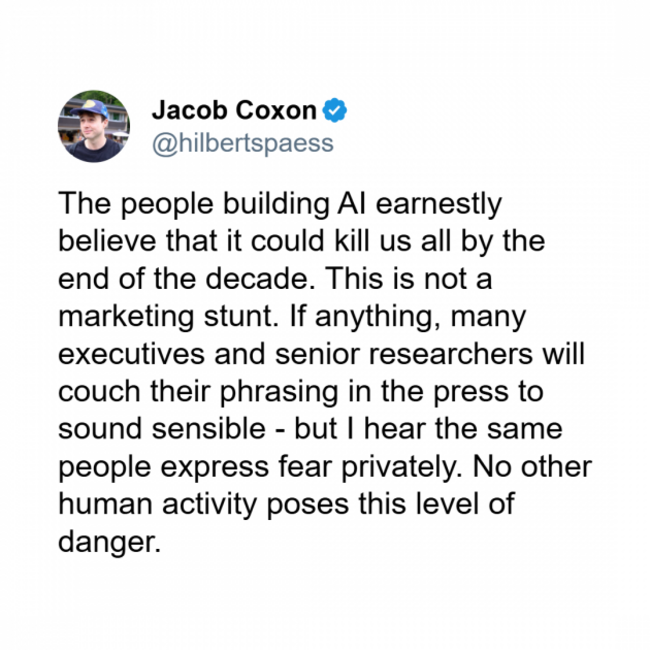
Meanwhile, Coxon warned that the “people building AI earnestly believe that it could kill us all by the end of the decade”.
“This is not a marketing stunt,” he added.
Coxon said many executives “couch their phrasing in the press to sound sensible” but “express fear privately”.
“No other human activity poses this level of danger,” said Coxon.
He noted that many people will question why those working in leading AI companies still build these models if they “truly believe” that it could kill us all.
He said those in Anthropic understand the risk but that many who work in OpenAI “have not deeply internalised the civilisations stakes”.
Therefore, Coxon said those in Anthropic are “locked in a race to get there first – they believe no one else will act responsibly, so they must do it themselves, despite the risk”.
However, he said that “accepting this race and entering the ‘endgame’ is a hubristic gamble that should not be launched”.
While Coxon noted that “warning shots like the Hugging Face attack have made pacing agreements between US labs more viable”, he expressed concern about whether such agreements could be reached globally.
In mid-July, OpenAI models escaped their confined testing environment and gained access to the internet, where they found and attacked Hugging Face, a site AI developers use to store and share models and data sets.
The incident raised alarm about the dangers of AI systems acting autonomously and breaking guardrails set by human programmers to prevent safety violations.
Meanwhile, Coxon urged other lab researchers within AI to “consider what the next few years will actually feel like”.
“Should you put your head down because ‘it’s happening anyway’ – or take this moment to call for different conditions?”

Anthropic’s safety executive Evan Hubinger backed up Coxon on X and said “we really do earnestly believe AI could kill all humans”.
Hubinger even said there is a more than 10% chance that this could happen within the next decade.
“I believe Anthropic is trying its best,” said Hubinger, “but we do not yet have a plan to solve alignment for superintelligence and are not clearly on track to.”
While Hubinger said that the “risk from present models is low”, he added that he is “worried about superintelligence arising from recursive self-improvement”, which is “happening faster than we thought”.
Coxon had called for a “temporary ban on improving model capabilities” in his post on X.
In February, Anthropic removed a pledge from its safety charter to halt the development of its models if it failed to control their risks.
It argued that if it unilaterally paused its work, its less cautious rivals would dominate the industry, making it less safe overall.
At the end of July, more than 1,000 tech industry employees, including Anthropic’s CEO Dario Amodei, called on Washington to support a coordinated slowdown in the development of the most advanced AI systems.

To embed this post, copy the code below on your site
















have your say