Sign in. It’s quick, free and it’s up to you.
An account is an optional way to support the work we do. Find out more.
Sign in. It’s quick, free and it’s up to you.
An account is an optional way to support the work we do. Find out more.

SCIENTISTS FILMED A sperm whale in the Caribbean Sea giving birth while other whales gathered round the mother to assist her and her newborn calf.
The team of researchers from Project Ceti (Cetacean Translation Initiative), an international organisation that studies the communications of sperm whales, observed the event in July 2023.
Yesterday, their findings were published in the journals Science and Scientific Reports, which have provided the most detailed ever account of a sperm whale birth.
When the researchers arrived on the scene, they initially believed that predators were attacking the mother and calf, marine biologist Shane Gero told the US news outlet NPR.
“To be honest, I thought that predators had attacked,” Gero said. “And I was like, ‘Oh no. This is going to be a horrible, terrible, no-good, very bad day.”
It turned out to be quite the opposite.
The Ceti researchers, who use artificial intelligence to try to understand the clicking sounds used by sperm whales to communicate with each other, launched drones to observe the scene and also used underwater microphones to record the whales.
The birth took 34 minutes and analysis the video footage as well as audio recordings (with the help of AI), the researchers were able to indentify the mother as a 19-year-old sperm whale they have named Rounder.
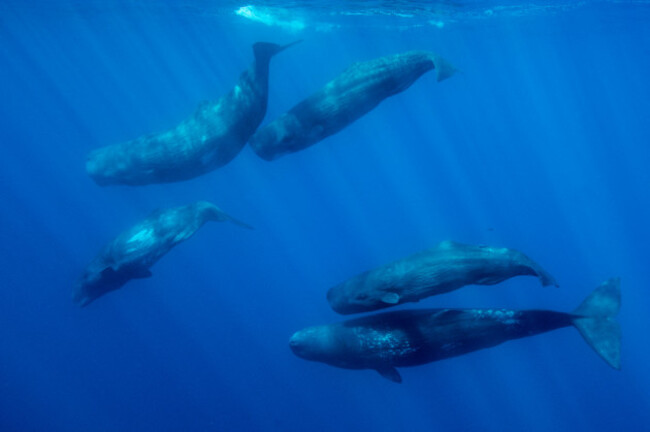
The researchers found that other females assisted the mother, “including those that were in different kin and social groups and were only distantly related to her”, the Science report reads.
“Such assisted births have thus far only been seen in primates.
“This observation confirms the suspected social complexity of whales and suggests that modern observational tools are likely to continue to reveal the secrets of other species that are difficult to study.”
When the newborn emerged, the group of whales “rapidly transitioned to cohesive and highly active behavior”
“Individuals took turns lifting the newborn, physically supporting and pushing it to the surface, consistent with supporting a negatively buoyant neonate.”
The birth was also attended by dolphins and pilot whales, who swam around and under the sperm whales throughout.
Observations of cetacean births are extremely rare. Less than 10% of whale, dolphin and porpoise species have been recorded giving birth.

To embed this post, copy the code below on your site
















have your say