Sign in. It’s quick, free and it’s up to you.
An account is an optional way to support the work we do. Find out more.
Sign in. It’s quick, free and it’s up to you.
An account is an optional way to support the work we do. Find out more.
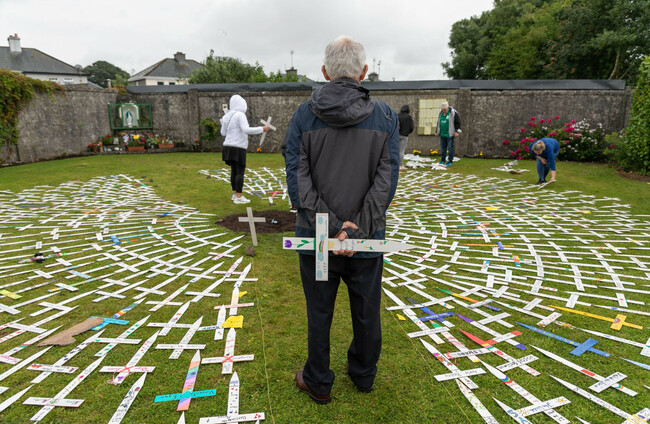
A LEADING FORENSIC EXPERT has said that the Tuam babies identification and excavation process will take many years.
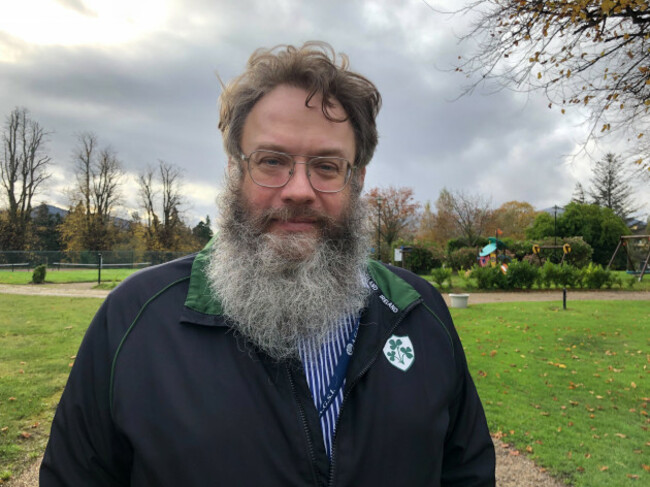
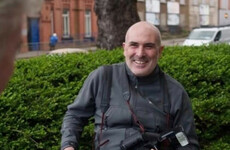
Dr René Gapert, who is originally from Germany, has been involved in high profile investigations across Germany and was recently part of the identification team at the Grenfell Tower disaster in London.
Gapert has lived in Ireland for the past 20 years and works as a freelance forensic anthropologist involved in identifying skeletal human remains at crime scenes.
He spoke to The Journal after delivering a speech to delegates at the Association of Garda Sergeants and Inspectors conference in Killarney.
Across the years he has worked for Irish coroners identifying mummified, decomposed and skeletal remains, including on missing persons cases. He has also worked with gardaí, the PSNI and other police forces.
A Commission of Investigation was set up following claims that 796 babies were interred in an unmarked mass grave at a former Bon Secours mother and baby home in Tuam – following extensive research by local historian Catherine Corless.
Excavations carried out between November 2016 and February 2017 found a significant quantity of human remains interred in a vault on the site.
Survivors, relatives and archaeologists have called for the site to be excavated as a matter of urgency so that further examination of the remains can take place.
The archaeologists involved in a test excavation in 2016 and 2017 have said in a documentary that aired this week that excavation of the site needs to happen as soon as possible so DNA can be used to identify the remains.
While Gapert is not involved at present in the response to Tuam he said in an interview that he would expect it to take years before answers are found.
“There is a lot of talk about the DNA sample, but it is not that easy – there is a need for individualisation which has to take place before any DNA can be applied.
“Individualisation means that each bone of each skeleton must be identified and matched with the corresponding other elements.
In a mortuary setting, once we get these remains in, we separate them into individuals by age by sex, so in human remains it would be very laborious.
Gapert cautioned that work would take years and there would also have to be an examination to determine if any trauma was suffered before their deaths.
It will take time because you have a lot of the same age groups. It will just take time – perhaps years.
Speaking in the Dáil this week, Catherine Connolly, an independent Galway TD, criticised what she described as the inaction of authorities since the discovery of the remains.
“More than four years ago, an expert team went in and looked at it in response to the Commission of Investigation, which had a press release saying there were substantial human remains there.
“Their work was a scoping exercise to see what was there,” Ms Connolly told the Taoiseach in the Dáil. “They temporarily protected the site for six months and nothing has happened four years later.
“We are sitting here today after a series of mistakes and delays. A report from the commission that was in the Government’s offices from October last year was only published in January of this year – and was never given to the former residents until afterwards.”
“There is a whole list of other delays and obfuscations, not to mention the tapes,” she said.
Taoiseach Micheál Martin said that legislation was being worked on that would clear the way for the excavations.

To embed this post, copy the code below on your site









have your say