Sign in. It’s quick, free and it’s up to you.
An account is an optional way to support the work we do. Find out more.
Sign in. It’s quick, free and it’s up to you.
An account is an optional way to support the work we do. Find out more.

EDUCATION MINISTER NORMA Foley has said social media companies have refused to “commit” to supporting age verification measures.
The Department of Education today hosted a Social Media Summit which had representatives from Meta (the parent company of Facebook and Instagram), Google, Microsoft, TikTok, Three Ireland, Vodafone, Tesco Mobile and Ibec.
X, formerly called Twitter, was not among the organisations whose presence was noted by Minister Foley.
Foley described the summit as “very constructive” and added that there was “very robust engagement.”
Foley also said that age verification was one of the topics that she was “very keen to advance”.
“Social media providers would tell us that they have a mandate around 13 years of age, but I think we all know that there are children younger than 13 accessing these platforms,” said Foley.
She added: “I did seek an undertaking from them that they would facilitate age verification, whatever form that might take.
“That wasn’t forthcoming at present, but they have undertaken to engage again on it.”
Coimisiún na Meán develops and enforces the Irish regulatory regime for online safety.
Its draft online safety code noted that “mere self-declaration of age” is not an effective age verification technique and proposed mechanisms such as document-based age verification.
“While I accept that they have different mechanisms, we are specifically looking for an engagement around age verification,” said Foley.
“I was clear, it’s not the mechanism, I’m not prescriptive on that, I would need them to come forward with a type of mechanism, which wasn’t forthcoming at this point, that would ensure categorically that the age verification is working.
“We know young people are incredibly smart, and they can find a way around the age verification currently.
“It wasn’t forthcoming today, but we will continue to work with them, and I will be supportive of the work of Coimisiún na Meán who have ultimate responsibility.”
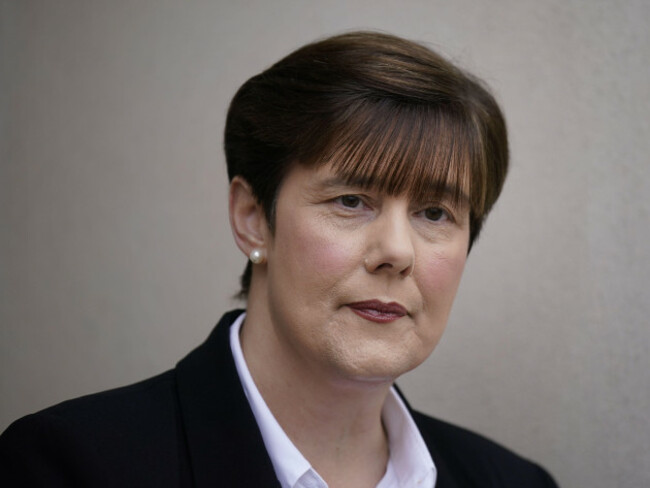
Foley told reporters she also wanted a commitment to support a government policy to encourage parents to avoid buying smartphones for primary school-aged children.
Foley said a commitment to support this policy was not forthcoming either, but there was a “commitment to engage with us on an ongoing basis”.
The Education Minister added that this policy is “not an anti-mobile phone agenda at all”.
“I recognise the great value in students being able to contact parents and parents to be in contact with young people,” said Foley. “It’s smartphone element of it.
“We are specifically looking for an engagement around age verification, and we’re specifically looking for an engagement around the work with parents.
“It wasn’t forthcoming today, but we will continue to engage and we will continue to work with them.”
Foley added that she also raised the issue of “sextortion” at the summit.
Sextortion is a form of cyber extortion which involves a threat or blackmail of having intimate information, images or clips shared without consent.
The threat or blackmail may be to get the victim to do or refrain from doing something, or the threat or blackmail may be purely for money or financial gain.
“We’re seeing that an adult can trick a young person into providing explicit materials and then there may well be efforts such as financial extortion,” said Foley today.
When asked how tough the government will be on social media companies for any potential wrongdoing going forward, Foley pointed to the “great body of work being undertaken by Coimisiún na Meán.”
“Government is taking it very seriously with the setting up of Coimisiún na Meán and around the fine that will be there – up to €20 million or 10% of profits,” said Foley. “There will be ramifications going forward.”
Foley was also asked about calls for mobile phones that are suitable for young people.
Esther Ghey, the mother of murdered teenager Brianna Ghey, is leading efforts in this realm in the UK.
Earlier this month, she told the BBC that she wanted a law “that there are mobile phones that are only suitable for under-16s”.
She said that such phones would “not have all of the social media apps that are out there now”.
While Foley said she wasn’t familiar with this concept, she told reporters that “we would be happy to look at any proposal that’s put on the table”.

To embed this post, copy the code below on your site














have your say